Teachers. Subscribe now and amaze exactly 0% of your friends, but you'll get great discounts and news!
THE HISTORY CAT

U.S. History Lesson Plans for Grades 7–12
Simulations, primary source investigations, DBQs, and critical thinking activities that get students genuinely engaged with American history.
Your students are going to love learning history.
We know that's a big claim. But here's the thing — when a student is pitching a colonial investment to a skeptical board of investors, or working a crime scene to figure out labor conditions of the Industrial Revolution, or navigating an Underground Railroad escape route with real geographic constraints, they're not just learning history, they're learning how to solve problems.
That's what The History Cat is built for. We cover U.S. History from Native America through the Cold War with free readings on the site, plus a growing library of classroom-ready lesson plans you can grab from the shop. Everything is designed for grades 7–12.
WHY THE HISTORY CAT
Our content isn't just engaging. It's genuinely different.
There's no shortage of history content out there. Here's what makes ours worth your time.
-
Unexpected formats meet serious content. Students encounter history through formats they recognize — GoFundMe pitches, CSI investigations, mock trials, escape rooms, advice columns. The format creates immediate buy-in. The content does the real work.
-
Investigations over summaries. Instead of reading about the Boston Massacre, students analyze competing eyewitness accounts and decide who's responsible. Instead of being told the Civil War wasn't about states' rights, they prove it with primary sources.
-
Critical thinking skills that transfer. Every activity is scaffolded to move students from basic comprehension into analysis, evaluation, and argumentation — the skills that show up on APUSH exams and, more importantly, everywhere else.
-
Ready to use. Every activity comes with a teacher guide and answer key. Download & Go. That's it!

"History is more interesting when students are solving problems"
OUR CURRICULUM
18 Units. Colonial America through the Cold War.
Each unit includes free articles and readings right here on the site. Classroom activities — simulations, DBQs, primary source investigations, group activities, and more — are available in the shop and linked below each unit. Browse everything at thehistorycat.com/category/all-products.
Unit 1: Native America & Early Exploration
This unit opens with free readings that introduce students to indigenous nations and early European contact. Students build context through articles, then move into discussion-based activities that challenge assumptions about whose story gets centered and why. A strong unit for establishing historical thinking habits — sourcing, perspective, and point of view — that students will use all year.
⏳ Free articles & paid activities coming August 2026.
Unit 2: Colonial America
This unit opens with a mystery — the Roanoke Colony disappearance — that works as an entry point for document-based investigation skills before the content gets heavier. Students then move through free articles on the three colonial regions, then shift into hands-on activities that ask them to take a side. The Colonial GoFundMe activity has students pitching a colonial investment — which means they have to actually understand each colony's economic model, religious identity, and governing structure well enough to sell it to a skeptical audience.
▸ Roanoke Lost Colony DBQ — Investigation Activity
Students analyze six pieces of evidence and develop their own hypothesis about what happened to the colony. No single correct answer — which is the point. A strong intro to DBQ skills
▸ Comparing Colonial Regions Graphic Organizer and Mapping Activity
Students organize and map economic, geographic, and social differences across the three colonial regions. A solid anchor before any activity that asks students to argue which colony was 'better.'
▸ Colonial GoFundMe Pitch — Hands-On Group Activity
Students pitch a colonial investment using a GoFundMe format. Forces real understanding of what made each colony distinct — no surface-level answers survive the room. (Coming soon)
Unit 3: Countdown to Revolution (1760–1775)
This unit runs more activities than almost any other in the catalog, which reflects how much is happening between 1754 and 1775. Start with the French and Indian War stations activity to establish what the colonies owed Britain and what Native nations lost — then follow the chain of resentment through the taxation activities and into the mystery game and DBQs. The Boston Massacre and Sons of Liberty activities work well together as a paired CER sequence, and Pine Haven gives you a full-period mystery investigation that asks students to hold both Loyalist and Patriot perspectives at once.
▸ Native Perspectives: French and Indian War Stations Activity
Students decide whether Native nations should side with the British, French, or remain neutral. Shifts the war away from European score-settling and onto the people whose land was on the line.
▸ Mercantile Mayhem — Colonial Trade Simulation Game
Students act as 1760s merchants deciding whether to trade legally or smuggle as Parliament shifts the rules. Makes students feel why colonial resentment wasn't just about principle — it was about survival.
▸ Pine Haven Chronicles — Historical Mystery Game
Students investigate eight townspeople in a fictional colonial town to identify who is feeding information to the British Crown. The only Revolutionary War mystery that requires students to hold both Loyalist and Patriot perspectives simultaneously. (Coming soon)
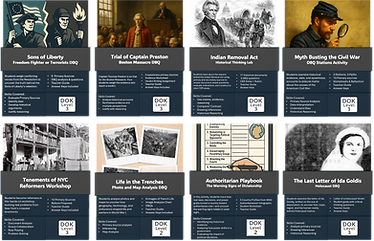
▸ Boston Massacre Mock Trial & DBQ Activity
Students analyze eyewitness accounts, weigh conflicting evidence, and argue the case. A natural fit for document analysis and evidence-based writing.
▸ Sons of Liberty DBQ — Freedom Fighters or Terrorists?
Students build and defend an argument using primary sources. One of the most debated topics in the unit — and in the room.
Unit 4: The American Revolution
This unit gives students multiple ways to engage with the war depending on what your class needs. The decision-making simulation works well as a full-period activity where students navigate real strategic tradeoffs. The Draft Pick group activity runs faster and works great for collaborative analysis and peer debate. The counterfactual critical thinking piece is an ideal exit ticket or discussion starter. Mix and match based on your pacing.
▸ American Revolution Decision-Making Simulation
Students play military and political decision-makers with real resource constraints. High engagement, strong cause-and-effect thinking.
▸ American Revolution Draft Pick — Group Activity
Small groups evaluate and rank key figures based on historical evidence. Builds collaborative analysis skills and generates real debate.
▸ What If Paul Revere Had Been Arrested? — Critical Thinking Activity
A counterfactual DBQ investigation into historical causation. Students argue how the Revolution might have unfolded differently — with evidence.
Unit 5: A New Nation — The Constitution & Early Republic
Students move from readings on the Constitutional Convention into activities that ask them to apply constitutional reasoning rather than just describe it. The escape room tests knowledge of constitutional structure in a format that keeps everyone moving. The Supreme Court Simulator goes deeper — students argue what the Bill of Rights means in scenarios that are genuinely contested. The War of 1812 activities close out the unit with primary source analysis that makes a neglected war feel consequential.
▸ Constitution Quest — U.S. Constitution Escape Room
Students work through Constitution-based puzzles to advance through the escape room. A strong review activity, unit closer, or sub-day option.
▸ Bill of Rights: Supreme Court Simulator
Students apply constitutional reasoning to real-world cases. Connects 1791 to today in a way that actually lands.
▸ War of 1812: Perspectives, Causes, and Consequences CER & Lesson
Multi-perspective primary source analysis with structured CER writing support. A solid single-period investigation for a war most textbooks give two paragraphs.
▸ Star-Spangled Banner Primary Source Analysis | War of 1812 DBQ
Students analyze the original poem as a document — including the verses that never get sung. A quick, genuinely surprising close-reading activity.
Unit 6: Westward Expansion
This unit opens with the Louisiana Purchase and an exploration of Manifest Destiny From there, dive into the realities of the Oregon Trail with a CSI for forensic-style investigation, hit the California Gold Rush, and examine the costs of expansion as they look closely at the Indian Removal Act Historical Thinking Lab for extended primary source argumentation.
▸ Indian Removal Act — Historical Thinking Lab | DBQ Activity
Primary source document analysis with scaffolded argumentation. Students build and defend an evidence-based claim. Strong APUSH alignment, grades 8–12.
▸ Oregon Trail CSI — Case of the Missing Wagon Train
A forensic-style investigation where students follow evidence to reconstruct what happened to a fictional wagon train — and why.
Unit 7: Slavery in America
This unit pairs free readings with two very different classroom formats. The abolitionist debate simulation is structured as a role-play where students represent real historical factions and argue their actual positions — not simplified versions. The Underground Railroad escape room runs as an individual or partner activity, putting students inside real decisions with real stakes. Both are appropriate for grades 7–12 and include full teacher guides. Plan for discussion time after Northbound in particular.
▸ Fire in the Republic — Abolitionist Council Debate Simulation
A structured role-play and debate activity. Students represent real historical factions and argue actual abolitionist positions — tactics, morality, and all.
▸ Northbound — Underground Railroad Digital Escape Room
An interactive digital escape room. Students make decisions under real geographic and legal constraints. High engagement, strong historical thinking. Plan time for debrief.
Unit 8: The American Civil War
This unit has three activities that can be used independently or sequenced. The DBQ stations activity works best early in the unit — students rotate through primary source documents and do the myth-busting themselves, which sets up everything else. The strategy simulation runs mid-unit as a full-period activity. The Confederate government worksheet works well as a close reading assignment or document analysis assessment.
▸ Civil War DBQ Stations — Myth-Busting Evidence Investigation
Rotating stations, primary source documents, and student-led myth-busting. Great for document-based question practice early in the unit.
▸ Civil War Strategy Simulation — Mapping Lab
Students take on strategic planning roles with maps, troop data, and resource constraints. Works as a full-period simulation with real military geography.
▸ Examining the Confederate Government — Worksheet & Reading
Close reading and document analysis. Students examine the Confederate government's founding documents in their own words.
Unit 9: Reconstruction Era
Students read free articles on Reconstruction, then shift into a PBL project that asks them to research specific historical perspectives and present them through a contemporary media format — TikTok-style video script or podcast outline. The format lowers the barrier for reluctant writers while still demanding real historical research and sourcing. Works well as a capstone activity for the unit or as a paired assignment with the readings.
▸ After Emancipation — Reconstruction PBL Project
Project-based learning with real historical research requirements. Students produce in a format they recognize — with content that demands depth.
Unit 10: The Gilded Age & Industrialization
The CSI investigation format is the centerpiece of this unit. Students work through a chain of evidence — documents, data, images — to build a conclusion about who bears responsibility for the conditions of industrial labor. The Ellis Island simulation is one of the most immersive activities in the catalog: a branching digital narrative that puts students inside the immigration experience in a way a timeline never could. Both run as full-period activities and include scaffolding for different reading levels.
▸ Industrial Revolution Mystery Activity | Factory Conditions CSI Investigation
A forensic-style evidence investigation. Students follow a chain of documents to build and defend a claim about industrial labor conditions. No prep, print-and-go.
▸ Ellis Island Digital Simulation Game
A branching digital simulation of the Ellis Island immigration process. Students make decisions, face inspections, and navigate a system designed to sort people. A perennial student favorite.
▸ Transcontinental Railroad Game — History Simulation Activity
Students manage the competing pressures of terrain, labor, cost, and politics in a classroom simulation. Surfaces whose labor built the railroad and who got left out of the celebration.
Unit 11: The Progressive Era
This unit runs two activities that approach Progressive Era reform from different angles. The Reformer's Workshop is a two-day group activity built around the tenement housing crisis — students analyze primary sources including Jacob Riis photographs, then design and pitch their own reform proposals. The Women's Suffrage museum project works as a multi-day capstone that asks students to make curatorial decisions: what the historical record should foreground and why. Both include teacher guides and rubrics.
▸ Progressive Era Reformer's Workshop: Solving the Tenement Crisis
Students become Progressive Era reformers and design practical solutions to the New York tenement crisis. Two-day DBQ-style group activity with Jacob Riis photo analysis and a reform pitch.
▸ Women's Suffrage PBL Project — Create Your Own Museum
A multi-day project-based learning activity. Students research, curate, and build a museum exhibit on the suffrage movement. Includes research scaffolding, rubric, and teacher guide.
Unit 12: Imperialism & World War One
The trench warfare DBQ is built around photographs and maps rather than text-heavy documents — which makes it accessible for a wider range of readers while still requiring genuine document analysis. The Treaty of Versailles simulation is the unit's major role-play: students negotiate peace terms through the fictional Pelmont Peace Conference and discover firsthand why the agreement that ended WWI planted the seeds for the next one. Both activities work as standalone lessons or as a paired sequence closing out the unit.
Causes of WWI Reading & Activity Pack
Students read the History Cat article on WWI's causes, analyze political cartoons and primary sources, and work through cause-and-effect charts tracing how a regional dispute became a global war. Includes emerging reader support and answer keys. A strong unit opener before students encounter the human cost.
▸ WW1 DBQ: Life in the Trenches — Photo & Map Analysis
Visual primary source document analysis using photographs and trench maps. Accessible for mixed reading levels, rigorous for all of them.
▸ WW1 Treaty of Versailles Simulation Activity
Students negotiate peace as the Allied powers at the Paris Peace Conference. They discover why the treaty that ended WWI set up the next one.
Unit 13: The Roaring 20s & Great Depression
This unit has four activities that work at different points in your sequence. The survival simulation works best mid-unit — students manage a Depression-era family budget and track the consequences, which makes abstract economic forces immediate and personal. The New Deal worksheet works as structured close reading or a follow-up assessment. The two Dust Bowl activities pair naturally: the primary source DBQs build document analysis skills, and the PSA poster project closes the loop with an argument about what should have been done.
▸ Great Depression Survival Simulation
Students manage a family budget during the Depression, making real choices as conditions deteriorate around them. Abstract economics becomes something students feel.
▸ New Deal Relief Agency Worksheet
Structured close reading and analysis of the New Deal alphabet agencies. Works as an in-class activity or assessment. Answer key included.
▸ Life in the Dust Bowl Primary Source DBQs
Students analyze five historical photographs and two eyewitness farmer accounts. Sixteen analysis and inference questions. Single period, DOK 2–3.
▸ Dust Bowl PSA Poster Project — Causes, Effects & Soil Conservation
Students read a five-page article, answer scaffolded questions, then design a historically grounded PSA poster promoting sustainable farming. Includes rubric. 90–120 minutes.
Unit 14: World War Two
This unit has four activities that move from pattern recognition to decision-making to forensic analysis. Start with the Warning Signs Playbook to help students understand how democracies actually fall before they get to the war itself. The two French Resistance activities — cipher worksheet and digital simulation — work as a pair or independently, with Shadows of Resistance going deeper on moral decision-making under occupation. The Pearl Harbor CSI closes the unit with a CER writing investigation built for APUSH-level analytical practice.
▸ Warning Signs of Authoritarianism — Historical Playbook Activity
Students use a 10-sign Authoritarian Playbook to analyze how Germany, Italy, Japan, Spain, or the Soviet Union dismantled democracy in the 1920s–30s. Pattern recognition over dictator memorization. (Coming soon)
▸ Secret Messages in WW2: French Resistance Questions & Cipher Activity
Students decode messages and answer historical questions about occupation, collaboration, and resistance in WWII France. The cipher gives it a hook; the historical thinking is the substance.
▸ Shadows of Resistance — French Resistance Digital Simulation Game
A branching digital simulation where students navigate the moral and tactical decisions of a Resistance operative in occupied France. More immersive companion to the cipher activity, or a standalone.
▸ CSI Pearl Harbor — CER Analysis & Writing Activity
Claim-Evidence-Reasoning writing practice built around primary source documents. One of the stronger analytical writing activities in the catalog. Strong APUSH alignment, grades 9–12.
Unit 15: Human Rights in Crisis
This unit is built around perspective-taking and structured argumentation. Students read free articles on Japanese American internment and the Holocaust, then work through activities that ask them to step inside impossible situations. The loyalty questionnaire activity works best when students take the test themselves before they know the consequences — the discomfort is the lesson. The Ida Goldis DBQ is one of the quieter activities in the catalog, centered on a single letter, and one of the most memorable.
▸ Would YOU Pass the Loyalty Test? Japanese American Internment Activity
Students take the actual 1943 loyalty questionnaire and grapple with what it means to be asked questions with no good answers. Includes four character perspectives and a structured discussion framework.
▸ The Last Letter of Ida Goldis — Holocaust DBQ Activity
A document-based question centered on a single primary source. Close reading, historical empathy, and analytical writing in one activity. One of the most memorable in the catalog.
Unit 16: The Cold War
Students move through readings on nuclear anxiety, McCarthyism, and proxy conflicts, then engage with an activity that asks them to analyze how authoritarian power actually works — how it's built, how it's maintained, and how it falls.
Unit 17: The Civil Rights Movement
This unit offers two distinct formats depending on what your class needs. The advice column activity runs as a creative writing and perspective-taking exercise — students write as historical figures navigating real strategic debates, which demands genuine understanding of each person's position. The Harmony Ridge simulation is a full-period immersive activity on housing segregation that generates some really great discussions.
▸ Civil Rights Advice Column — Perspectives -Activity
Students write as historical figures navigating real strategic debates. Creative format, serious historical thinking.
▸ Welcome to Harmony Ridge — Redlining & Housing Segregation Simulation
An immersive simulation on housing segregation. Students work through a scenario that generates genuine discussion about structural racism and policy. One of the most discussion-generating activities in the catalog.
Browse all classroom activities → thehistorycat.com/category/all-products
Explore the free articles → thehistorycat.com/ushistory
Test Page