Teachers. Subscribe now and amaze exactly 0% of your friends, but you'll get great discounts and news!
THE HISTORY CAT

Why the Americans Won the Revolution
Listen to the audio version.
So How Did They Pull It Off?
Let's be honest—on paper, the American Revolution should have been a complete disaster for the colonists. Think about it: a bunch of farmers with muskets taking on the British Empire, the most powerful military force on the planet. The same empire that had just finished beating France in the Seven Years' War. The odds were about as good as a high school basketball team taking on NBA champions. And yet, somehow, spoiler alert, the Americans won.
The American victory was the result of a perfect storm: British economic troubles, a completely different approach to warfare that evolved through trial and error, geography that favored the underdog, and—perhaps most importantly—help from some very powerful friends across the Atlantic.

British colonial possessions in 1776. Zoom in on the Caribbean. Those islands might be tiny, but they were very wealthy from the production of luxury goods like sugar and tobacco.

Listen to the audio version.
The Economics of War
Here's something they don't always emphasize enough in history class: wars are expensive. Really expensive. And both Britain and America raised money the same two ways—taxes and exports. The problem? The war wrecked both revenue sources for each side.
Let's start with Britain. When the war kicked off in 1775, Britain was already drowning in debt from the Seven Years' War—over 130 million pounds, an absolutely staggering amount for the 18th century. British citizens were already paying heavy taxes to service that debt. But now they had to pay for another war three thousand miles across an ocean.
Fighting a war on the other side of the Atlantic wasn't like fighting one in Europe. Every single thing—every musket ball, every uniform, every barrel of gunpowder, every piece of food—had to be shipped across the ocean. Ships got lost in storms, supplies rotted in humid cargo holds, and the whole operation was bleeding money faster than Parliament could raise it. And here's the kicker: there was no new revenue coming in to pay for it all.
But the real economic killer for Britain was the collapse of colonial trade. British merchants had gotten very comfortable trading with the American colonies—selling manufactured goods, buying raw materials like tobacco and timber. The colonies were one of Britain's biggest markets. When the war started, that trade vanished overnight. Ships sat idle in harbors. Factories slowed production. Workers got laid off. Merchants started making serious noise in Parliament about how this war was destroying their businesses and demanding it end so they could get back to making money.
.jpg)
British imports and exports to the 13 Colonies. The values on the Y Axis are the total value of goods (in British currency called Pounds Sterling). US Bureau of the Census 1975.
The economic pressure kept building. Wages couldn't keep up with rising costs. Then in June 1780, the Gordon Riots erupted in London—officially over Catholic relief legislation, but historians point out that economic hardship from the war was a major reason people were so angry. Some rioters openly opposed continuing the war and supported American independence. For a week, London descended into chaos with rioters attacking government buildings and prisons. Hundreds were killed when troops restored order. The message was clear: the British public was tired of paying for this war.

The Gordon riots broke out in London because Parliament decided to give limited rights to Catholics. But tensions were already high over food prices and high taxes.
Now here's where it gets interesting: the Americans had the exact same two revenue problems, but worse.
First, taxes. The Continental Congress had no authority to raise them. Think about that for a second. They were fighting a war that started partially over taxation, so they couldn't exactly turn around and start taxing colonists themselves. They could ask the thirteen states nicely for money, but getting thirteen colonies to agree on anything was like herding cats. Some states contributed; others barely helped at all.
So Congress tried printing paper money called "Continentals." The problem? This money wasn't backed by anything. As they printed more, inflation went completely out of control. By 1781, it took 100 Continental dollars to equal 1 dollar in gold. People started using the phrase "not worth a Continental" to describe something worthless. Soldiers got paid in worthless paper. Many brought their own weapons from home—whatever musket they owned. Some didn't have shoes and marched through winter snow barefoot. At Valley Forge in 1777-1778, soldiers were starving and dying because Congress couldn't afford to supply them.
Second, exports. American farmers and merchants couldn't sell their goods abroad because British warships controlled the coast. The Royal Navy blockaded American ports, intercepting ships and choking off trade. Even when American ships slipped through, they couldn't reach their biggest customer—Britain—because, well, they were at war. No tobacco sales. No timber sales. No money coming in.
This is where foreign allies became critical, and not just for military support. When France officially entered the war in 1778, they brought loans that kept the Continental Army from collapsing. Spain and the Netherlands also extended credit. Without foreign money, the American war effort would have imploded by 1780.
So you had this bizarre standoff: The Americans were technically more broke—they couldn't tax, couldn't export, and were running on foreign loans. The British had more money and a functioning tax system. But Britain had to keep justifying the enormous expense to their own people who were rioting in the streets, while Americans were fighting for their homes and willing to endure incredible hardship. In the end, it wasn't about who had more money—it was about who would give up first.
Listen to the audio version.
A Tale of Two Battle Strategies
In June 1775, the Second Continental Congress authorized creating a continental army and chose George Washington to lead it. Washington had fought in the French and Indian War and carried himself like a leader. It also didn’t hurt that he was one of the wealthiest and most respected men in America. Congress thought he was the right man for the job. But, Washington had his work cut out for him. He was now the leader of a ragtag force of untrained volunteers, short on supplies, and no clear strategy for victory.
The British army, on the other hand, was one of the most professional fighting forces in the world, trained in European-style warfare. You know, where everyone stands in neat little rows and fires point blank at the enemy doing the same thing 100 feet away. Today we'd call that insane. Back then they called it civilized. The Americans tried to fight the same way at first, and it nearly destroyed them.

This map illustrates the American War of Independence (1775 to 1783), during which thirteen North American colonies rebelled against British rule and ultimately secured their independence.
Uploaded by Simeon Netchev, published on 17 July 2023.
The Continental Army learned that they couldn't beat the British in traditional battles—not yet, anyway. But Washington figured out something crucial: this war wasn't about winning battles. It was about not losing them. As long as the Continental Army existed, the war wasn't over. And the longer it dragged on, the more it cost Britain.
Washington developed a strategy that kept his army intact by avoiding catastrophic defeats. He relied on surprise attacks, intelligence from spies, and facing the enemy when he outnumbered them. When opportunity presented itself, Washington could be vicious.
Take the Battle of Trenton for example. In December 1776, after losing New York, morale had collapsed, soldiers' enlistments were expiring, and many were ready to go home. Washington crossed the ice-choked Delaware River on Christmas night in a blinding snowstorm, marched nine miles through snow, and attacked Trenton, New Jersey at dawn. He hit 1,500 hungover Hessian mercenaries completely by surprise. The Americans captured over 900 enemy soldiers. American combat deaths? Zero. The victory proved the Americans could win battles. Soldiers re-enlisted, morale soared, and the Revolution had a future again.
But Congress hated Washington's overall strategy. They wanted more Trentons every week. They wanted glorious battles and thought all this retreating was cowardly. Some tried to have him replaced.

George Washington's famous crossing of the Delaware River was the first of a series of surprise attacks which brought the Continental Army to victory at Trenton.
Meanwhile, at Valley Forge in winter 1778, the army was barely functional. Soldiers were starving and most didn't know basic drill tactics. Then Prussian officer Baron von Steuben showed up. He drilled 120 soldiers relentlessly in marching, musket loading, and bayonet fighting. Those soldiers trained others until the whole army transformed. Von Steuben even wrote the "Blue Book" training manual the US Army used for 36 years.
The proof came fast. Just months after leaving Valley Forge, the Continental Army fought the British at Monmouth in June 1778. For the first time, American soldiers stood in formation in blazing heat and fought the British to a draw. It wasn't a crushing victory, but it didn't need to be—the Americans had proven they could hold their own. A year later at Stony Point, American soldiers won using only bayonets—impossible before von Steuben's training.
Washington now had a professional army that could pick its battles, engage when advantageous, and retreat when outnumbered. More importantly, it proved to France and other European powers that the Revolution was worth supporting.
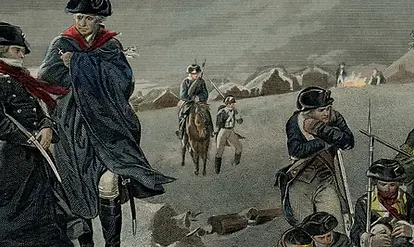
The French military leader Marquis de Lafayette and General George Washington at the Valley Forge encampment of the Continental Army during the winter of 1777–78
Listen to the audio version.
The Militia: Farmers with Muskets
But the Continental Army didn't fight alone. Colonial militias—farmers who volunteered for local defense—played a critical supporting role. At major battles, militia units would reinforce the Continental Army regulars, sometimes doubling Washington's force overnight. After the battle, militiamen would head home until needed again.
This drove the British crazy. They could never get an accurate count of American strength. A Continental force that looked beatable one day could suddenly double when local militias showed up. The British were used to fighting European armies with predictable numbers. In America, they faced an enemy that could swell and shrink depending on who was available to leave their farm that week.
The system worked because militias operated locally. They knew the terrain, defended their own communities, and could disperse quickly when not needed. Washington couldn't afford to keep a massive standing army fed and supplied year-round—Congress barely had money to pay the regulars. But militias brought their own weapons, served for short periods, then went home.
Together, the Continental Army and militias created a two-part defense the British couldn't break. Washington's regulars fought conventional battles and maintained legitimacy with European allies. Militias provided flexible reinforcements that made American forces unpredictable. The British could win battles, but they couldn't eliminate American resistance entirely. There was always another militia unit ready to mobilize.

John Blake White’s General Marion Inviting a British Officer to Share his Meal (1836)

Listen to the audio version.
Geography as a Weapon.
The sheer size and ruggedness of the Thirteen Colonies would make it difficult to conquer. Combined, the Thirteen Colonies were four times bigger than the whole of Great Britain. And while Britain had centuries-old highways connecting its cities, in America, cities and towns sat days or weeks apart, connected by routes that barely qualified as trails. Moving an army from New York to Philadelphia meant weeks of slow marching through wilderness. Communication between British commanders took so long that by the time orders arrived, the situation had often changed completely.
British soldiers were trained to fight on open fields where armies could maneuver and spot the enemy from miles away. America was nothing like that. The terrain itself was unforgiving. The Appalachian Mountains cut through the interior like a massive wall—rugged peaks, narrow passes, and virtually no roads. Dense old-growth forests blanketed much of the land, so thick in places you couldn't see fifty feet ahead. In the South, vast swamps stretched for miles with standing water and mud so thick it could swallow a horse.
Americans knew this terrain like the back of their hand, and they used that knowledge to their advantage. In 1777, British General John Burgoyne marched south from Canada with about 8,000 troops, trying to cut off New England from the rest of the colonies. His plan was to control the Hudson River Valley and split the rebellion in half. But to do that, Burgoyne had to hack his way through wilderness that had barely been touched. His army moved one mile per day through dense forests, building bridges over swamps and hauling cannons up steep hills with no roads. Meanwhile, American forces used their knowledge of the terrain to pick off British scouts and disrupt supply lines.
By the time Burgoyne reached Saratoga, his army was exhausted and low on supplies. American forces had fortified Bemis Heights overlooking the Hudson River. When Burgoyne tried to attack, his troops had to assault uphill on ground the Americans had chosen. The Americans had been using the terrain to wear him down for weeks. When Burgoyne finally attacked American positions in September and October 1777, his army got mauled in two fierce battles. Surrounded, outnumbered, and with no way out, Burgoyne surrendered his entire army—7,000 men.

British Red Coats marching along a dirt road. This an AI image that illustrates one of the difficulties British troops faced in moving troops and supplies across a rugged wilderness.
Saratoga was a conventional battle—the Continental Army stood their ground and fought the enemy head on. But in the South, militias waged a completely different kind of war. The British called it ‘ungentlemanly’. Historians call it guerrilla warfare.
Francis Marion—the "Swamp Fox"—showed just how devastating local knowledge could be. Marion set up camp deep in the Carolina swamps at places like Snow's Island. His men brought their own horses and weapons, didn't get paid, and grew up hunting and fishing in these marshes. They knew which paths were solid ground and which would swallow a horse whole. British troops didn't.
Marion's strategy was simple: hit fast, disappear faster. His militia would ambush a British supply convoy, grab what they needed, burn the rest, and vanish into swamps where British soldiers couldn't follow. British Colonel Banastre Tarleton chased Marion for weeks with more men and better equipment and never caught him. Imagine trying to march a thousand redcoats in full gear through a South Carolina swamp in August while Marion's boys—who knew every creek and cypress stand—watched from the trees, choosing their moment to strike and then melt back into the forest.
Guerrilla warfare didn’t win the Revolution—Washington's army and French support did that. But this kind of fighting made it much harder to conquer the colonists. Britain was trying to control a thousand miles of coastline from Maine to Georgia. They could take cities like Philadelphia or Charleston easily enough, but they were never able to conquer the countryside, where most Americans lived. This pattern would repeat throughout history. In the Vietnam War, the Viet Cong used jungle terrain the same way Marion used the swamps. In Afghanistan, Taliban fighters used knowledge of the mountain passes. The lesson is always the same: knowing the land can matter more than having better weapons when you're fighting on home ground.
Listen to the audio version.
Friends in High Places
If there’s one factor that stands out above the rest it’s this: the Americans didn't win this war alone. Without help from France, Spain, and the Netherlands, the Revolution probably would have failed. These European powers didn't help out of kindness—they wanted to see Britain taken down a notch.
France was the big one. They'd just lost the Seven Years' War and were still bitter about it. When the Revolution started, the French king saw an opportunity for revenge. Starting in 1776, France secretly began shipping guns, ammunition, and uniforms to the Americans. But they weren't ready to officially declare war yet. They wanted proof the Americans could hold their own.
The Battle of Saratoga in 1777 won the French over. When Americans captured 7,000 British prisoners, it proved they could actually fight. On February 6, 1778, France officially recognized the United States and signed a military alliance. Suddenly, Britain wasn't just fighting colonists—they were fighting France, too.
This was huge. The French navy challenged British control of the seas, meaning the British could no longer count on unrestricted access to supplies and reinforcements. French ships intercepted British convoys and provided naval support. French soldiers landed to fight alongside the Continental Army. And France gave the Americans legitimacy on the world stage.
Spain entered the war in 1779 as France's ally (though nervous about American ambitions in Florida). Spain's involvement meant Britain had to defend Gibraltar and Caribbean possessions, spreading their military thinner. The Dutch provided crucial financial support and allowed American ships to use their ports.
All of this foreign support came together at Yorktown in 1781. When Washington and French general Rochambeau combined forces—about 16,000 men—they outnumbered Cornwallis's British force two-to-one. But more critically, a French fleet controlled the waters around Yorktown, preventing British ships from evacuating Cornwallis or bringing reinforcements. The British were trapped. When Cornwallis surrendered on October 19, 1781, the French fleet had blocked his escape and French troops had helped surround him. Without French help, there's no Yorktown victory.
When Lord North heard the news of Yorktown, he reportedly said, "Oh God, it's over." He was right. The British still had armies in the field, but they'd lost something more important: the will to keep fighting. Against all odds, the Americans had won their independence.
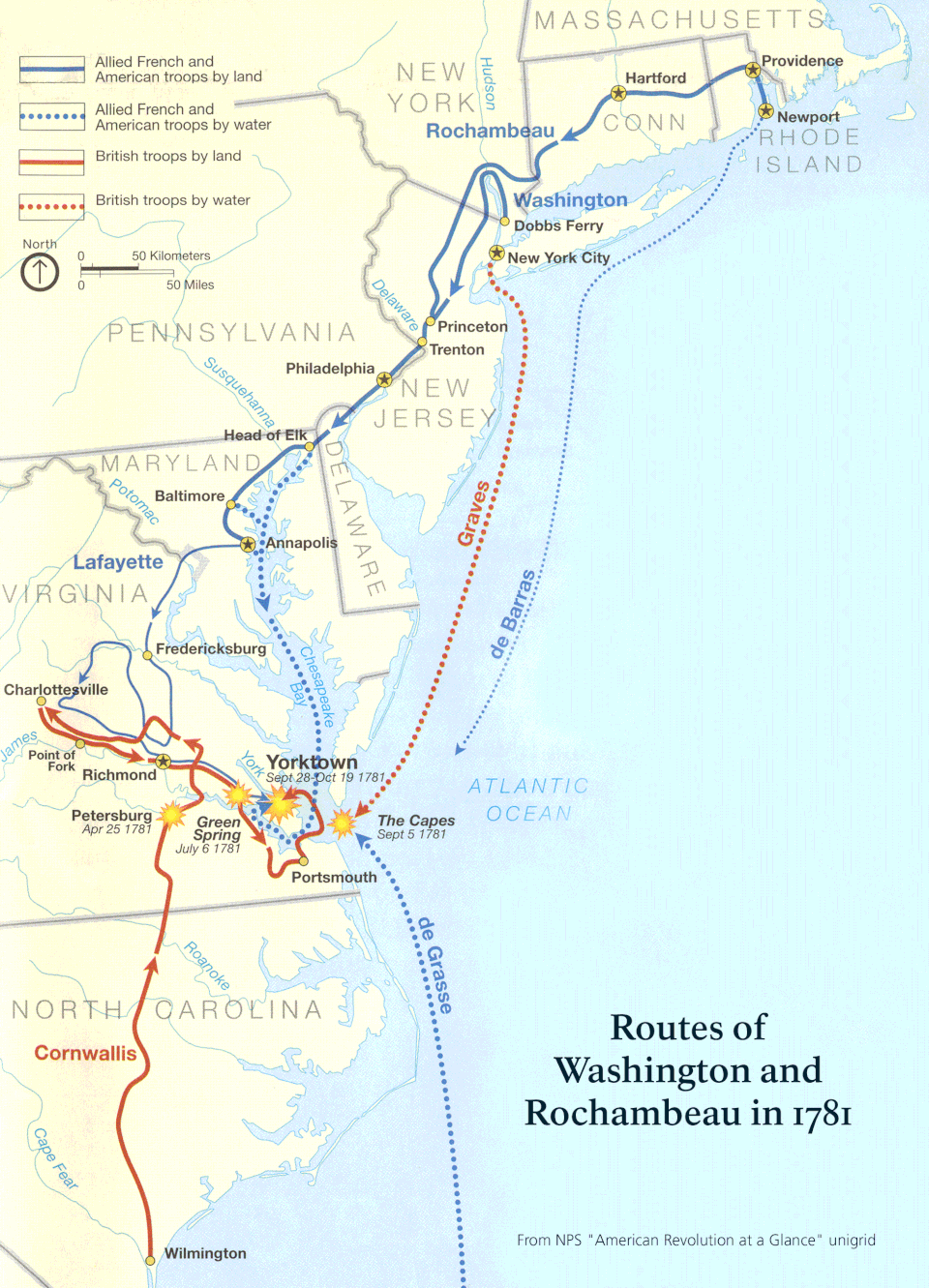
Franco-American routes during the Yorktown campaign.
Credit: U.S. National Park Service.
Digging Deeper
Use the article to answer the questions below.
-
What challenges did the Continental Army face during the American Revolutionary War?
-
How did French support help the American war effort?
-
What happened at Valley Forge, and why was it an important turning point for the Continental Army?
-
What happened at the Battle of Yorktown, and why did it effectively end the war?
-
What did Britain agree to in the Treaty of Paris of 1783, and why was that agreement important for the United States?
Copy and paste the questions onto a Word or Google Doc

Continental Congress War Council
In this high-stakes decision simulation, students guide the Continental Congress through 16 escalating crises where every choice can tip the Revolution toward independence or total collapse. By wrestling with real tradeoffs over money, military strategy, and alliances, they learn how fragile the American cause was—and how easily it could have failed.
Test Page