Teachers. Subscribe now and amaze exactly 0% of your friends, but you'll get great discounts and news!
THE HISTORY CAT

Listen to the audio version.
The Rebels Strike Back
Within days of the Battle of Lexington, 15,000 militia marched on Boston, a city that had been under military control since the Boston Tea Party. Boston, perched on a peninsula connected to the mainland by the narrow Roxbury Neck, was effectively trapped. The British troops and Loyalists inside the city were cut off, but General Gage wasn’t worried. After all, the British navy controlled Boston Harbor, giving them access to supplies and reinforcements. To Gage, the Americans were a bunch of disorganized country hicks. What could they do against the most powerful military force in the world.
But the Americans had a plan. They needed artillery to bombard the British position from the surrounding hills, and they knew just where to get it. Enter Fort Ticonderoga, an old British fort on Lake Champlain. Once called the "Gibraltar of America," the fort had seen better days, and its defenses were practically a joke. The British garrison consisted of just 47 soldiers—half of whom were invalids. On May 10, 1775, Ethan Allen and his Green Mountain Boys, along with Benedict Arnold, launched a surprise attack. The two guards on duty were so stunned that they didn’t even shut the gates. Without firing a single shot, the Americans captured the fort and its treasure trove of 78 cannons, 6 mortars, and 3 howitzers. Those cannons would soon make life very difficult for the British in Boston.
Meanwhile, the Second Continental Congress was meeting in Philadelphia, debating what to do next. Congress voted to create a Continental Army and appointed George Washington as its commander-in-chief.
Washington arrived outside Boston in July of 1775 and took command of the American forces surrounding the city. Rather than launching a risky attack on the city, Washington focused on holding the high ground and tightening the American grip around Boston.
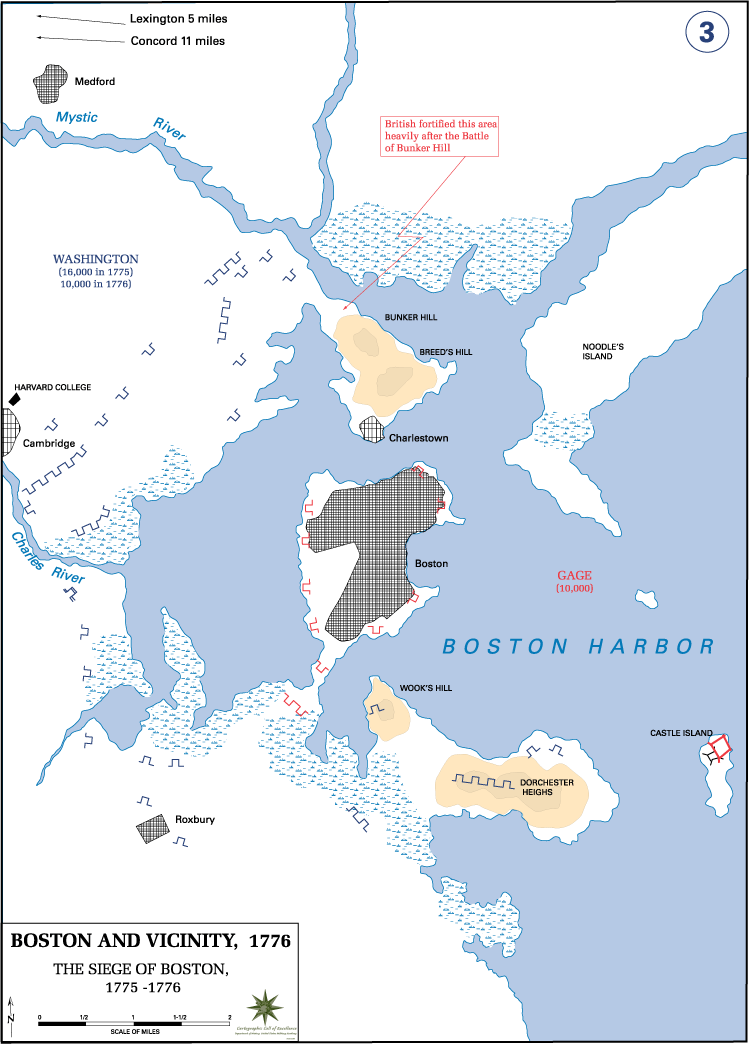
The American rebels (in blue) quickly surrounded key positions around the city of Boston, which kept the British troops (in red) bottled inside the city.

To gain access to cannons and gunpowder, the American rebels would have to march 220 miles to capture Fort Ticonderoga.

Listen to the audio version.
The Battle of Bunker Hill
On June 17th, 1775, the British awoke to find the Americans deeply entrenched. Naval guns from British warships pounded the Patriot position to soften them up before the main assault. The British were confident their well-trained regulars could easily defeat "the American rabble." Howe sent 3000 troops fully loaded with their 100-pound backpacks in the blazing 90-degree heat to dislodge the rebels. The Americans waited until the British got within 50 yards and opened fire, mowing down the enemy marching in tight formation. The British retreated and tried again. The second attempt ended like the first. But the third charge did the job when the rebels ran out of ammo. The British jumped over the walls and stabbed the retreating colonists with their bayonets. The Brits won the battle, but at a cost of over 1,000 casualties compared to only 400 on the American side. By March of 1776, Boston was back in American hands when the British realized New York would make a better headquarters.
Bunker Hill taught the Americans they could hold their own against the best-trained army in the world. At the same time, it showed the British they weren't going to crush the rebellion as easily as they thought. British troops began mobilizing across the empire to converge on the rebellious colonies, enlisting 30,000 German mercenary troops known as Hessians to sweeten the deal.
Later that summer, the Continental Congress issued the Olive Branch Petition telling King George there was still time for compromise. It arrived in London too late to do any good, but we doubt George would have backed down anyway.

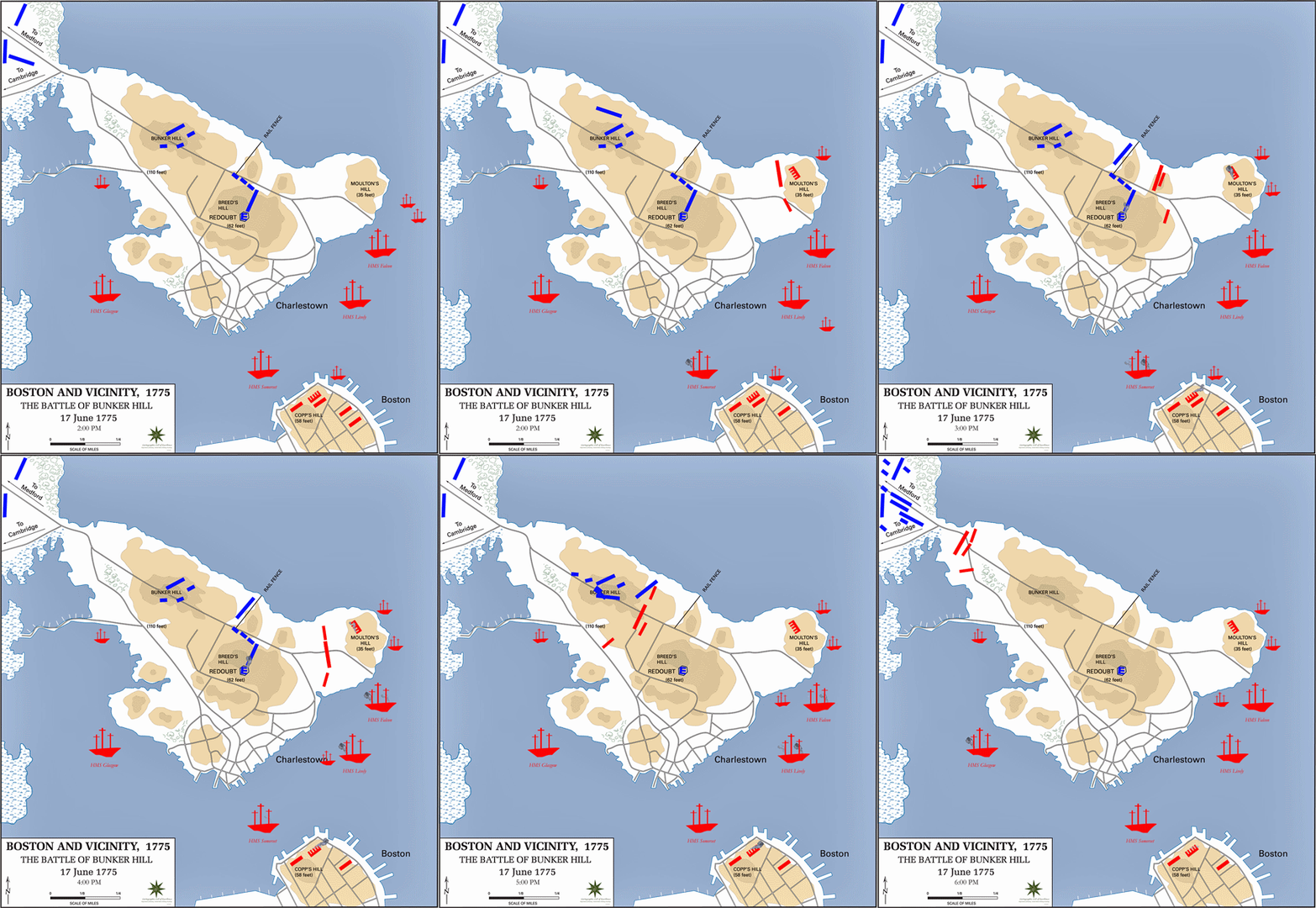
Map of the Battle of Bunker Hill
Listen to the audio version.
The Economics of War
Wars aren't just won by having the best battle strategy, they need money to keep them going, and war is expensive. Like, really expensive.
Britain was already drowning in debt from the Seven Years' War—over 130 million pounds—and British citizens were getting crushed by taxes. Now they had to pay for another war three thousand miles across an ocean where every musket ball, every uniform, every barrel of gunpowder had to be shipped across the Atlantic. But, the real economic killer was the collapse of colonial trade. British merchants had gotten comfortable selling manufactured goods to America and buying raw materials like tobacco and timber. When the war started, that trade vanished overnight. Ships sat idle, factories slowed production, workers got laid off. By 1780, economic hardship helped fuel the Gordon Riots in London. For a week the city descended into chaos with rioters attacking government buildings. The message was clear: the British public was tired of paying for this war.
.jpg)
Chart showing American imports and exports to Great Britain before, during, and after the revolution.
The Americans had the same revenue problems, but worse. The Continental Congress had no authority to raise taxes—kind of hard to tax people after starting a war over taxation. They could ask the thirteen states nicely for money, but getting thirteen colonies to agree on anything was like herding cats. So Congress printed paper money called "Continentals" that wasn't backed by anything. Inflation went out of control as the value of the currency dropped. By 1781, it took 100 Continental dollars to equal 1 dollar in gold. Soldiers got paid in worthless paper, brought their own weapons from home, and some marched barefoot through winter snow. At Valley Forge soldiers were starving because Congress couldn't afford to supply them. American farmers and merchants couldn't sell goods abroad either because the Royal Navy blockaded ports and choked off trade. Without French loans starting in 1778, plus money from Spain and the Netherlands, the Continental Army would have collapsed.
So, you had this standoff: The Americans were technically more broke—they couldn't tax, couldn't export, and were running on foreign loans. Britain had more money and a functioning tax system. But Britain had to keep justifying the enormous expense to their own people who were rioting in the streets, while Americans were fighting for their homes and willing to endure incredible hardship.
Listen to the audio version.
The Battles of Brooklyn and Trenton
Now back to more battles. At the same time that the Continental Congress was voting on the Declaration of Independence, General Howe was landing 32,000 British troops at Staten Island. Defending New York City was Washington's Continental Army—19,000 mostly untrained volunteers. Washington knew he didn't have a chance, but Congress badly needed a win. Losing New York City would divide New England from the rest of the colonies, which is exactly what the British planned to do. Washington made his stand at Brooklyn Heights on Long Island. As Howe advanced, British warships pounded the American position. The Americans were trapped between the East River behind them and Howe ahead. Washington may have been inexperienced, but he wasn't stupid. He knew his men had little chance in open combat. Lucky for him, Howe was cautious and didn't attack right away. Then a massive rainstorm blew in, further slowing the British. Using the storm for cover, Washington and 6,000 men retreated across the East River. Howe now held New York City, which remained in British hands for the rest of the war.
After crossing into New Jersey, Washington stumbled across a band of Hessians camped at Trenton. Washington, a master at using spies and deception, put on a little show for the Germans with the help of John Honeyman, a former British soldier turned Patriot. Honeyman's mission was simple: get arrested by Washington's army, escape to the German camp, and spread disinformation. Washington even had his guards fire at the escaping Honeyman to make it look real. Once at the German camp, Honeyman told stories of how the Americans were hopelessly unprepared and near collapse. The German commander Johann Rall told his men to relax and celebrate Christmas. Meanwhile, Honeyman was secretly sending back details of the enemy camp, troop positions, and ammunition stores. Hungover from too much Christmas booze, the Hessians were totally unprepared for Washington's attack. Under cover of darkness on December 25, 1776, Washington crossed the icy Delaware River with 2,400 men, shocking the Hessians who had been partying all night. Out of 1,500 Hessian soldiers, only 500 made it out alive. The Americans lost only six men.
However, the biggest battle Washington faced wasn't the British—it was keeping his soldiers from deserting. The British had won most of the battles and controlled nearly all the colonial cities. American morale was at rock bottom. On December 31st, most of the Continental Army's enlistment was up, and many exhausted, unpaid, poorly fed soldiers weren't planning on signing up for a second tour of duty. The Revolution wasn't even a year old and was already falling apart.
Listen to the audio version.
The Year of the Hangman
People call 1777 "the year of the hangman," referring to the way the sevens resembled a gallows. With the American army running out of everything, loyalists predicted that the rebel leaders would be soon swinging at the end of a rope. The British had retaken Fort Ticonderoga and chased the Americans out of New York and Pennsylvania. When General Howe captured the capital of Philadelphia on September 26th, it looked as if the cause for independence was all but dead. But, those crafty Americans still had a few tricks up their sleeve.
While Howe was busy taking Philadelphia, British General John Burgoyne was marching south from Canada with 8,000 troops. The plan was simple: Burgoyne would march down from Canada and meet up with Howe's forces coming up from New York to cut New England off from the rest of the colonies by controlling the Hudson River Valley. Problem was, Howe decided to attack Philadelphia instead of linking up with Burgoyne. Huge mistake. Burgoyne was now on his own. His supply lines stretched too thin as he moved deeper into New York. The thick forests slowed his progress, and American militia kept harassing his troops. By the time Burgoyne reached Saratoga in September 1777, he was running low on supplies and reinforcements weren't coming.

The Americans saw their chance. They dug in on Bemis Heights overlooking the Hudson River and waited. Burgoyne attacked on September 19th but couldn't break through the American lines. He tried again on October 7th with the same result. Benedict Arnold, against orders, led a charge that smashed through the British defenses and left Burgoyne's army surrounded. On October 17, 1777, Burgoyne surrendered his entire army—nearly 6,000 men.
This was the turning point of the war. France had been watching from the sidelines, waiting to see if the Americans could actually win before committing to an alliance. Saratoga proved they could. In February 1778, France officially entered the war as America's ally. This wasn't just symbolic—France brought money to keep the Continental Army from collapsing, experienced troops to bolster American forces, and most importantly, a navy that could challenge British control of the seas. Without French support, the Americans would have run out of cash and supplies within a year or two. Saratoga didn't just win a battle—it won the war's most important ally.
Listen to the audio version.
The Fight in the South
For most of the war, the fighting had been up North. The British spent years trying to crush the rebellion in New England and the mid-Atlantic but had little to show for it. So in 1780 they decided to try their luck in the South. The British figured the southern colonies were packed with loyalists who would jump at the chance to help squash the rebellion. And they had a point. The South was different. A lot of the loyalists were recent immigrants—Germans, Irish, Scots—who had settled in the backcountry. These folks didn't have much love for the wealthy plantation owners calling the shots. The British saw a chance to turn these tensions into a winning strategy. They also saw another opportunity: enslaved people. Back in 1775, Virginia's royal governor Lord Dunmore had issued a proclamation promising freedom to any enslaved person who escaped their Patriot masters and joined the British. Thousands took the risk. For wealthy Patriot plantation owners, this was a nightmare. Losing their enslaved workers meant losing their fortunes, and the British knew it. It was a calculated move to hit the southern Patriots where it hurt most.
On May 12, 1780, the British scored their biggest victory in the South. Not only did the Brits capture Charleston, SC, America's fourth-largest city, but also over 5,000 POW's— about one-fourth of the entire continental army! Unlike in the north, the southern war for independence was about to get a whole lot meaner, uglier, and dirtier.
The southern theater saw both traditional battles and brutal guerrilla warfare. Loyalist and patriot militias laid waste to enemy towns, hung traitors from trees, and burnt homes to the ground. One of the most famous guerrilla fighters was Francis "Swamp Fox" Marion, a South Carolina plantation owner who broke his ankle and missed the fall of Charleston. From then on, Marion led maybe 50 men using tactics learned fighting the Cherokee—hiding in the swamps, picking off enemy patrols, and then disappearing back into the forest. Outnumbered 100 to 1, the Swamp Fox became the stuff of legend and kept the British constantly looking over their shoulders.
The swamps, mountains, and thick forests of the American South turned out to be the British army's worst enemy. The thirteen colonies were four times bigger than all of Great Britain, and the South's terrain made conquering that territory a nightmare. The British could take cities, but holding the countryside was a different story. Guerrilla fighters like Marion used the landscape to their advantage—they knew every swamp, every mountain pass, every hidden trail. The British found themselves spread thin trying to protect loyalist settlements while also guarding convoys and hunting down raiders who could disappear into terrain the Redcoats didn't understand. The longer the war dragged on, the harder it became for Britain to justify the cost and manpower needed to keep fighting. Time was on America's side.

Map of the Southern theater of the American Revolution

Clarendon County, South Carolina
Listen to the audio version.
Yorktown: An Unlikely Win
In 1781, a British force of about 7,000 led by General Cornwallis and Benedict Arnold (who had been an American commander at Saratoga, but changed sides soon after) was camped out in Virginia near Yorktown. The British blockade had kept the French from providing much assistance, and the Americans were trying to figure out a way to force the British to surrender. The French managed to land about 6,000 men in Rhode Island, and Washington was planning on linking up with them for a full out assault on New York. When Washington received news that French reinforcements were headed to fight Cornwallis in Virginia, he had a change of plans. The combined American-French army, about 16,000 strong and double the size of Cornwallis, decided to try to land a knockout punch to the British resistance.
On September 28, 1781, the French-American forces began a siege of the British position. British attempts to break the siege failed. On October 14, 1781, the British tried to recapture some lost ground. When they failed, they decided to sneak out that night across the York River. In one of those moments of irony, a storm came across that was similar to the ones that allowed Washington to escape from New York back in 1776. This time the storm worked in Washington’s favor by trapping Cornwallis. On October 19, 1781, the British called for a truce. The Battle of Yorktown marked the end of the British war with America. Against all odds, the Americans with tremendous support from their French allies had beaten the biggest superpower in the colonial world. When news reached London, Lord North replied, "Oh God, it's over." Shortly after that, he resigned as Prime Minister.
Listen to the audio version.
The Treaty of Paris- 1783
The Battle of Yorktown marked the end of the British war with America. Against all odds, the Americans, with huge support from their French allies, had beaten the biggest superpower in the world. When news reached London, Lord North replied, "Oh God, it's over." ...Shortly after he resigned as Prime Minister.
Peace talks would strain the relationship between the former allies. The Americans feared that the French would try to negotiate with the British to reclaim the lands west of the Appalachian Mountains. The Americans, who had been prevented from settling into their lands by the Proclamation of 1763, wanted that land for their new nation.
The Americans secretly negotiated a treaty with the British that gave the United States control the lands east of the Mississippi River. On September 3, 1783, a peace treaty was signed that recognized the sovereignty of the United States of America. By the terms of the treaty, a lot of land began to change hands. Britain got the island of Gibraltar (south of Spain), Spain regained Florida. The French got Tobago and the African colony of Senegal.
Under the terms of the treaty prisoners of war were to be released and the Americans were to return all property confiscated from loyalists during the war. Those who were in New York or the Carolinas had the best chance of getting paid. For those loyalists who owned land in New England, the chances of receiving compensation were pretty slim. After the war, about 100,000 Loyalists fled the United States. Most went to Canada while some fled to either England or the Caribbean.
%20(October%202020)_jpg.webp)
Yorktown Sep 28- Oct 19, 1781. Source: American Battlefield Trust
Yorktown Sep 28- Oct 19, 1781. Source: American Battlefield Trust

Listen to the audio version.
Why It Matters
The American Revolution proved that a bunch of colonists could take on the most powerful empire in the world and win. The idea that regular people could have a say in their government instead of just doing what a king told them? That was revolutionary. Other countries noticed. France launched their own revolution in 1789. Enslaved people in Haiti fought for their freedom. Revolutions spread across South America as people realized they didn't have to accept rule by distant monarchs.
The Revolution wasn't perfect and didn't solve everything. The Declaration said all men are created equal, but the country still had slavery. Women couldn't vote. Native Americans lost their land. It took a civil war to end slavery, decades of activism to get women the vote, and the civil rights movement to challenge segregation. The Revolution started the conversation about freedom and equality, but Americans have been arguing about what those words actually mean ever since.
The world we live in today—with democratic governments, constitutions that limit power, and the idea that leaders should answer to the people—comes directly from 1776. The Revolution established that people have the right to govern themselves and that government gets its power from the consent of the governed, not from divine right or military force.
Digging Deeper
Use the article to answer the questions below.
-
What did the Battle of Bunker Hill (June 1775) teach both the Americans and the British about the war ahead?
-
Why was keeping soldiers in the Continental Army such a challenge for George Washington? What problems did he face by December 1776?
-
Explain how the militia and guerrilla fighters like Francis Marion helped the American cause in the South.
-
Why was the French alliance so important to America winning the war? What did France provide beyond just soldiers?
-
What economic problems did the Continental Congress face when trying to pay for the war?
-
What territories did the United States gain under the Treaty of Paris in 1783?
Copy and paste the questions onto a Word or Google Doc
Test Page