Teachers. Subscribe now and amaze exactly 0% of your friends, but you'll get great discounts and news!
THE HISTORY CAT


Listen to the audio version.
Seneca Falls: Where It All Began
In 1848, five women in upstate New York did something downright scandalous for their time—they held a meeting—in public! Elizabeth Cady Stanton, Lucretia Mott, Mary Ann McClintock, Martha C. Wright, and Jane Hunt organized the Seneca Falls Convention with only five days’ notice. Despite low expectations, more than 300 men and women showed up—half genuinely curious and half just there to gawk at the sight of women daring to speak their minds.
At the convention, Stanton unveiled the Declaration of Sentiments, a bold document modeled after the Declaration of Independence. It listed twelve grievances against the male-dominated society, from the obvious to the outrageous. Women couldn’t vote, hold public office, or serve on juries. Once married, they lost legal identity altogether—their property, wages, and even their children legally belonged to their husbands.
Women couldn’t attend most colleges, and divorce laws were stacked entirely in favor of men. Even church pulpits barred them from preaching.
The most shocking resolution of all? The demand for women’s right to vote—a notion so bold that even some supporters thought it went too far. When Stanton stood her ground, her husband, Henry, stormed out in protest.
Though the Seneca Falls Convention marked the official start of the women’s rights movement, progress soon slowed. The nation’s focus turned toward the growing crisis over slavery—and by 1861, when the Civil War erupted, the fight for women’s equality was pushed to the back burner.

Listen to the audio version.
How the Civil War Paused the Fight for Women’s Rights
When the Civil War began, the women’s rights movement went quiet. The country was in crisis, and most reformers shifted their attention to the war effort. The same women who once gave fiery speeches about equality were now organizing fundraisers, sewing uniforms, and gathering medical supplies for soldiers on the front lines.
In the North, women joined the U.S. Sanitary Commission, managing field hospitals and nursing the wounded. Leaders like Elizabeth Cady Stanton and Susan B. Anthony helped coordinate massive relief drives that kept Union armies supplied. Others became spies, couriers, and clerks—roles that pulled them directly into the machinery of war.
Women in the Confederacy took on similar work, caring for the injured, managing farms and plantations, and keeping households afloat as men went off to fight. A few even disguised themselves as soldiers and served in battle, a daring act that shocked everyone when discovered.
The war pushed women into public life like never before. They proved they could lead, organize, and endure under pressure. But their movement for equal rights faded into the background. Every ounce of energy went toward the war effort, and by the time peace returned in 1865, the suffrage cause had lost its momentum—at least for a while.

Listen to the audio version.
After the War: Hopes, Betrayal, and Division
After the Union victory, suffragists expected that their wartime service would finally be rewarded. But as Reconstruction began, the focus shifted to the rights of formerly enslaved men. The Fourteenth Amendment introduced the word “male” into the Constitution for the first time, and the Fifteenth Amendment granted voting rights to Black men—but excluded women entirely.
For many suffragists, this was a bitter betrayal. Women who had risked their reputations and safety fighting for abolition were now told that it was “the Negro’s hour,” a phrase used by abolitionist Wendell Phillips to argue that the nation had to prioritize Black male suffrage before women’s rights. Frederick Douglass agreed, insisting that Black men faced deadly violence and urgently needed the ballot for protection. Stanton and Anthony disagreed, furious that women were being asked to wait yet again. The suffrage movement fractured under the strain.
In 1869, Elizabeth Cady Stanton and Susan B. Anthony formed the National Woman Suffrage Association (NWSA), opposing the Fifteenth Amendment unless a federal amendment for women’s rights was also passed. At the same time, Lucy Stone and Henry Blackwell founded the American Woman Suffrage Association (AWSA), supporting the Fifteenth Amendment as progress and focusing on a slower, state-by-state strategy.
Race added another layer of division. Some white suffragists, including Stanton, began using racist arguments to appeal to white voters, claiming educated white women deserved the vote before freedmen. Former allies like Frederick Douglass broke with them over these remarks. The unity that had once defined the movement was gone, replaced by rival organizations that would remain divided for twenty years.

“The National Colored Convention in Session at Washington, DC.” Harper’s Weekly (February 6, 1869).

Listen to the audio version.
The Fight for Suffrage Heats Back Up
By the early 1900s, the women’s rights movement was running out of patience—and running into walls. The old guard had regrouped under the National American Woman Suffrage Association (NAWSA), pushing the same polite, state-by-state strategy that had barely moved the needle. By 1900, only four western states—Wyoming, Colorado, Idaho, and Utah—allowed women to vote. Western lawmakers weren’t exactly feminists; they just hoped the ballot might convince more women to move west and even out the gender imbalance.
Then came the new generation—Alice Paul and Lucy Burns—and they were done asking nicely. These two had studied under British suffragettes who chained themselves to fences, smashed windows, and went on hunger strikes. Compared to them, NAWSA’s tea-party approach looked downright quaint.
In 1913, Paul and Burns organized a massive suffrage parade in Washington, D.C., timed for the day before President Woodrow Wilson’s inauguration. Over 8,000 women marched with banners that read “How Long Must Women Wait for Liberty?” while half a million spectators crowded Pennsylvania Avenue. The crowd turned ugly fast—men shoved, spit, and shouted insults while police mostly stood by. The violent chaos made headlines, but so did the women’s grit. They had refused to fade quietly into the background, and that alone was revolutionary.
After that, Paul and Burns split from NAWSA to form the National Woman’s Party (NWP)—and things got radical. Instead of charming politicians, they targeted them. The NWP focused on a federal amendment guaranteeing the right to vote, and they weren’t afraid to call out the President himself. They picketed the White House gates, held banners comparing Wilson’s democracy to tyranny, and refused to stop even when America entered World War I.
That’s what made it so shocking: while men fought overseas “to make the world safe for democracy,” women were arrested at home for asking to share in it. When imprisoned at the Occoquan Workhouse, NWP members launched hunger strikes, enduring beatings and force-feeding through rubber tubes. The brutality horrified the public. Suddenly, the question wasn’t whether women were ready for the vote—it was why on earth the government feared them so much.
What had started as a polite request for equality had turned into a national confrontation over power, protest, and principle. The suffragists weren’t waiting anymore—they were demanding.


Lucy Burns, who with Alice Paul established the first permanent headquarters for suffrage work in Washington, D.C., served more time in jail than any other suffragist in America. (Library of Congress)
Listen to the audio version.
Racism and Exclusion in the Movement
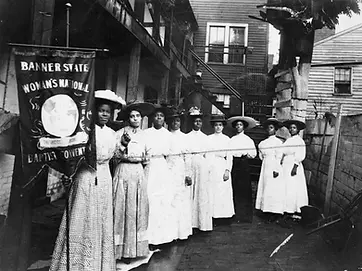
For all their talk about equality, many white suffragists drew the line at race. Black women who showed up to meetings or marches were often told to wait, walk in the back, or form their own groups. During the famous 1913 suffrage parade in Washington, D.C., Illinois activist Ida B. Wells was told she’d have to march at the end so she wouldn’t “offend” Southern women. She didn’t listen. When the parade began, she stepped right into the Illinois delegation and kept walking, head high, daring anyone to stop her.
Tired of being pushed aside, Black women built their own movement. Leaders like Mary Church Terrell, Frances Ellen Watkins Harper, and Nannie Helen Burroughs founded the National Association of Colored Women (NACW) in 1896 with the motto “Lifting as We Climb.” They fought for the vote, but also for schools, anti-lynching laws, and real justice—things white suffrage leaders too often ignored. There were moments of unity, especially in northern cities, but full cooperation was rare. Even inside a movement for equality, racism shaped who got a seat at the table and who had to build their own.
Listen to the audio version.
Opposition to Suffrage
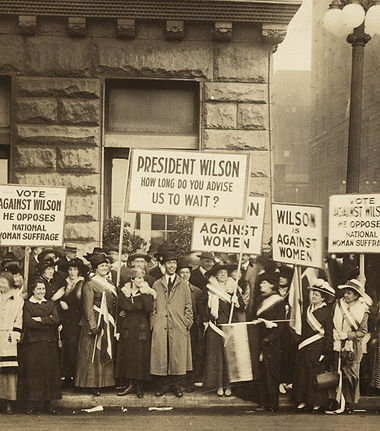
The fight for women’s suffrage wasn’t just about convincing lawmakers—it also meant overcoming fierce public opposition. Anti-suffragists, both men and women, believed giving women the vote would destroy traditional family roles and upset the natural order of society. They argued that women were too emotional, inexperienced, or simply uninterested in politics. Campaigns against suffrage painted women voters as abandoning their homes and families, with propaganda showing children crying over neglected dinners.
Ironically, some of the loudest voices against suffrage came from women themselves. Groups like the National Association Opposed to Woman Suffrage insisted that political involvement would harm women’s moral purity and create chaos in the country. They claimed suffrage was “unwomanly” and “unpatriotic,” even warning that allowing women to vote could lead to the breakdown of American democracy.
Businesses also joined the fight against suffrage. Liquor companies feared that women voters would push for prohibition laws (which they did!), while factory owners worried that women voters would demand better wages and working conditions. Suffragists had to battle this organized resistance every step of the way, proving again and again that women deserved equal rights as citizens.


Anti-Suffrage Propaganda
Listen to the audio version.
The War That Changed Everything
World War I proved to be a turning point for the suffrage movement. With millions of men sent overseas, women stepped into traditionally male jobs, keeping factories, offices, and farms running. Their contributions shattered the stereotype that women were too delicate for hard work, providing a powerful argument for equality.
After the war, momentum for suffrage reached a fever pitch. In January 1918, Congress held its third vote on women’s suffrage. The House narrowly passed the measure, but the more conservative Senate delayed until June 1919. Finally, the Nineteenth Amendment was approved, sending it to the states for ratification.
Listen to the audio version.
Race to Ratify the Nineteenth Amendment
Passing the amendment in Congress was only half the fight—now 36 of the 48 states had to approve it. Suffragists launched a nationwide blitz. They crisscrossed the country by train, speaking in courthouse squares, hotel lobbies, and state capitols, urging lawmakers to make history. Telegrams flew daily with updates: “North Dakota firm. Louisiana wavering.”
The opposition was relentless. Anti-suffrage groups, backed by business interests and conservative politicians, warned that women voters would destroy the family and unleash moral chaos. In the South, many legislators feared the idea of Black women voting and vowed to block the amendment at any cost.
By mid-1920, thirty-five states had ratified—just one short. All eyes turned to Tennessee, the last hope for victory. Nashville’s hotels and hallways turned into political battlegrounds. Suffragists wore yellow roses to show support; opponents wore red, giving the showdown its nickname: “The War of the Roses.”
On August 18, 1920, the Tennessee legislature met to decide. The vote tied—until a young lawmaker, Harry Burn, changed sides after reading a letter from his mother urging him to “be a good boy” and support suffrage. His single “yes” vote broke the deadlock.
With Tennessee’s ratification, the Nineteenth Amendment cleared its final hurdle. Six days later, on August 26, 1920, it became law, granting women across America the right to vote—and proving that one letter, one vote, and one act of courage can change a nation.
Listen to the audio version.
Victory at Last
On August 26, 1920, the Nineteenth Amendment was officially added to the U.S. Constitution, marking a monumental victory for women’s rights. After more than 70 years of struggle, debates, and countless sacrifices, women across the nation finally had the right to vote. For many suffragists, this moment was the culmination of a lifetime of work. Leaders like Susan B. Anthony, Elizabeth Cady Stanton, and Sojourner Truth had not lived to see the day, but their efforts laid the foundation for this historic achievement.
Celebrations erupted nationwide. Women marched in parades, waved banners, and proudly cast their first votes in the 1920 presidential election between Warren G. Harding and James Cox. Though voter turnout among women was lower than expected—only about 35% of eligible women participated—it was a first step toward a new era of civic involvement. For some women, decades of being told that politics was "unfeminine" left them hesitant or intimidated, but the barriers were finally beginning to crumble.

Listen to the audio version.
Why It Matters
The passage of the Nineteenth Amendment in 1920 granted women the right to vote, but it was only the beginning of a much longer struggle for equality. For decades, women were still blocked from full participation in civic life. In many states, women couldn’t serve on juries until the 1940s, and married women in some places couldn’t hold property in their own name until the 1950s. Banks refused loans or credit cards without a husband’s co-signature until the Equal Credit Opportunity Act of 1974 finally made that illegal. Even something as simple as wearing pants in public or the workplace remained taboo for most women until the 1960s and 1970s—a reminder of how deeply society policed gender roles.
Economic independence came just as slowly. In 1920, women earned less than half of what men made. The Equal Pay Act of 1963 tried to address wage discrimination, but progress was uneven. The Equal Rights Amendment (ERA), first written by suffragist Alice Paul in 1923, passed Congress in 1972 but still hasn’t been fully ratified by enough states to become law.
These milestones show that equality didn’t arrive with one amendment—it’s been a century-long climb. The Nineteenth Amendment opened the door, but every generation since has had to push it a little wider.
Digging Deeper
Use the article to answer the questions below.
-
What was the Seneca Falls Convention and why was it important to the women’s suffrage movement?
-
Who were major leaders in the women’s suffrage movement, and how did they work for voting rights?
-
Briefly describe 2 different strategies that suffragists used to gain support for the right to vote?
-
What kinds of opposition did women’s suffrage activists face from people who did not want them to vote?
-
How did the 19th Amendment change voting rights in the United States?
Copy and paste the questions onto a Word or Google Doc
Test Page