Teachers. Subscribe now and amaze exactly 0% of your friends, but you'll get great discounts and news!


Unit 10: The Last Frontier
1865-1890
Native American Boarding Schools
Native American Boarding Schools Lesson Plan | Grades 7-12
TEACHER RESOURCES

Get the Complete Lesson
Listen to the audio version.
Just after midnight on October 6, 1879, a train pulled into the small town of Carlisle, Pennsylvania, carrying 82 Lakota children who had traveled more than a thousand miles from the plains of Dakota Territory. A crowd of townspeople had waited up to gawk at the "wild Indians." The children had been told they were going to school. None of them knew they would not see home again for years, and some of them would never see it again.
Over the next ninety years, tens of thousands of Native American children were sent away to schools like Carlisle. The federal government ran or paid for 417 boarding schools in 37 states and territories, and churches ran at least 115 more on their own. At these schools, children had their long hair cut short, their buckskin and moccasins swapped out for uniforms and dresses, and their names were replaced with English ones.
This was all part of a government policy known as assimilation (getting Native Americans to give up their own cultures and live like white Americans). Many of the people who built these schools were reformers who believed they were actually helping to save Native American children. But save them from what?

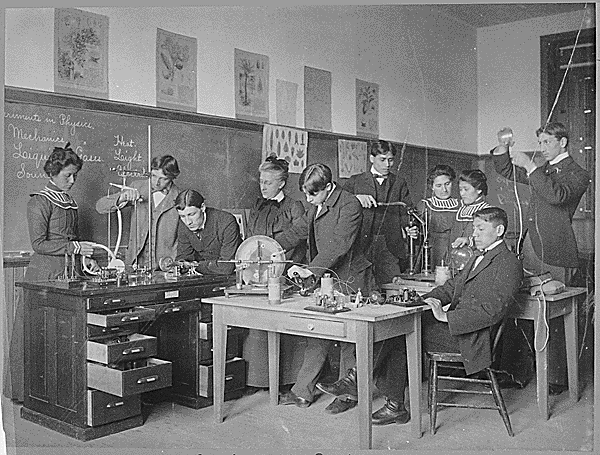
Students at Carlisle Indian Industrial School, Pennsylvania, c. 1900
Listen to the audio version.
Pratt's Experiment
By the late 1870s, the wars on the Great Plains were coming to an end, and Native nations were on the losing side. Most had signed treaties or been forced onto reservations, and the Army's job was to keep them there.
Tribal Leaders who refused were rounded up and sent to prison. On the reservations, government agents were supposed to hand out the food, blankets, and payments promised in treaties, but many of them stole the supplies and cheated the people they were sent to serve. Native leaders had to negotiate through interpreters, and the interpreters did not always translate honestly. The Lakota leader Red Cloud later said of one treaty, "We could not read them, and they did not tell us truly what was in these papers."
Richard Henry Pratt had watched all of this up close. He was an Army officer who had spent years fighting the Kiowa, Comanche, and Cheyenne. In 1875, the Army put him in charge of more than seventy Plains warriors held as prisoners at Fort Marion in St. Augustine, Florida. Under Pratt's command, the prisoners had their hair cut and were issued Army uniforms, and volunteer teachers from the town taught them to read and write English.

Richard Henry Pratt, founder of the Carlisle Indian Industrial School.
Within a few years, some of the prisoners were reading and working jobs in town. Pratt was convinced that if this worked on grown warriors, it would work even better on their children.
Basically, Pratt figured Native nations had lost the wars, and on the reservations they would go on being cheated. The only way to save Native people, he believed, was for them to give up their cultures, learn English, and blend into white society so completely that no one could take advantage of them again.
In 1879, the government gave Pratt an empty Army post in Carlisle, Pennsylvania, and reformers who called themselves "Friends of the Indian" donated money to help. Pratt traveled to Dakota Territory to recruit students. Lakota leaders had every reason to distrust him, but Pratt's argument hit home. He told them their people kept getting cheated because they could not read the treaties or speak for themselves, and if their children learned English, the next generation could. The Brulé Lakota leader Spotted Tail agreed to send his own children, and other families followed.
"Here a Lieutenant struggles to evolve order out of the chaos of fourteen different languages! Civilization out of savagery! Industry and thrift out of laziness! Education out of ignorance! Cleanliness out of filth! And is forced to educate the courage of his own instructors to the work, and see that all the interests of his Govt. and the Indian as well are properly served."
- Richard Henry Pratt in a letter to President Hayes
Listen to the audio version.
Life at School
For new students, the changes started pretty much the minute they arrived, because the whole point of the school was assimilation, and Pratt wanted every sign of home gone as fast as possible. Their long hair was cut short (which in many Native nations was only done when someone had died), and their buckskin and moccasins were taken away and replaced with stiff leather shoes, wool military uniforms for the boys, and high-collared Victorian dresses for the girls. Most students were also given new English names, which were sometimes picked off a list written on a blackboard. From then on, a bell would tell them when to wake up, when to march to meals, and when to go to class.
Students would spend half the day in class, where the main goal was learning English, and the other half working. Technically, the work was supposed to be job training, so boys learned trades like farming and blacksmithing while girls learned sewing and cooking, but it also happened to keep the schools running, since students grew a lot of the food, sewed their own uniforms, and fixed up the buildings. Every student was also expected to become a Christian, so church services and Sunday school were part of the routine too.
Schools also used sports to teach students to act like other Americans, and Carlisle, of all places, ended up with one of the best football teams in the country. Coached by Pop Warner, the Carlisle Indians took on the biggest college teams of the day, and in 1912, led by Sac and Fox star Jim Thorpe, they beat Army 27 to 6 at West Point (and a young Dwight Eisenhower was on that Army team, no less). Carlisle had a baseball team too, and one of its players, an Ojibwe student named Charles Bender, went on to pitch the Philadelphia Athletics to three World Series titles and ended up in the Hall of Fame.
Students usually signed on for three to five years, and most were not allowed to go home in the summers, because school officials worried they would slip back into their old ways. Instead, Carlisle sent them to live and work with white families on nearby farms and in nearby towns through what it called the "outing" system. Boys usually did farm work and girls cooked and cleaned, and while Pratt said the families were supposed to treat students like family instead of servants, a lot of students ended up working long days with hardly any time off. Some stayed with their outing families right through the school year, and by 1903 Carlisle had nearly 950 students out on outings.

Hastiin To'Haali was a student at Carlisle Indian Industrial School. Upon arrival he was assigned the name Tom Torlino, given a western style haircut and clothes as part of the school's assimilation program.


Listen to the audio version.
Culture Shock
Zitkála-Šá, a Yankton Dakota girl who was sent to a Quaker boarding school in Indiana when she was eight, had been taught by her mother that only cowards and warriors captured by the enemy had their hair cut short. So when she found out the staff planned to cut her braids, she crawled under a bed and hid in a dark corner until she was dragged out and tied to a chair. She later wrote that she cried and shook her head "until I felt the cold blades of the scissors against my neck, and heard them gnaw off one of my thick braids. Then I lost my spirit."
Not knowing English got a lot of new students in trouble too. One winter, Zitkála-Šá and two friends were caught playing in the snow, which was against the rules, and her friend Judéwin, who knew a few words of English, told the others to just answer "no" to whatever the woman in charge asked them. So when their friend Thowin was called in first and asked if she would obey next time, she kept saying "no," and the woman kept spanking her harder. As Zitkála-Šá remembered it, "This time the woman meant her blows to smart, for the poor frightened girl shrieked at the top of her voice."
Of course, spanking was pretty normal in American schools back then, and a kid who talked back to a teacher could expect a paddling, but boarding schools took it a lot further because Pratt ran Carlisle like an Army post. Speaking a Native language, wearing moccasins, talking back, or running away could get a student whipped, slapped across the face, forced to skip meals, or locked alone in a room for days, and Carlisle even used an old stone guardhouse on the grounds as a jail for students. A 2022 federal investigation found the same kinds of punishments at schools across the whole system, and that older students were sometimes ordered to punish the younger ones.
For many Native children, this was a total shock, because in a lot of Native nations adults hardly ever hit children and would correct them by teasing them, telling them a story, or just talking it through. As Zitkála-Šá put it, at school "not a soul reasoned quietly with me, as my own mother used to do." Former students also remembered the crying in the dormitories at night, once it sank in that they would not see home for years.
On top of all that, the schools made children sick. Dormitories were packed with narrow iron beds, and at the Cantonment Boarding School in Oklahoma children slept three to a bed. Bathrooms were scarce (a 1928 study called the Meriam Report found one school where two toilets served 80 girls), and students shared towels, washbasins, and drinking cups, so tuberculosis, measles, and trachoma, an eye infection that can cause blindness, spread easily. Sick children were often sent home to die so the deaths would not be counted at the school, but many others died there and were buried on school grounds, including at least 102 children at the Genoa Indian School in Nebraska.

Shower in the girls dorm on the Blackfoot Reservation, Cutbank Boarding School (Bureau of Indian Affairs, Morrow, May 1951)
Listen to the audio version.
Parents Fight Back
Within a few decades, the government had copied Carlisle at boarding schools across the West. In the 1890s, Congress gave Indian agents the power to force children into school, and an 1893 law let agents cut off food and supplies to families who refused. Agents, sometimes backed by soldiers, went village to village to collect children. By 1926, more than 60,000 Native American children, over 80 percent of all Native children of school age, were in boarding schools.
Native American families did not hand over their children quietly, and the pushback started almost as soon as Carlisle opened. Even Spotted Tail, the Brulé Lakota leader who had helped Pratt fill that first train, changed his mind. In June 1880, he traveled to Carlisle, and after a heated scene, he took his own children and grandchildren back home. The next spring, Spotted Tail and other leaders at Rosebud wrote to Pratt asking for the rest of their children, because so many were getting sick and dying so far from home, and they wanted a school on the reservation instead.

Soldiers guarding the Hopi prisoners on their arrest in Arizona, 1894
Mennonite Library and Archives, Bethel College, North Newton, Kansas
Other parents fought back the moment agents showed up. In 1892, the government agent for the Navajo came to the Round Rock area of Arizona with a small police force to round up children for school. A Navajo leader named Black Horse, who believed the schools would destroy the Navajo way of life, and his followers attacked the agent, beat him badly, and nearly threw him off a cliff. The agent ended up barricaded inside a trading post for days until soldiers arrived, and he left Round Rock without a single child.
Most families, though, resisted in quieter ways, and when agents came, some parents hid their children in the hills or sent them to stay with relatives in other villages, while others promised to send them in the fall and never did. Some leaders refused outright and told the government to keep its rations. For that, parents could be arrested and sent to prison, and in at least one case the Army shipped a group of fathers to a military prison hundreds of miles from home.
Other families took the fight to court. In 1923, Alice Piper, a 15-year-old Owens Valley Paiute girl, and six other Native children were turned away from the public school in Big Pine, California, and told to go to the government's Indian school instead. Her family sued, and the next year the California Supreme Court ruled unanimously in her favor, which opened California's public schools to Native American students.
Listen to the audio version.
The Long Road to Closing the Schools
The Meriam Report also found students underfed, overworked, and sick, and it called for change. Over the next decades, the government slowly shifted toward day schools closer to home, but while Carlisle closed in 1918, many boarding schools stayed open into the 1960s and beyond. In 1978, Congress passed the Indian Child Welfare Act to stop state and private agencies from taking Native children away from their families and communities.
In 2022 and 2024, the Department of the Interior, led by Deb Haaland, the first Native American cabinet secretary, published the results of a federal investigation. It confirmed that at least 973 children died while attending the schools, with burial sites at 65 of them. The report itself warned that those numbers were an undercount, and later that year a Washington Post investigation counted at least 3,104 students who died at the schools, more than 800 of them buried at or near the schools instead of at home. On October 25, 2024, President Joe Biden traveled to the Gila River Indian Community in Arizona and stood before survivors and their families. "I formally apologize," he said, "as president of the United States of America, for what we did."

Deb Haaland served as the Secretary of Interior from 2021-2025. She is the first Native American to hold this position.
Listen to the audio version.
Why It Matters
The damage caused by Native American boarding schools lasted long after the schools closed. Children who had been punished for speaking their own languages grew into adults who sometimes struggled to communicate with their parents and grandparents. Traditions that had been passed down for hundreds of years were interrupted, and some languages nearly disappeared. Many survivors carried painful memories of the schools for the rest of their lives. Today, Native American nations are working to bring back endangered languages, preserve their traditions, and uncover what happened to the thousands of children who never returned home.
Despite everything the government did to erase their cultures, Native Americans never stopped fighting to preserve them. Today, communities across the country are teaching children languages that their grandparents were once punished for speaking. Tribal schools offer classes in traditional history and customs, while elders work to pass down stories, songs, and ceremonies to younger generations. But rebuilding what was lost is no easy task. Some languages have only a handful of fluent speakers left, and others have already lost their last native speakers. For many Native American nations, preserving their cultures has become a race against time. The boarding schools may be gone, but the struggle to repair the damage they caused is far from over.
Exit Ticket
Take a stand. Use 2-3 sentences to explain your thinking based on what you just read.
Exit Ticket: The Long Term Consequences
1. Which boarding school policy do you think caused the greatest long-term harm to Native American communities? Identify the policy and explain your reasoning.
Test Page