Teachers. Subscribe now and amaze exactly 0% of your friends, but you'll get great discounts and news!
THE HISTORY CAT


Unit 7: Slavery in America
1650-1865
Abolitionist Movement
Abolition Lesson Plan | Grades 7-12
Listen to the audio version.
The Birth of Abolitionism
Opposition to slavery in America goes way back to 1688, when a small group of Quakers drafted the Germantown Petition Against Slavery, calling it un-Christian. Most people saw the Quakers—with their pacifism and funny hats—as religious oddballs, and their petition ended up in history’s trash bin.
Fast forward to 1776. Americans, fired up on Enlightenment ideals, demanded freedom from Britain, shouting about their rights to “life, liberty, and the pursuit of happiness.” The irony of slave owners demanding liberty wasn’t lost on anyone. Thomas Jefferson, who owned slaves but had a guilty conscience, tried to condemn the slave trade in his draft of the Declaration. The other Founders deleted it — no one was giving up their cash cow because Jefferson had second thoughts.
In 1775, Benjamin Franklin — a former slave owner himself — helped found the American Abolition Society. By the early 1800s, abolition groups popped up across the country, printing newspapers that exposed the brutal reality of slavery. Still, most reformers took the “don’t rock the boat” route, calling for a gradual end and even paying slaveholders for their “losses.”
When Jefferson banned the Trans-Atlantic Slave Trade in 1808, it backfired. Slave prices rose, and planters turned to breeding people for profit. The more entrenched slavery became, the louder its critics grew.

Listen to the audio version.
The Fractured Fight for Freedom
The abolition movement was like a family road trip — everyone knew where they were headed, but everybody had their own opinion on which route to take. Behind the wheel — or shouting directions from the backseat — were the men and women who defined the fight to end slavery. Let's take a closer look at four famous abolitionists and their vision for freedom.
Listen to the audio version.
William Lloyd Garrison: The Firebrand
William Lloyd Garrison, editor of an abolitionist newspaper called The Liberator, saw slavery as a sin demanding immediate repentance. He wanted freedom now — no delays, no compromises. He denounced the Constitution as “a covenant with death,” even burning copies of it at rallies for dramatic effect.
Georgia put a $5,000 bounty on his head, but he never backed down. Garrison blasted northern businessmen who got rich off slave-grown cotton and warned that silence was complicity. He didn’t just want to end slavery — he wanted to end inequality in all forms, backing women’s rights, racial equality, and pacifism. In a country built on hierarchy, that made him one of the most radical men alive.

Looking more like an accountant than a fiery abolitionist speaker, Garrison would use his "in your face" style to force Americans to confront the evils of slavery
Listen to the audio version.
Sarah and Angelina Grimké: Rebels in Bonnets
Sarah and Angelina Grimké were daughters of a wealthy South Carolina slaveholding family who turned against everything they’d been raised to believe. After leaving the South, they began speaking publicly against slavery — shocking for women in the 1830s.
They faced hecklers and preachers who warned that public speaking would turn them into men, which is honestly the most ridiculous thing we’ve ever heard. The sisters argued that slavery and sexism were two sides of the same injustice. Their speeches inspired women to join the abolitionist cause and linked the fight for racial equality to women’s rights — a connection that would later fuel the suffrage movement.
As Angelina declared, “I recognize no rights but human rights.” The Grimkés proved that real reform doesn’t come from comfort — it comes from courage.

Listen to the audio version.
Frederick Douglass: The Voice of Freedom
Frederick Douglass’s story hit like a lightning bolt. Born enslaved, he taught himself to read, escaped north, and became one of the most powerful voices in American history. His eloquence shattered every racist myth about Black inferiority.
Douglass began as Garrison’s ally but later broke with him. While Garrison wanted moral purity, Douglass wanted practical action. “The Constitution is a glorious liberty document,” he argued, using the same text Garrison had condemned as a weapon against slavery.
He founded The North Star, advised politicians (including Abraham Lincoln), and urged Black men to enlist in the Union Army. Douglass didn’t just fight for freedom — he demanded equality: voting rights, education, and dignity. He never stopped pushing America to live up to its own promises.

Listen to the audio version.
The Moderates: Law Before Revolution
Not every abolitionist was ready to burn the Constitution or raid an armory. The moderates — cautious politicians, preachers, and reformers — believed slavery was wrong but feared what might happen if it ended overnight.
They wanted to contain it, limit it, and slowly legislate it out of existence. The most famous of them, Abraham Lincoln, believed the Union’s survival came first. In his early speeches, Lincoln admitted that if he could save the Union without freeing a single slave, he would — but if freedom became possible without igniting a civil war, he’d act.
Lincoln rejected Garrison’s claim that the Constitution was evil. He saw it as imperfect but redeemable — a document that already contained the seeds of liberty. He wanted to fix the system from within, not tear it down.
But Lincoln and most white Americans shared one blind spot: they wanted slavery to end, not social equality. Many northerners supported emancipation only if it didn’t mean living alongside those they helped free. Ending slavery was one thing; accepting Black equality was a bridge too far.

Listen to the audio version.
Violence and Division
In Washington D.C., Senator Charles Sumner’s antislavery speeches enraged Southern lawmakers so much that South Carolina Congressman Preston Brooks beat Sumner nearly to death with a cane on the Senate floor. The message was clear: the debate was over. Violence had entered politics.
Meanwhile, Underground Railroad leader, Harriet Tubman took action against slavery, not with speeches but by leading dozens of enslaved people to freedom through the Underground Railroad. Legally her actions were considered theft but her courage freed dozens of enslaved people and embarrassed a government bound by the Fugitive Slave Act to return runaways.
And then came John Brown — the abolitionist who decided that words weren’t enough. In 1859, he led a failed raid on the federal armory at Harpers Ferry, hoping to start a slave uprising. He was captured and executed, but his rebellion left America facing a question it could no longer avoid: would slavery end by law — or by blood?

Listen to the audio version.
The Business of Bondage
By mid-century, slavery wasn’t just a Southern system — it was the backbone of the national economy. Nearly four million enslaved people in the South were worth about $3 billion — more than all U.S. railroads, factories, and banks combined. In comparison, the entire U.S. economy produced $4.3 billion a year.
Slavery powered the North’s mills, filled American ships, and fueled trade with England and France. Ending it would have been like Americans today instantly stopping all oil and gas production — possible in theory, economic suicide in practice.

Listen to the audio version.
Slave Owners Return Fire
Southern planters fought back with defenses that collapsed faster than a paper straw in a milkshake. They claimed enslaved people were “happy” and “childlike,” blessed to have such caring masters. Some even pointed to songs in the fields as proof of contentment — because nothing says joy like singing under a whip.
Preachers joined the chorus, twisting Bible verses to defend slavery, while the real motive — profit — stayed conveniently hidden. Slavery was simply too valuable to lose. Thirteen of the first eighteen presidents had owned slaves, and the government preferred compromise to confrontation.
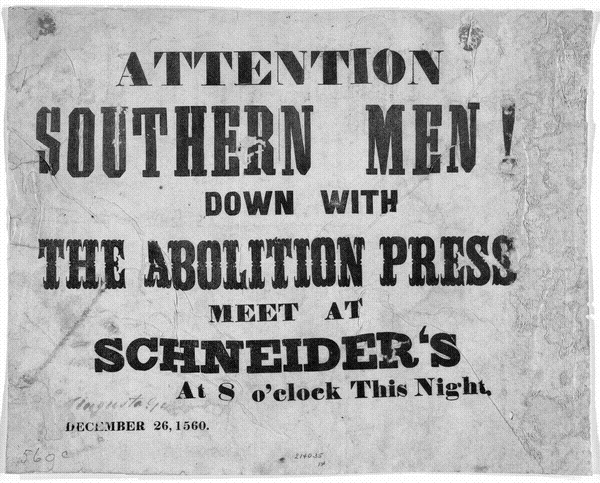
Across the South, abolitionist writings were banned, mail was censored, and rewards were offered for the capture of activists. Harriet Tubman’s was rumored at $40,000 — over a million dollars today — proof of how much her courage threatened the system.
Listen to the audio version.
Why It Matters
Slavery had divided America long before independence, but most citizens ignored it. The abolitionists were always a small, noisy minority — but they refused to be silenced.
In the South, they terrified planters more than they changed policy. But radicals like Garrison, Douglass, and John Brown made the South nervous enough to consider breaking away.
Even when the Civil War began, most northerners claimed they were fighting to preserve the Union, not to end slavery. But without the abolitionists — the loud, the brave, the uncompromising — America might never have faced its greatest hypocrisy or taken its first real step toward freedom.
Digging Deeper
Use the article to answer the questions below.
-
What goals did abolitionists have for ending slavery in the United States?
-
What methods did abolitionists use to spread their message and gain support?
-
How did slaveholders and pro-slavery leaders try to stop the abolitionist movement?
-
Why was the abolitionist movement important in the fight against slavery?
Copy and paste the questions onto a Word or Google Doc
Check out more great activities

Fire in the Republic: Abolitionist Council
The year is 1859. The Union is cracking. Fire in the Republic transforms your classroom into a nation on the brink as students join the Abolition Council to debate how to end slavery and keep the country from tearing apart. With faction fact sheets, a four-round simulation, and the Failed Compromises reading, students wrestle with moral conviction, political strategy, and the price of unity in one of the most intense debates in U.S. history.
Test Page