Teachers. Subscribe now and amaze exactly 0% of your friends, but you'll get great discounts and news!
THE HISTORY CAT

Listen to the audio version.
The American Republic was just a young pup when it decided to get involved in a second scrap with its former nemesis, Great Britain. The War of 1812 was a smaller part of a much larger conflict called the Napoleonic Wars. French Emperor Napoleon Bonaparte was busy trying to conquer Europe, the British were desperate to stop him, and neutral America was caught in the middle trying to make money off both sides.
The War of 1812 ended up— like other misfit conflicts such as the Spanish American War and the First Barbary War—in the junk heap of forgotten history. Well, we’re going dumpster diving to give this war the respect that it deserves.


Listen to the audio version.
Reasons for War
So, what actually caused the War of 1812? There were five main grievances, and they fed into each other.
The Embargo Act of 1807
The first was trade restrictions. Britain and France were at war in a conflict known as the Napoleonic Wars. Both countries made it illegal to trade with the other side. British warships seized American cargo ships heading to French ports. French warships seized American ships heading to British ports. American merchants were getting squeezed from both directions and there was nothing they could do about it.
Congress tried one alternative to war: the Embargo Act of 1807, which closed American ports to all trade with everyone. The idea was to inflict enough economic pain on Britain and France to force them to back off. Instead, it had the same effect as punching yourself in the face to win an argument. American exports crashed from $108 million to $22 million in a single year, and Britain and France barely noticed.
Impressment
The second was impressment. The Royal Navy needed tens of thousands of sailors to keep its massive war fleet running and couldn’t get enough volunteers, so press gangs boarded neutral ships and forced anyone suspected of being a British subject back into service. With maggot-infested food, brutal discipline, and horrible pay, it was no mystery why one-quarter of American sailors were actually British deserters in disguise.
So, the British began boarding any foreign ships it suspected of having runaway British sailors, point to a number of men they claimed were deserters, and haul them away. As many as 6,000 Americans were snatched from their ships, including three sailors from the USS Chesapeake, whose crew was fired on by the HMS Leopard simply for refusing to allow a search. John Adams put it plainly: “No nation can be Independent which suffers her Citizens to be stolen from her.” The British apologized for the Chesapeake but flat out refused to end impressment.

1780 caricature of a British impressment gang,
Listen to the audio version.
Conflict Over Native American Land
The third cause was the frontier conflict with Native Americans. In the early 1800s a familiar story was unfolding in the Old Northwest—Ohio, Michigan, and Indiana. Native American tribes were becoming increasingly worried about American settlers moving onto their land. One by one each native nation (Kickapoo, Shawnee, Lenape, Huron, and Miami) had collectively ceded millions of acres to the United States through treaties that were often negotiated through bribery, intimidation, or by dealing with tribal leaders who had no authority to sign away land that belonged to everyone.
These land deals caused a lot of tension between Indians and the newly arrived white settlers, pushing one Shawnee chief named Tecumseh to take action. Tecumseh was one of the most gifted military and political leaders in American history. His plan was to unite all of the Great Lakes tribes into a single confederation strong enough to permanently stop American expansion. His brother, known as The Prophet, provided the spiritual firepower, preaching that Indians needed to reject American culture and return to traditional ways. Together they built a settlement called Prophetstown in Indiana that became the nerve center of pan-Indian resistance.
So, when war with Britain became a real possibility, Tecumseh made a calculated decision: he would side with the British. Tecumseh understood the math. The Americans wanted Indian land. The British, on the other hand, needed Indian allies to defend Canada, and British agents promised that if they won the war, they would help establish a permanent Indian homeland— a buffer state between the United States and Canada where American settlers could not go. Tecumseh jumped at the deal and promised to fight with the British.
The Canada Issue
The fourth cause was the desire to annex Canada. War Hawks believed that seizing Canada would end British meddling on the frontier for good and open up vast new territory for American expansion.
National Pride
The fifth was wounded national pride— to the War Hawks, a country that let foreign navies kidnap its sailors and push its merchant ships around wasn’t really independent at all. It was just a former colony that hadn’t gotten the memo.

Map showing the general distribution of Native American tribes in the Northwest Territory at the time of the Northwest Indian War.
Credit: Drdpw
Wikipedia.
Listen to the audio version.
Fighting the War of 1812
By 1812, the War Hawks in Congress— led by Senator Henry Clay of Kentucky— were done with playing nice. Their solution to impressment, seized merchant ships, British-armed Indians, and wounded national pride was simple: invade Canada. Clay famously bragged that the Kentucky militia alone could conquer Canada. Not everyone was buying it.
The loudest opposition to war with Great Britain came from the Federalists of New England— the merchants, bankers, and shippers who, despite being the ones most directly hurt by the blockades and impressment, still preferred a bad peace over a ruinous war against the most powerful navy on earth. Some Federalists were so opposed they would later flirt with seceding from the Union entirely. The debate in Congress was ugly and bitter. When the final war vote came in June 1812, it passed the Senate by the narrowest margin in American history: 19 to 13. Not exactly a nation united. President Madison— described by witnesses as “white as a sheet” when the result was announced— had been pushed into a war that half the country didn’t want and the military wasn’t ready to fight.
The war got off to a great start… for the British. The Americans sent their declaration of war by regular mail— which meant some frontier forts learned they were at war only when British troops showed up to take them. The three-pronged invasion of Canada that Henry Clay had promised would be a cakewalk turned into one humiliation after another. At Detroit, a general so terrified of Tecumseh’s warriors that he surrendered the fort without firing a shot— his own men were so disgusted they had him court-martialed. At Niagara, the militia on the American side of the river watched their comrades get surrounded and simply went home. And the third column, aimed at Montreal, never crossed the border at all. The militia refused. It turned out that the farmers and lawyers who made up America’s fighting force were perfectly willing to defend their homes, but invading a foreign country? Hard pass. By the end of 1812, the score was British: everything, Americans: nothing.
That, folks, was how 1812 ended. In 1813 things got slightly less embarrassing. The Americans managed to push back a British offensive in Ohio, and during the fighting Tecumseh was killed— effectively ending the dream of a united Indian confederacy. With Tecumseh gone, the remaining tribes made separate truces with the United States, each one involving more land cessions. The power of the Great Lakes nations was effectively over. On a brighter note, the Americans pulled off one of the great upsets of the war when the USS Constitution demolished the HMS Guerriere in a broadside battle that left British cannon balls bouncing harmlessly off her hull. Hence the nickname “Old Ironsides.” Congress, suddenly remembering that navies were useful, voted the U.S. Navy a $2.5 million boost. The Americans also finally scored a win in Canada, capturing and burning York— present-day Toronto— including the parliament buildings of Upper Canada. It felt like a victory at the time. But that victory wouldn’t last.
By 1814, the Americans were being so badly beaten that the British were preparing terms of surrender that would transfer parts of Maine and Minnesota to British Canada as well as creating a permanent buffer zone out of Michigan, Indiana and half of Ohio for their Indian allies. Not only had the invasion of Canada been stopped cold in its tracks, the British army and navy was on full assault along the eastern seaboard of the United States. But, wait there’s more (bad news)! In 1814, Napoleon was defeated. The British could now turn their full attention and resources to crushing the Americans. Uh Oh.

Henry Clay and Andrew Jackson ride a War Hawk.
This is an AI generated image (obviously).

Major Battles of the War of 1812
Listen to the audio version.
The British Burn the White House
With the British blockade choking the American economy and New England states openly talking about seceding from the Union things hit rock bottom in August when 5,000 battle-hardened British regulars sailed up the Chesapeake Bay. Nobody seriously believed they would attack Washington D.C. I mean, who wastes their energy attacking a construction site covered in swamp water and dirt roads? Soldiers bent on avenging the burning of York, that’s who.
With all the professional soldiers busy failing to conquer Canada, there was literally nobody defending the capital. The British marched on Washington and the American militia, badly outmatched against veterans fresh from defeating Napoleon, broke ranks and fled.
When the British arrived at 8 p.m. they found the city more deserted than a vegan restaurant in Texas. Dolly Madison was still at the White House, refusing to leave without rescuing a portrait of George Washington that would have become British target practice. Clerks scrambled to save the Declaration of Independence and the Constitution. By nightfall, Madison watched from the hills as the White House, Congress, and the Library of Congress went up in flames.

Burning of the White House

Thanks to some quick finger pointing, Dolly Madison saves the portrait of Washington from becoming target practice. No wonder they named a snack cake after her.
Listen to the audio version.
The Treaty of Ghent
Across the ocean, in Ghent, Belgium, the British and Americans sat down to talk peace. All the old grievances hit the table— impressment, trade rights, Indian land. But with Napoleon defeated, most of the issues that started the war had already resolved themselves. The British, who had promised their Indian allies a permanent homeland, quietly dropped that demand when the Americans refused to budge. Impressment? Also dropped— the war was over, the Royal Navy didn’t need to impress anyone anymore. For months both sides stalled, waiting for a military victory to strengthen their hand at the table. Neither got one. So they split the difference and agreed to put everything back exactly the way it was before the war started.

This is what the U.S. would have likely looked like had it lost the War of 1812.
Listen to the audio version.
The Battle of New Orleans
While American and British diplomats were working on a peace treaty in Belgium, a British naval flotilla was heading straight for New Orleans with plans to seize the city and control the entire Mississippi River — cutting Americans off from the Louisiana Territory.
At the head of the American troops was future President Andrew Jackson, who had a plan: forget open battle — plant 4,000 men in the swamps outside the city and let the British come to them. Marching for miles through mosquito and snake-infested swamps to get there was considerably less fun for the British. Outnumbered 3 to 1, Jackson's men opened up a hail of fire from behind a dirt rampart and held their position, mowing down row after row of advancing redcoats. Two hours later it was over. The British commander was dead alongside two thousand of his men. The Americans had lost thirteen. The Battle of New Orleans didn't decide the outcome of the war, but it gave Americans a shot of national pride that had been missing since the Revolution — and made Andrew Jackson a hero.
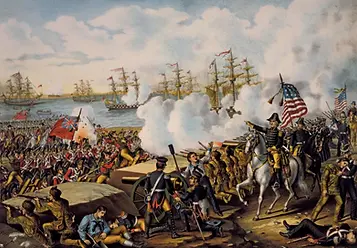
Battle of New Orleans
Listen to the audio version.
Why It Matters
In the end, the Treaty of Ghent puts everything back the way that it was before 1812. Officially both sides claimed victory, which means that both sides also equally lost. Call it a draw if you’re the optimistic type. Canada remained a British colony until 1931, but after the War of 1812 the Canadians began to think of themselves as more than just British subjects or colonials. The Americans picked up their westward expansion where they left off. Six new states were admitted to the Union between 1814 and 1820. This led to conflicts over slavery which would soon evolve into the American Civil War. The real losers of the conflict were the Native Americans. No Indian representatives had been invited to the peace talks. The British thought of sending out an Evite but the Americans argued that they weren’t a real nation. After the death of Tecumseh, dreams of a united Indian confederacy died. One by one tribes were forced to cede their land until finally all tribes east of the Mississippi River were either pushed west or rounded up and force marched in the Trail of Tears. Two centuries later, nearly everyone has forgotten about the little war that determined the fates of three peoples.
Digging Deeper
Use the article to answer the questions below.
-
What were five main causes of the War of 1812?
-
What happened when British forces attacked Washington, D.C.?
-
Describe one way ordinary Americans were affected by the War of 1812.
-
What happened to the Native peoples of the Northwest Territory after the war?
-
What problems or goals did the War of 1812 resolve for the United States?
Copy and paste the questions onto a Word or Google Doc
Test Page