Teachers. Subscribe now and amaze exactly 0% of your friends, but you'll get great discounts and news!
THE HISTORY CAT

Listen to the audio version
Ask most people what started the American Revolution and they’ll say the colonists got sick of being taxed to death. But, here’s the thing—the colonists weren’t exactly drowning in tax bills. In 1765, your average Virginian paid about five pence a year in taxes; while the average person living in London paid a whopping three hundred and twelve pence. So if it wasn’t the amount of taxes that got the colonists angry enough to overthrow their government, then what was it? The answer has less to do with money than with power—specifically, who had the right to take that money from you.
Listen to the audio version
Mercantilism: How the Economy Worked
To understand why a few taxes tore an empire apart, you first need to understand the world the colonists were living in. Britain ran its empire on an economic system called mercantilism — the idea that a nation grows powerful by selling more than it buys. The colonies existed to make that happen. Colonists grew the tobacco, cut the timber, and trapped the furs, but the Navigation Acts banned them from selling any of it directly to anyone else. A colonial merchant couldn’t just shop around and sell their goods to the French or Spanish, even if they were offering better prices.
Every shipment had to go through a British port first, where it was inspected and taxed. Then colonists loaded their ships back up with British manufactured goods (tools, fabric, furniture) and sailed home, where those goods were inspected and taxed again on the way in. Britain collected money coming and going, and colonists had no say in any of it.
Without competition, prices stayed higher than they otherwise would have, which hurt merchant profits. And so, many colonial merchants decided to do things the old fashioned way: illegal smuggling.


Mercantilism is an old economic system where countries tried to get rich and powerful by controlling trade. They believed they should sell more goods to other countries than they bought and collect as much gold and silver as possible. This often meant building colonies to get resources and sell products.
Unit 3: Countdown to Revolution
1755-1775

The Stamp Act Crisis
Stamp Act Lesson Plan for Grades 7-12
Listen to the audio version
Smuggling Gone Wild
By 1763, smuggling in the American colonies wasn’t a just side hustle—it was the economy. Somewhere between seventy and ninety percent of imports were being illegally snuck into colonial ports. Colonists bribed customs officials, hid barrels of French rum under piles of legal lumber, and secretly unloaded cargo at night in coves where no redcoat dared patrol. In many towns, smuggling was practically a community sport, and everyone from merchants to dockworkers had a stake in keeping it going.
What made this possible was weak enforcement. Customs officials were underpaid, understaffed, and often willing to look the other way for a small consideration (wink wink). Even Parliament knew all of this smuggling was happening. They had just chosen, for decades, not to do much about it. That was about to change.


Listen to the audio version.
Great Britain’s Money Problems
Britain’s problem wasn’t just that the colonists were cheating on their taxes. It was that Britain was also broke. The French and Indian War had ended in 1763 with a decisive British victory—France was pushed out of Canada, out of the Ohio Valley, out of most of North America. It was the greatest territorial expansion in the empire’s history. It also nearly doubled Britain’s national debt, which now stood at one hundred and twenty-nine million pounds, roughly twenty-one billion dollars today.
Parliament also decided to station ten thousand troops in America to maintain peace between colonists and Native Americans after the war. Someone had to pay for them. Enter Lord George Grenville, Britain’s new prime minister, who had very little patience for colonial loopholes. When he crunched the numbers, he found that British citizens at home were being taxed twenty-six times more than colonists in America. Raising taxes further in Britain would have meant pitchfork-wielding mobs in the streets of London. Grenville saw an obvious solution: make the colonies pay their share. The first step was shutting down the smuggling economy that had been bleeding Britain dry for years.

This chart shows how the income (green line) versus war debt (red line. Find two events that caused the biggest increase in Great Britain's national debt.
Listen to the audio version
The Sugar Act
In 1764, Parliament passed the Sugar Act. On the surface, it looked perfectly reasonable—the law actually cut the tax on molasses in half, from six pence per gallon to three. The idea was to make legal trade cheaper than smuggling, so merchants would stop cheating. But the catch was that Great Britain meant to enforce it.
Corrupt customs officials were replaced with stricter ones. Smugglers, instead of facing local juries who were often their neighbors and business partners, were sent to Admiralty courts—royal courts run by British judges with no jury at all. The law also expanded regulations on coffee, wine, and fine fabrics, and cut off colonial merchants from their trading partners in the French and Spanish Caribbean.
The tax itself wasn’t outrageous. But getting hauled before a British judge with no jury for not paying it? That was something new entirely. For the first time, Parliament was directly regulating colonial trade and denying colonists the right to be judged by their peers. Many merchants and political leaders recognized it as a warning: if Parliament could do this once, they could do it again. They were right.
Listen to the audio version
The Stamp Act
The Sugar Act had targeted merchants. The Stamp Act, passed in 1765, came for everyone. It placed a tax on almost anything printed on paper: legal documents, diplomas, land contracts, marriage licenses, wills, newspapers, pamphlets, and even playing cards. Every one of these items had to be printed on special stamped paper purchased from British tax collectors. Violators faced the same Admiralty courts—no jury, just a British judge in a powdered wig deciding your fate.
What made the Stamp Act different from anything before it was its reach. A farmer buying land, a printer running a newspaper, a lawyer drafting a will, a kid buying a deck of cards—everyone paid the tax. It wasn’t possible to live colonial life without touching something the Stamp Act taxed. Parliament assumed the colonists would grumble and pay up. Wrong again.

Under the Stamp Act, colonists had to pay a tax for anything printed on paper, which was then given a stamp to show that the tax had been paid.
Listen to the audio version
The Virginia Resolves
The organized resistance to the Stamp Act didn’t start in Boston (though Boston would certainly make up for lost time later). It started in Virginia. On May 29, 1765, a fiery young lawyer named Patrick Henry stood up in the Virginia House of Burgesses and made an argument that would echo through the next decade: Parliament had no right to tax the colonies. That power belonged exclusively to colonial legislatures, whose members were elected by the people being taxed. Henry went further, warning that a king who behaved like a tyrant might meet the same fate as other tyrants—he named Julius Caesar and Charles I, both of whom had been killed by their own people.
The room erupted. Shouts of “Treason!” came from multiple directions. In 1765 treason could get you executed. But, Henry didn’t flinch. “If this be treason,” he said, “make the most of it.”
Virginia adopted five resolutions arguing that colonists held the same rights as people living in Britain, that those rights included being taxed only by their elected representatives, and that only the Virginia Assembly had the legal authority to tax Virginians.

Patrick Henry delivers his fiery anti taxation speech before the Virginia legislature. It was during this speech that he said the famous word: "Give me liberty, or give me death".
Word spread fast as newspapers reprinted the Virginia Resolves up and down the coast. By the time the news reached Parliament, the Virginia Resolves were already being argued over in taverns from Massachusetts to South Carolina.
Parliament responded by saying that the colonists had virtual representation—the idea that every member of Parliament represented all British subjects everywhere, not just the voters who actually elected them. Under this logic, the colonists already had representation in Parliament, even though they’d never voted for a single member of it. Colonists found this argument insulting and ridiculous. The men deciding colonial tax policy had never set foot in America, had no business interests there, and would never feel the consequences of the laws they passed. That was taxation without representation, and no amount of legal wordplay was going to make it sound like anything else.
Listen to the audio version.
The Sons of Liberty
In Boston, a secret society calling itself the Sons of Liberty organized to fight British taxation from the ground up. Officially the group had no leadership, but men like Samuel Adams, John Hancock, and Paul Revere went down in history as known members. Being an underground organization, the Sons held their meetings beneath liberty trees, in taverns, and in private homes—anywhere they could talk without British officials listening in. In hindsight, gathering a crowd beneath an oak tree doesn’t seem like it would be the best place to hold a secret meeting — but who are we to judge?
Their most famous rallying cry, “No Taxation Without Representation,” summed up the colonist’s main complaint: since they had no vote in Parliament, Parliament had no business reaching into their pockets. Sons of Liberty chapters began popping up across all thirteen colonies, and officially their goals were peaceful—organizing boycotts, circulating pamphlets, and pressuring merchants to refuse British goods until the Stamp Act was repealed. Women joined the cause as the Daughters of Liberty, spinning homemade cloth rather than buying British fabric and turning the boycott into something that ran through every household in the colonies.
But the Sons of Liberty had a darker side. The organization has been accused of inciting drunken mobs to intimidate tax collectors and anyone else they considered an ‘enemy of liberty’, and the evidence suggests the accusations were fair.
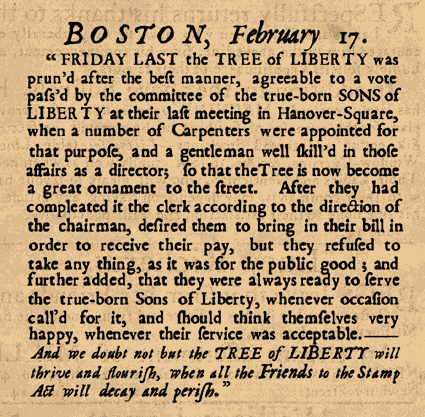
A Boston newspaper report on the ‘Tree of Liberty’, an important rallying point
Listen to the audio version.
Tax Collectors Become Targets
Tax collectors became particular targets for an obvious reason—you can’t collect taxes if nobody’s willing to take the job. The Sons of Liberty started with effigy burning, a colonial tradition that involved decorating a straw dummy to look like your least favorite government official, hanging it from a Liberty Tree while a crowd pelted it with rocks, chopping its head off, and tossing the whole thing into a bonfire.
As mobs usually go, the drunker they got, the less the protest stayed peaceful. In Boston, an angry crowd broke into Governor Thomas Hutchinson’s house while he and his family were having dinner, ransacked the place, looted his wine cellar, and used his expensive furniture for bonfire fuel. The Hutchinsons barely escaped out the back door. The same treatment went to Andrew Oliver, the man appointed to collect taxes for Massachusetts—his office was torn down and his house destroyed. Fearing for his life, Oliver quit and sailed back to England.
For those who still didn’t get the message, the Sons of Liberty had one more card to play: tar and feathering. It sounds almost cartoonish until you understand what it actually involved. Hot pine tar was poured over the victim while a mob decorated him with feathers, then marched him through the streets to give everything time to cool and harden. The cleanup was worse than the application—layers of skin and hair came off with the tar, leaving painful rashes and open sores. Many people called it barbaric. Sam Adams fired back that if Parliament hadn’t passed unconstitutional taxes, none of it would be happening.
%2C_The_Bostonians_Paying_the_Excise-man%2C_or_Tarring_and_Feathering_.jpg)
Colonial print called "The Bostonians Paying the Excise-man, or Tarring and Feathering."
Artist: Phillipe Dawe. October 31, 1774.
Listen to the audio version.
The Stamp Act Congress
While the Sons of Liberty were busy in the streets, colonial leaders decided it was time to make their case the respectable way. In October 1765, delegates from nine of the thirteen colonies packed their bags and headed to New York City for what became known as the Stamp Act Congress—the first time the colonies had ever sat down together to hash out a response to British policy. The delegates were mostly lawyers, merchants, and assemblymen, not radicals. Many of them still considered themselves loyal British subjects who just wanted Parliament to back off.
What they produced was a letter called the Declaration of Rights and Grievances that said that Parliament could regulate trade, but taxing the colonies directly without their consent was unconstitutional. They signed it, packaged it up, and sent it to the king. And just like writing a letter to your elected officials today, both King George III and Parliament ignored it. Some things never change.

Artists Unknown. Woodcut of a Stamp Act protest.
Listen to the audio version.
The Declaratory Act
In March 1766, Parliament repealed the Stamp Act and the colonists went absolutely nuts. The Sons of Liberty threw parties in the streets, church bells rang out across the colonies, and colonists raised their glasses to toast King George III's health (oh, the irony). It felt like a total victory. After months of boycotts, street protests, and formal legal challenges, the American colonists had actually forced the most powerful legislature in the world to back down. Score one for the little guy, right?
Well, not exactly.
Parliament had attached a little something extra to the Stamp Act repeal. On the very same day they repealed the hated tax, they passed something called the Declaratory Act. And what did this act declare? That Parliament held full and complete authority to make laws binding the American colonies "in all cases whatsoever."
Let that sink in for a moment. "In all cases whatsoever." That's about as broad as you can get.
Parliament wasn't admitting they'd been wrong about the Stamp Act. They weren't saying "Oops, our bad, we shouldn't have tried to tax you without representation." Nope. They were simply dropping the one specific tax that had caused all the trouble while making absolutely certain everyone understood they still had the authority to pass another tax whenever they felt like it. Think of it like your parents grounding you, then lifting the grounding but adding "just so we're clear, we can ground you anytime we want for any reason we want."
The colonists had won the battle against the Stamp Act, but Parliament had just made it crystal clear they hadn't won the war over who actually had the power to govern them.
Listen to the audio version
Why It Matters
The Stamp Act crisis taught both sides some valuable lessons. The colonies learned that when they acted together—boycotts, street pressure, a unified legal argument—they could force the most powerful legislature in the world to back down. Britain learned that backing down looked like weakness, and decided it wouldn’t happen again.
Digging Deeper
Use the article to answer the questions below.
-
What does the phrase “No Taxation Without Representation” mean in the context of the American colonies?
-
Describe the Stamp Act and Sugar Act.
-
Describe how colonists responded to taxes like the Stamp Act and Townshend Acts.
-
What were the Virginia Resolves, and how did they challenge British authority in the colonies?
Copy and paste the questions onto a Word or Google Doc
Test Page