Teachers. Subscribe now and amaze exactly 0% of your friends, but you'll get great discounts and news!
THE HISTORY CAT

Unit 2: Colonial America
1650-1755

Motivations for Colonization
Colonization Lesson Plan Grades 7-12
Listen to the audio version.
Let’s be honest—moving across the ocean in the 1600s wasn’t exactly a vacation. You didn’t hop on a ship for the legroom or gourmet meals. You were crammed into a wooden tub with rats, bad water, and seasickness as your daily reality. So why did hundreds of thousands of Europeans leave behind everything they knew and head for the unknown?
Historians explain the reasons why people emigrate using push factors and pull factors. Push factors are the reasons people wanted out of Europe—things like war, famine, poverty, overcrowding, and a legal system that kept land locked up in the hands of the elite. Pull factors were what drew them across the Atlantic—cheap land, new opportunities, and the promise of freedom (or at least fewer rules). Some were chasing wealth. Others were avoiding a prison sentence. Some wanted to worship freely. And more than a few were just trying not to starve.
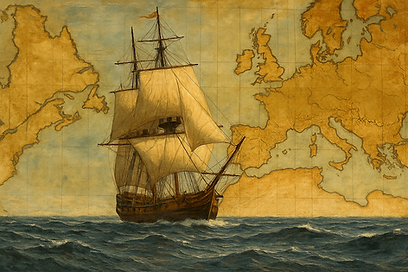
It's estimated that about 1.3 to 2 million people were brought to or migrated to North America between 1600 and 1775.
This is the story of how the British colonies went from a swampy beachhead in Virginia to a string of colonies stretching up and down the Atlantic coast. In 1607, they had just over a hundred settlers clinging to life in Jamestown. By 1775, there were over 1.3 million colonists of European descent living in British North America. The growth was anything but smooth. Colonies failed. Wars broke out. People starved, froze, rebelled, and died. But year after year, more ships came. Some carried families, others brought debtors, laborers, or prisoners. What started as a few scattered outposts turned into towns, ports, and sprawling farming settlements—and by the 1700s, Great Britain had built one of the most powerful colonial empires in the world.
Listen to the audio version.
Land, Land, and More Land
In Europe, land was everything—it meant wealth, status, political power, and the right to make decisions in your community. But most land was locked up in the hands of wealthy nobles, the Church, or the Crown. Ordinary people worked the land but didn’t own it. And thanks to English inheritance laws—especially primogeniture, where the oldest son inherited the entire estate—younger sons were often left with nothing but a family name and a suitcase.

In the colonies, the situation was completely different. The New World offered something Europe didn’t: land people could actually own under their own name. Colonial leaders wanted to fill empty settlements fast, so they rolled out offers that sounded too good to be true. Under the headright system, introduced in Virginia in 1618, anyone who paid their way across the Atlantic got 50 acres of land—plus another 50 acres for every additional person they brought with them. That meant a wealthy planter could rack up thousands of acres just by importing laborers, while even poor settlers who finished their time as indentured servants were often promised land of their own—typically 25 to 100 acres, depending on the colony and local conditions.
For many, that was enough. They packed up and crossed the Atlantic because life in Europe offered no future. There was no land to inherit, no way to move up, and no real chance to change their circumstances. In the colonies, people saw a chance to build farms, raise families, and live on land that belonged to them—not some lord collecting rent. But the pull was real—and it was enough to draw hundreds of thousands of people to settle in the New World.
Listen to the audio version.
Religion and the New World
In the 1600s, England wasn’t exactly a safe place to practice your faith—unless you were doing it the “official” way. The Church of England had one rule: follow the program or face the consequences. People who believed the church was too Catholic, or not Catholic enough, could end up in court, in jail, or worse.
For many, the solution was simple: leave. The New World was wild and unpredictable, but it offered something England didn’t—room to build new communities where people could worship in their own way. So, across the Atlantic they went, carrying hopes for freedom, faith, and maybe a fresh start.
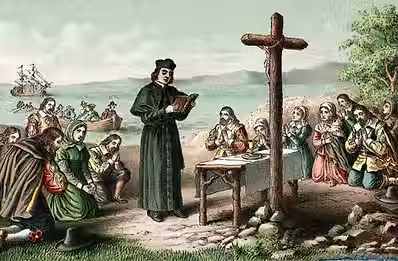
The Puritans
The Puritans wanted to strip away Catholic influences and return to a more “pure” form of Christianity. They disliked rituals, stained glass, priestly robes—anything they thought made worship feel more like a performance than a connection to God. For a while they even outlawed Christmas. They wanted plain churches, long sermons, and strict moral behavior.
When they came to New England, they were building what they saw as a model Christian society. Their leader, John Winthrop, described it as a “city on a hill”—a community that would serve as a shining example of godly living for the rest of the world. In Massachusetts Bay Colony, religion wasn’t just important—it was the law. There was no separation of church and state. Missing church could earn you a fine. Criticizing a minister might get you banished.
That’s what happened to Roger Williams, who argued that church and government should be separate—and that colonists had no right to take Native American land without paying for it. That kind of thinking didn’t go over well. He was kicked out and later founded Rhode Island, a rare colony that offered real religious freedom.
Anne Hutchinson clashed with Puritan leaders for challenging the colony’s religious teachings—and even worse, she did it publicly, as a woman. She believed that faith alone was enough for salvation and criticized ministers who taught that strict behavior was the key to God’s favor. She held meetings in her home to share her views, attracting a following and raising concern among the colony’s leadership. In 1637, she was put on trial for heresy and banished. Like Williams, she found refuge in Rhode Island.
So, while the Puritans came seeking freedom, they weren’t too eager to extend it to people with different beliefs—even if those people were their neighbors.
Quakers in Pennsylvania
The Quakers, or Religious Society of Friends, had a very different approach. They believed that every person had an “inner light” from God—so no need for priests, rituals, or even sermons. Just quiet meetings and reflection.
This didn’t go over well in England. Or in Puritan Massachusetts. Quakers were harassed, jailed, and sometimes executed for preaching peace and equality.
Then along came William Penn, a wealthy English Quaker who had a bold plan: start a colony where Quakers and other persecuted groups could live in peace. The king (who owed Penn’s dad money) granted him a huge chunk of land, and in 1681, Pennsylvania was born.
Unlike most colonies, Pennsylvania offered religious tolerance from the beginning. Quakers welcomed people of all faiths—yes, even the ones they didn’t agree with—and tried to live peacefully with Native Americans too. It was weirdly progressive for its time… and kind of amazing that it worked as well as it did.
Catholics in Maryland
After King Henry VIII split from the Catholic Church back in 1500s, life for English Catholics got harder. They were banned from public life, restricted from schools, and sometimes targeted for simply attending Mass.
To escape these pressures, Lord Baltimore (George Calvert) helped found Maryland in 1632 as a safe place for Catholics. Early on, it offered rare religious tolerance—but it didn’t last. Protestants eventually became the majority, and Maryland swung back and forth between inclusion and persecution. Still, for a brief time, it gave Catholics something they hadn’t had in England: space to worship openly.
Jews in the New World
Unlike the Puritans, Quakers, or Catholics, Jewish settlers didn’t come from England. Most were Sephardic Jews from Spain and Portugal, fleeing the long arm of the Inquisition—a brutal system of religious courts that targeted Jews for centuries.
There were no grand plans to build a religious utopia—just a hope to worship in peace and maybe run a successful business without getting exiled every other generation. Even in the colonies, Jews faced restrictions. They couldn’t vote, hold office, or always worship publicly. But compared to Europe, it was progress. Over time, Jewish merchants and tradesmen became part of the colonial urban scene, especially in port cities like New York, Charleston, and Philadelphia. Their presence helped lay the groundwork for a more religiously diverse society—even if it was still a long way from actual equality.
Listen to the audio version.
Why It Matters
The people who came to colonial America didn’t all want the same thing. Some came for religious freedom, others for land or trade. Some were forced here through slavery. Each group brought different beliefs, cultures, and goals—and they built very different types of colonies. New England’s towns looked nothing like the plantations of the South, and Pennsylvania’s tolerance didn’t match the strict laws of Massachusetts.
Because the colonies started with such different foundations, they developed distinct economies, cultures, and ways of life. A person from Virginia had little in common with someone from Massachusetts or New York. Most people thought of themselves first as Virginians or Pennsylvanians—not as “Americans.”
These differences made it hard for the colonies to unite. Even during the American Revolution, it took serious effort to get them to work together. But at the same time, the variety of people and ideas in early America became one of its greatest strengths. Understanding how—and why—these different communities formed helps explain both the challenges and the potential that shaped the United States from the very beginning.
Digging Deeper
Use the article to answer the questions below.
-
What economic goals motivated European nations to explore and colonize new lands?
-
How did religious beliefs or the desire to spread Christianity influence colonization?
-
How did competition between countries like Spain, France, and England push them to claim land in the Americas?
-
Why was expanding trade an important reason for building colonies?
Copy and paste the questions onto a Word or Google Doc
Test Page