Teachers. Subscribe now and amaze exactly 0% of your friends, but you'll get great discounts and news!
THE HISTORY CAT


Unit 19: The Civil Rights Movement
1945-1970
Freedom Riders
Civil Rights Protests Lesson Plan | Grades 7-12
Inspired by the Sit-Ins seven black and six white riders boarded two buses in Washington D.C. May 4, 1961, to fight bring the fight to the next level. Their destination: the deeply segregated city of New Orleans. Like Mahatma Gandhi had done in India, these “Freedom Riders” were about to embark on their own March to the Sea. The thirteen riders had been training for weeks in defense tactics— like how to take a beating while protecting your face. The Riders expected violence. If they were lucky, in the thinking of organizer James Farmer, they would be beaten and arrested to expose the ugly face of racism. They even brought along a few journalists to broadcast the violence to the world. The white supremacists didn’t disappoint.
Aside from a run-in with the Klan in South Carolina, the first leg of the journey into Atlanta was surprisingly calm. The Freedom Riders had violated the interstate segregation laws by having blacks and whites sit next to one another on the buses. At the stations, blacks and whites used restrooms that were off limits to their race, and blacks ordered from segregated counters in the whites-only waiting room.

In Atlanta, the riders were greeted with a hero’s welcome. But Dr. Martin Luther King Jr. warned one of the reporters that they would never make it out of Alabama. Like a psychic, King’s prediction was dead on. One of the buses— the Greyhound – was the first to reach Anniston, Alabama. There they were met by a mob of angry white supremacists who attacked the bus with bats, metal pipes, and clubs.
The mob slashed the tires, smashed windows with rocks and brass knuckles. Under a police escort (that was none too quick to show up in the first place) the bus took off, making it only a few miles down the road before a flat tire forced them to pull over. There, the police escort suddenly disappeared and a white mob materialized. The riders barricaded themselves in the bus until someone threw a Molotov cocktail into the bus –causing the gas tank to explode. The riders were trapped inside a burning vehicle while the crowd screamed: “burn them alive””. As the riders ran from the burning bus, the crowd mercilessly beat them with their fists, baseball bats, and clubs. It took an undercover highway patrolman who was on board to protect the riders. The second bus arrived in Anniston an hour after the Greyhound had been attacked. This time the bus was hijacked by Klansmen who forcibly segregated the bus. One white rider was beaten so severely that he suffered a stroke and was paralyzed for the remainder of his life.
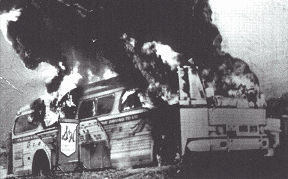
Greyhound Bus torched outside of Anniston, Alabama
Freedom Riders
When the second bus arrived in Birmingham, Alabama another crowd was there to greet the Freedom Riders. More blood flowed as every member of the bus was severely beaten, including the journalists. The police didn’t show up for a full ten minutes to give the Klan enough time to do its work. Bull Connor--the police commissioner who had turned fire hoses on black school children a few years before-- made some lame excuse about it being Mother’s Day.
Six months later, Ralph Fetig— a white Freedom Rider—addressed a crowd from the steps of Mississippi’s Parchman Penitentiary. Like several of his fellow Freedom Riders, he had been released from six months of what only can be described as pure hell. Every one of his ribs had been broken in the Klan beating. He had been abused by guards, slept on the floor of his cell after his mattress had been taken for singing freedom songs. With tears streaming down his face he looked at the African-Americans in the crowd and asked: “how do you keep from hating white folks?” Every person onboard that second Freedom Bus had been given a beating as severe as the first. Some members had their teeth kicked in, one had flammable liquid poured over him and was lit on fire, some were beaten unconscious.
The first Freedom Ride had been a national embarrassment forcing President Kennedy and his brother, Secretary of State, Bobby to take action. After all, the Soviet Union— which was known for its own terrible human rights record— was calling the United States a hypocrite for calling itself the guardian of democracy and freedom while millions of Americans lived as second-class citizens. On September 22, 1961, President Kennedy gave the order for the Interstate Commerce Commission to ban segregation in interstate highway facilities. The “WHITE ONLY” and “COLORED ONLY” signs came down. In 1964, after dozens more marches and protests, Congress finally defied their southern colleagues and passed the Civil Rights Act which banned discrimination on the basis of color, nationality, and creed. This was the most sweeping action in promoting equality since Reconstruction. The Sit-Ins, the Freedom Rides, the marches into Birmingham, the jailings, the beatings, and even murder is what brought down Jim Crow. Like in India and South Africa, civil disobedience proved that peaceful protest could stand up to the most vicious act of violence— and win.
 freedom riders leaving from DC |
|---|
 police brutality birmingham-1963 |
 jim crow protest and counter protest |
 jim zweg beating |
 little rock black man being beaten |
 freedom_riders_pic_klan_beatings |
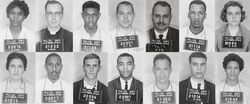 freedom riders arrested in Jackson, MS.jpg |
 Fankhauser hospitalized |
 freedom riders under national guard |
 Birmingham_campaign_water_hoses 1963 |
 freedom bus escort |
Digging Deeper
Use the article to answer the questions below.
-
What was the purpose of the Freedom Riders during the Civil Rights Movement?
-
How did segregation in interstate bus travel affect African Americans before the Freedom Rides?
-
What dangers and violence did Freedom Riders face on their journeys through the South?
-
Why were Freedom Riders arrested in places like Birmingham and Jackson, Mississippi?
-
How did federal authorities respond to the attacks and arrests of Freedom Riders?
Copy and paste the questions onto a Word or Google Doc
Test Page