Teachers. Subscribe now and amaze exactly 0% of your friends, but you'll get great discounts and news!
THE HISTORY CAT


Unit 19: The Civil Rights Movement
1945-1970
Montgomery Bus Boycott
& The Freedom Riders
Civil Rights Lesson Plan | Grades 7-12
Listen to the audio version.
The Long Road to Justice: From Montgomery to the Freedom Riders
The battle for civil rights was fought on many fronts—classrooms, courtrooms, and lunch counters—but few battlegrounds were as personal or as dangerous as the seats of a public bus. While the Supreme Court had technically started the process of ending segregation in schools, the "Jim Crow" reality of daily life in the South meant that for most Black Americans, the world stayed separate and unequal. It started with a single act of defiance in 1955 and grew into a decade-long struggle that proved legal victories on paper didn’t mean much unless there were people brave enough to put their lives on the line to enforce them.
Listen to the audio version.
The Bus Ride That Changed History
At 6:00 p.m. on the evening of December 1, 1955, Rosa Parks ended her shift as a seamstress at the Montgomery Fair department store. She boarded the Cleveland Ave. bus and headed home. But Parks didn’t make it home. Instead, she made history. As you might already know Parks was arrested that night for refusing to give up her seat to a white passenger. At that time, Montgomery, Alabama was one of the most segregated cities in the South. The city had laws that segregated churches, schools, restaurants, parks, drinking fountains, and even playing a game of checkers was banned between whites and blacks.
But the law that would make the history books was the segregation of buses. Whites were given the front four rows, blacks the rear seats. The middle seats, however, could be taken by anyone so long as a black person did not sit in front or across the aisle from a white person. It’s amazing how much thought and energy segregationists put into trying to keep people apart. A few stops later the bus had filled its seats and the bus driver, James Blake, moved the colored sign one row back. When Blake moved towards Parks’ aisle and demanded their seats three blacks seated in the same row as Parks immediately followed custom and got up without a word. But, Parks stayed where she was. When the bus driver asked her why she didn’t move, Parks replied: “I don’t think I should have to”. Parks knew full well that the Montgomery legal system– the police, the courts, the mayor, the governor, even her employers at the department store–had the upper hand. But Parks was tired of being pushed around.
“People always say that I didn't give up my seat because I was tired, but that isn't true. I was not tired physically, or no more tired than I usually was at the end of a working day. I was not old, although some people have an image of me as being old then. I was forty-two. No, the only tired I was, was tired of giving in”
For years African Americans in Montgomery and other southern cities endured a humiliation that cuts to the bone. The humiliation of being treated less than a person in your own country. The bus drivers in Montgomery especially had a nasty reputation of abusing their black customers. They often called them names, hollered, and cursed them for the slightest offense. Rosa Parks recalled one time when she got on the bus in the front to pay her fare she was told that she could not walk down the aisle to the back of the bus. Montgomery also had a law that black passengers couldn’t walk past whites on a bus. After paying her fare she was forced to get back off and enter through the rear door. But before she could re-board the bus driver, none other than James Blake had driven off leaving her standing in the rain and 10 cents shorter.


Rosa Parks, being arrested by the Montgomery police department for insubordination and violating segregation laws.

15 year old Claudette Covin, only a few months before Parks, had also refused to give up her seat on a Montgomery city bus. Because of her age, the NAACP decided not to use her in it's legal fight against segregation.
Listen to the audio version.
The Montgomery Bus Boycott
Rosa Parks' arrest didn't just make headlines — it lit a fuse. Within days, Black community leaders in Montgomery had organized a boycott of the city bus system, and what began as a one-day protest would stretch into one of the most sustained acts of collective defiance in American history.
The boycott officially kicked off on December 5, 1955, a typical Monday morning in Montgomery. Many thought it wouldn't work. One local pastor, Rev. Martin Luther King Jr., sat with his wife watching out of his living room window to see what would happen. When the first bus rode by, King was elated — it was completely empty. Black residents made up 70% of the city's bus riders, because few could afford to own a car. White city leaders were sure the boycott would collapse. Montgomery was experiencing one of the coldest winters in memory, with temperatures dropping below freezing. It was only a matter of days, they figured, before people got tired of walking and gave in. But that didn't happen.
What made Parks remarkable wasn't just that she refused to give up her seat — she did it knowing exactly what an angry, racist system would do to her for it. True courage always comes at a price. For the next 381 days, Parks, King, and thousands of unnamed people would keep paying it.
Most Black residents chose to walk. Those with cars formed carpools and offered discounted taxi rides. Churches were converted into makeshift bus stops. Along the way, boycotters endured insults from angry white drivers. Police ticketed and arrested Black taxi and carpool drivers on bogus charges — King himself was arrested for driving 30 in a 25 mph zone. The city tried invoking an obscure 1921 state law to arrest the movement's leaders. Parks and King received threatening phone calls nightly. King's house was bombed. The KKK drove through Black neighborhoods shouting threats. Parks' husband was forced to quit his job after his employer told him he could not speak about his wife. Parks herself was let go from the Montgomery Fair Department Store — though she maintained this had nothing to do with the boycott and considered her employer an honest man. She fell deeply into debt, relying on the charity of friends and neighbors. By her own account, these were the darkest days her family had known.

Like thousands of African-Americans, this Montgomery woman is hitch-hiking to support the bus boycott.

Montgomery city bus with a lone passenger aboard.
Listen to the audio version.
A Win For Integration
The city council refused to budge, but the boycott was doing its work. White Montgomery was feeling the impact too. Black residents had stopped shopping downtown. The bus company, hemorrhaging money, raised its fare to 45 cents — which enraged white riders. The people who had counted on Black Montgomerians to stay quiet were discovering that their economy depended on them.
The pressure was attracting international attention. Reporters from across the country and as far away as Europe descended on Alabama. State leaders maintained their usual line — that outside agitators and communists were stirring up trouble — but the truth was harder to spin with cameras rolling. In February 1956, the case of Browder v. Gayle reached the courts. Parks had become the face of the movement, but she was one of four plaintiffs challenging Montgomery's segregation laws, and the legal case was bigger than any one of them.
In November 1956, the Supreme Court ruled that segregation on public transportation was unconstitutional. On December 20, Parks, King, and other Black leaders boarded an integrated Montgomery bus. The driver that day was none other than James Blake — the same man who had demanded Parks give up her seat thirteen months earlier. He smiled politely and welcomed them aboard. King had come to Montgomery an unknown pastor. He left with a playbook. What worked here — the organization, the discipline, the refusal to meet violence with violence taught King that non-violent direct action could win. King took that lesson and built a movement around it. The marches, the sit-ins, the freedom rides that followed were all shaped by what ordinary people in Montgomery had shown was possible when they simply refused to cooperate with an unjust system.
"I have learned over the years that when one's mind is made up, this diminishes fear; knowing what must be done does away with fear."
-- Rosa Parks
Listen to the audio version.
The Freedom Riders
The victory in Montgomery proved that the law could be changed, but court rulings meant little without enforcement. In the five years that followed, much of the Deep South simply ignored the Supreme Court's orders — and the federal government largely let them. A 1960 ruling had extended desegregation to interstate bus terminals across the country, yet "WHITE ONLY" signs still hung in stations from Georgia to Louisiana as if the decision had never happened. Winning in court was only half the battle. A new group of activists decided the other half meant showing up in person.
By 1961, the civil rights movement had become something more than organized — it had become disciplined. Groups like the Congress of Racial Equality (CORE) had developed rigorous training programs grounded in nonviolent direct action. Protesters were taught to remain calm under provocation, to protect themselves without retaliating, to go limp rather than fight back when arrested. The same training was already being put to use at lunch counter sit-ins across the South, where Black students sat quietly at whites-only counters while being screamed at, doused with condiments, and dragged from their seats. Trainers played the role of aggressors — shouting slurs, shoving, dumping food on participants — while recruits practiced staying seated, covering their heads, and not responding. They ran the scenarios over and over until the physical response became automatic.
On May 4, 1961, thirteen riders — seven Black and six white — boarded two buses in Washington D.C. Their destination: the deeply segregated city of New Orleans.
Like Mahatma Gandhi had done in India, the Freedom Riders were embarking on their own march to the sea. They had spent weeks in CORE's training program, drilling in nonviolent tactics, including how to shield themselves while absorbing a beating. The Riders expected violence. If they were lucky, in the thinking of organizer James Farmer, they would be beaten and arrested — putting the ugly face of racism on the front page for the world to see. They brought journalists along to make sure of it.
Aside from a confrontation with the Klan in South Carolina, the first leg into Atlanta was surprisingly calm. The Riders violated interstate segregation laws at every stop — Black and white passengers sitting together on the buses, using restrooms that were off limits to their race, Black riders ordering from whites-only counters. In Atlanta, they were greeted as heroes. Dr. Martin Luther King Jr., who met them there, pulled one of the journalists aside with a warning: they would never make it out of Alabama.

Listen to the audio version.
Things Turn Violent
In Atlanta, the riders were greeted with a hero’s welcome. But Dr. Martin Luther King Jr. warned one of the reporters that they would never make it out of Alabama. Like a psychic, King’s prediction was dead on. One of the buses— the Greyhound – was the first to reach Anniston, Alabama. There they were met by a mob of angry white supremacists who attacked the bus with bats, metal pipes, and clubs.
The mob slashed the tires, smashed windows with rocks and brass knuckles. Under a police escort (that was none too quick to show up in the first place) the bus took off, making it only a few miles down the road before a flat tire forced them to pull over. There, the police escort suddenly disappeared and another white mob materialized. The riders barricaded themselves in the bus until someone threw a Molotov cocktail into the bus –causing the gas tank to explode. The riders were trapped inside a burning vehicle while the crowd screamed: “burn them alive””. As the riders ran from the burning bus, the crowd mercilessly beat them with their fists, baseball bats, and clubs. It took an undercover highway patrolman who was on board to protect the riders. The second bus arrived in Anniston an hour after the Greyhound had been attacked. This time the bus was hijacked by Klansmen who forcibly segregated the bus. One white rider was beaten so severely that he suffered a stroke and was paralyzed for the remainder of his life.
When the second bus arrived in Birmingham, Alabama another crowd was there to greet the Freedom Riders. More blood flowed as every member of the bus was severely beaten, including the journalists. The police didn’t show up for a full ten minutes to give the Klan enough time to do its work. Bull Connor--the police commissioner who had turned fire hoses on black school children a few years before-- made some lame excuse about it being Mother’s Day.
Six months later, Ralph Fetig— a white Freedom Rider—addressed a crowd from the steps of Mississippi’s Parchman Penitentiary. Like several of his fellow Freedom Riders, he had been released from six months of what only can be described as pure hell. Every one of his ribs had been broken in the Klan beating. He had been abused by guards, slept on the floor of his cell after his mattress had been taken for singing freedom songs. With tears streaming down his face he looked at the African-Americans in the crowd and asked: “how do you keep from hating white folks?” Every person onboard that second Freedom Bus had been given a beating as severe as the first. Some members had their teeth kicked in, one had flammable liquid poured over him and was lit on fire, some were beaten unconscious.
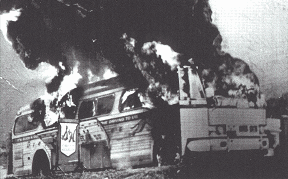
Greyhound Bus torched outside of Anniston, Alabama
 freedom riders leaving from DC |
|---|
 police brutality birmingham-1963 |
 jim crow protest and counter protest |
 jim zweg beating |
 little rock black man being beaten |
 freedom_riders_pic_klan_beatings |
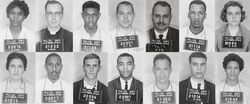 freedom riders arrested in Jackson, MS.jpg |
 Fankhauser hospitalized |
 freedom riders under national guard |
 Birmingham_campaign_water_hoses 1963 |
 freedom bus escort |
Listen to the audio version.
The Feds Step In
The first Freedom Ride was a national embarrassment, and it put President Kennedy in a corner. They needed Southern votes to pass their laws, but they were also locked in a global scrap with the Soviet Union. The Soviets used images of burning buses to tell the rest of the world that American democracy was a sham. Kennedy realized that every photograph of an angry mob attacking peaceful protesters was a win for Soviet propaganda, and he couldn't afford to look weak on the world stage.
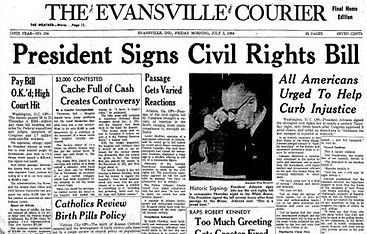
The Evansville Courier headline describes the signing of the Civil Rights Act of 1964 by President Lyndon Johnson.
On September 22, 1961, Kennedy finally told the Interstate Commerce Commission (ICC) to get moving and enforce its own rules. Those "WHITE ONLY" and "COLORED ONLY" signs that had cluttered up Southern stations for decades finally started coming down. For the first time, a Black passenger could legally sit anywhere on a bus and walk through the front door of a terminal—and they had a federal order to back them up.
But a ruling about bus seats wasn't the same thing as true equality. It took three more years of non-stop pressure—Freedom Rides, mass arrests, the March on Washington, and the assassination of Medgar Evers, a civil rights leader shot in his own driveway in Mississippi—before Congress was finally forced to act. In 1964, they stood up to their Southern colleagues and passed the Civil Rights Act, banning discrimination based on race or religion. It was the biggest leap forward since Reconstruction. Just like in India and South Africa, it proved that peaceful protest could overcome violent resistance.
Listen to the audio version.
Why It Matters
Rosa Parks didn't change the law just by writing a polite letter to her congressman. The Freedom Riders didn't desegregate bus terminals by filing a lawsuit and waiting for a judge to get around to it. They broke Jim Crow by refusing to play along with a system that treated them like they weren't human—and they did it in public, where everyone had to watch. Direct action works because it forces people to look at parts of the country they’d rather ignore. Every time a bus was burned or someone walked miles to work in the freezing cold, it forced the country to answer a question it had been trying to dodge for a century.
The Civil Rights Act of 1964 was what finally happened when the government couldn't ignore that pressure anymore. It made it illegal to turn someone away from a job, a hotel, or a lunch counter just because of the color of their skin. It also gave the feds some actual teeth to enforce the law by creating the EEOC (Equal Employment Opportunity Commission) to investigate when people were being treated unfairly. For millions of Black Americans, the daily insults they’d lived with—being told where to eat or which door to walk through—were finally against the law.
To be clear: it didn't "fix" racism. It didn't suddenly close the wage gap, fix segregated neighborhoods, or stop police brutality. But it ripped up the legal floor the country was standing on. It changed the rules of the game because a movement of ordinary people decided that waiting for things to change on their on, wasn't going to happen.
Exit Ticket
Take a stand on one of these questions. Use 3-5 sentences to explain your thinking based on what you just read.
Exit Ticket 1: The Montgomery Bus Boycott — Rosa Parks' arrest sparked a boycott where thousands of people walked for 381 days instead of riding segregated buses. Based on the article, how did this massive refusal to pay for a seat hurt the city's budget, and what did ordinary people have to go through just to stay off the buses?
Exit Ticket 2: The Risk of the Freedom Riders — The Supreme Court had already ruled that bus stations couldn't be segregated, yet many Southern states simply ignored the law. Based on the text, why did the Freedom Riders believe they had to put their own safety on the line just to bring about change?
Test Page