Teachers. Subscribe now and amaze exactly 0% of your friends, but you'll get great discounts and news!
THE HISTORY CAT

Listen to the audio version.
The Attack on Poland
World War II in Europe began with a lie broadcast over the airwaves. On the night of August 31, 1939, a small group of SS officers staged an attack at the German radio station in Gleiwitz, right near the Polish border. They read out a short, anti-German message in Polish, fired shots to make the scene look chaotic, and left behind the body of a murdered prisoner dressed in a Polish uniform.
By morning, newspapers and radio stations across Germany were reporting the “Polish attack,” and Hitler pointed to it as proof that Germany had been provoked. When Hitler was asked if anyone would believe it, he said “Its credibility doesn't matter. The victor will not be asked whether he told the truth".
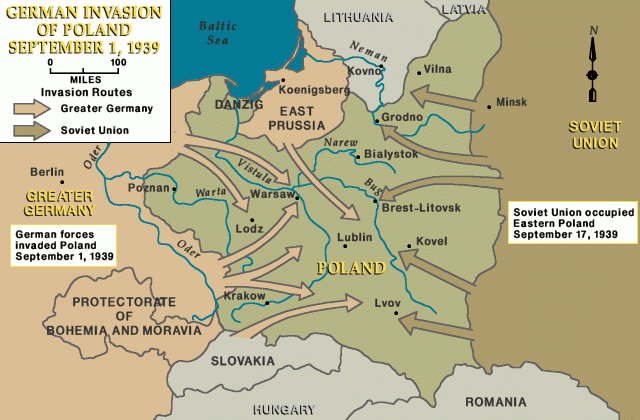
At dawn on September 1, German forces surged into Poland. Columns of armored vehicles cut through the countryside while dive-bombers screamed overhead. Poland fought back fiercely, but the combination of modern aircraft, fast-moving armor, and a coordinated assault was overwhelming. What stunned Europe even more was what happened next: the Soviet Union suddenly invaded from the east on September 17. Just weeks earlier, Germany and the Soviet Union had signed a secret deal to carve up Poland between them — a partnership so unlikely that most governments didn’t believe the rumors at first.
Hitler’s regime had spent years raging against communism, yet both dictators were perfectly willing to work together when it meant wiping Poland off the map. By the end of the campaign, about 66,000 Polish soldiers had been killed and more than 18,000 civilians in Warsaw alone had died under relentless bombing and shelling. Trenches, roads, and villages disappeared under the advance. Hundreds of thousands of civilians fled with nothing more than what they could carry in their hands.
The invasion of Poland wasn’t random. It was the first step in a larger push for what Hitler called Lebensraum, living space in the east where he planned to uproot existing communities and replace them with ethnic Germans. In the months after Poland fell, entire neighborhoods were emptied as more than a million Poles were expelled from their homes. German families were brought in to take their place, sometimes moving into houses where the dinner table was still set. Tens of thousands of Polish civilians were killed during the campaign, and many more were sent to forced-labor camps or pushed deeper into the interior of the Soviet zone when Stalin’s forces occupied the east. In response to the attack on Poland, Britain and France declared war on Germany. World War II had officially kicked off.
Associated Press News Broadcast of the Invasion of Poland.
Credit: Holocaust Encyclopedia

Unit 16: World War II
1939-1945
The War in Europe
WW2 European Front Lesson Plan | Grades 7-12
Listen to the audio version.
Lightning War in the West
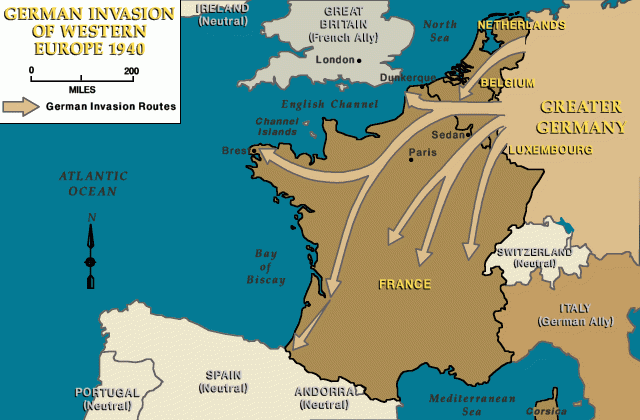
In the spring of 1940, the same style of lightning-fast attacks, that the Germans called Blitzkrieg, slammed into Western Europe. Denmark fell almost immediately. Norway followed. Then the Netherlands, Belgium, and finally France. German tactics were built on speed, shock, and constant movement. Tanks punched through weak spots, aircraft shattered communication lines, paratroopers dropped behind enemy lines and captured strategic points, and units coordinated by radio reacted faster than defenders could organize.
The human fallout was immediate. Rotterdam’s bombing killed hundreds in a single day, sending families racing from burning neighborhoods. In Belgium, the fortress of Eben-Emael, once believed to be nearly invincible, fell in less than twenty-four hours after airborne troops landed on its roof and disabled its defenses. France suffered one of the largest refugee movements in European history: roughly 8 to 10 million civilians fled their homes in just a few weeks. Roads were so clogged with carts, cars, mattresses, and terrified families that French soldiers struggled to move toward the front.
Paris fell in mid-June 1940. By then, entire regions had emptied, children were searching for missing parents in overflowing shelters, and people slept in barns or church basements hundreds of miles from home.
With France defeated, Great Britain stood alone against the entire German army. In the summer of 1940, the Battle of Britain turned the skies into the new front line. German bombers crossed the Channel almost daily, hoping to destroy the Royal Air Force (RAF) and clear the way for invasion. Britain’s radar stations caught incoming raids early, giving fighter pilots just enough time to scramble.
Some of those pilots were barely out of school. They flew multiple missions a day, landing only long enough to refuel. When the bombing shifted to cities, life on the ground changed instantly. Families learned to listen for the rising and falling pitch of warning sirens. Blackouts became a nightly ritual—turn off every light, pull the curtains tight, double-check the streetlamps were dark. People grabbed blankets, flashlights, and raced for bomb shelters as soon as the alarms sounded. In nine months of air raids, more than 43,000 British civilians were killed. Entire street blocks turned into smoking heaps of brick and splintered wood, and mornings often began with neighbors quietly checking which houses were still standing.
But the RAF held firm. By October, Germany abandoned its hopes of invading Britain, and the island remained a vital base for the future Allied return to Europe.

German Stuka bombers had exceptional precision in bombing their targets. Combined with a high pitched siren that pierced the air to cause panic.

Germans used smaller tanks called Panzers that were fast (for a tank) and could maneuver in tight areas.
Credit: Holocaust Encyclopedia
Listen to the audio version.
The United States Enters the War
For two years, the United States stayed out of the fighting but sent ships, food, and equipment to Britain and the Soviet Union. American factories ran nonstop, producing trucks, aircraft, and ammunition that kept the Allied war effort alive. But the country itself wasn’t at war... until December 7, 1941.
Japan’s surprise attack on Pearl Harbor stunned Americans. Within a day, the United States declared war on Japan, and Germany responded by declaring war on the United States. In a matter of hours, the conflict that had once been centered on Europe and Asia turned into a true global showdown between the Axis Powers and the Allied Powers. American servicemen began crossing the Atlantic in large numbers in 1942 and 1943, joining British and Soviet forces already worn down by years of fighting. Their arrival didn’t instantly change everything, but it did shift the balance. The Allies now had industrial strength, supplies, food, trucks, aircraft, and manpower on a scale the Axis could never match. This moment, when the United States officially stepped into the war, set the stage for the three-front pressure Germany would eventually collapse under.

Headline from the Mason City Globe Gazette, Mason City, Iowa.
Listen to the audio version.
Turning Point in the East
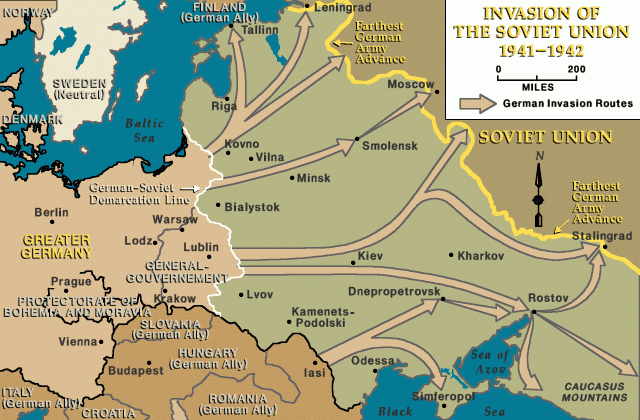
The most brutal fighting of the entire war took place far from Paris or London — on the vast plains, forests, and cities of the Soviet Union. In June 1941, Germany launched Operation Barbarossa, an invasion so massive that it stretched 1000 miles from the Baltic Sea in the north to the Black Sea in the south. And it caught the Soviets completely off guard. Stalin had been warned again and again by his own generals and foreign intelligence that an attack was coming, but he dismissed the reports, convinced Germany wouldn’t risk a two-front war. When the first shells landed and aircraft screamed overhead, many Soviet commanders were still waiting for confirmation that what they were seeing was real and didn’t fire back against the German invaders.
Hitler’s plans for the region went far beyond defeating the Red Army. He wanted full control of Eastern Europe — the land, the farms, the cities, and the people who lived there. His long-term vision included emptying massive areas of their residents and replacing them with German settlers. Moscow was marked on Nazi planning maps not as a future capital, but as a place to be wiped out entirely. One proposal was to destroy the city, flood the land, and turn it into a man-made lake.
The first months were a catastrophe for the Soviets. German forces smashed through border defenses, encircling entire Soviet armies and capturing or killing millions of soldiers in a matter of weeks. Villages that had barely heard the first explosions were overrun by columns of tanks and infantry. Behind the front lines came the Einsatzgruppen, special units whose job wasn’t to fight soldiers but to murder civilians — especially Jews, Communist leaders, and anyone the Nazi regime considered “undesirable.” Entire communities were herded out in fields, ravines, and forests and machine gunned down.
As the invasion pushed deeper into Soviet territory, geography and weather joined the battle. Roads turned into bottomless mud. Supply lines stretched across hundreds of miles of ruined landscape. When winter arrived, it hit harder than German planners ever imagined. Some days the temperatures plunged to as low as -40 °F Fuel froze. Metal cracked. Soldiers marched in thin uniforms that offered little protection against temperatures far below zero. Civilians suffered most. The Germans surrounded the city of Leningrad and tried to starve the people into surrender. The siege of Leningrad lasted 872 days and killed roughly a million people. Families burned furniture to stay warm and mixed wallpaper paste with melted snow to keep from starving.
Germany expected the Soviet Union to collapse in months, but the farther the German army pushed east, the tougher the fight became. Soviet leaders ordered factories dismantled, packed onto trains, and hauled thousands of miles into the interior. Entire steel plants and tank workshops disappeared from cities under fire and reappeared beyond the Ural Mountains, where they roared back to life.
Hitler thought he had kicked open the door of a weak opponent; instead, he had pushed his troops into a war of exhaustion against a country with enormous land, enormous resources, and a population willing to defend the Motherland no matter the cost. Civilians joined the effort in ways that surprised even German commanders. One woman, Mariya Oktyabrskaya, sold her belongings, donated the money to the Red Army, and asked only one thing in return: to drive the tank she had paid for into combat. Stories like hers captured the mood of a nation that refused to back down.
Stalingrad became the place where the German advance finally snapped. The city disintegrated into a nightmare of burning factories, collapsed apartments, and streets so shattered they didn’t look like streets anymore. Civilians and soldiers huddled in basements filled with smoke and dust, waiting for the bombardment to pause long enough to breathe. When Soviet forces launched a massive encirclement in the winter of 1942–43, hundreds of thousands of Axis soldiers found themselves trapped in frozen ruins with almost no food, fuel, or ammunition. Horses were eaten. Frostbite was constant. The cold alone killed thousands. In February 1943, the starving surviving German soldiers finally surrendered.
More than two million people, soldiers and civilians combined, became casualties in and around Stalingrad. That winter didn’t just slow Germany down. It broke the illusion of an unstoppable German advance. After Stalingrad, the Soviet Union wasn’t just defending itself anymore — it was beginning the long, push west to Berlin.

German troops at the border of the Soviet Union shortly after Operation Barbarossa had begun.
Credit: Holocaust Encyclopedia

Special killing squads called the Einsatzgruppen followed the army with orders to round up and murder anyone who the Nazi's saw as an "undesirable".
Listen to the audio version.
The Allies Push Back
Once American troops entered the war, the Allied strategy shifted from survival to pushing Germany backward on every front. The first major push came in North Africa, where control of ports and supply lines decided who could move into southern Europe. Desert heat soared above 120 degrees. Sandstorms swallowed entire convoys. Civilians in Libya and Egypt lived through repeated bombing raids and long shortages as shipping routes became battlegrounds. By mid-1943, Axis forces retreated, opening the door to an invasion of Italy.
Italy looked like a straightforward path into Europe on a map, but the terrain told a different story. The peninsula’s mountains, ridges, and river valleys created natural defensive barriers. Every mountain ridge became a battlefield. Monte Cassino, perched high above the only major road leading north, showed just how hard the Italian campaign really was. The monastery overlooked steep slopes, narrow valleys, and terrain that gave defenders a huge advantage. For months, Allied forces fought uphill through mud, rock, and constant shellfire while German troops held strong positions on the heights. Towns below the hill were shattered. By the end of the campaign, more than a million Italian civilians had been displaced, and many cities lay in ruins.
The momentum continued in June 1944 when Allied forces returned to France. D-Day brought thousands of ships and aircraft across the Channel under a sky thick with exhaust and the rumble of engines. As the sun rose, soldiers looked out at beaches lined with steel obstacles, mines buried in the sand, and machine-gun nests carved into cliffs like stone jaws waiting to bite down. Landing craft slammed open and men stepped into water churned red by earlier waves of the assault. Paratroopers scattered across the countryside after jumping into darkness, some landing exactly where they were supposed to, others dropping into orchards, hedgerows, and even the flooded fields meant to drown them. By midday, the shoreline looked like a scrapyard of twisted metal, burned-out vehicles, broken boats, and abandoned gear. By the end of June 6, around 4,400 Allied troops were dead and nearly 10,000 were killed or wounded, all in a single day of fighting to secure a foothold in France. But, France’s liberation had begun.
Normandy’s civilians lived through a nightmare summer. Towns like Caen and Saint-Lô were destroyed, some more than 90 percent in ruins. Farms were cratered, barns collapsed, livestock killed. But the landings worked. Allied forces began fighting their way across France, closing in as Soviet armies advanced from the east.

A German airborne machine-gun team defends the ruins of the Abbey of Monte Cassino.

Into the Jaws of Death: men of the 16th Infantry Regiment wade ashore on Omaha Beach
Credit: Wikimedia
Listen to the audio version.
The Collapse of Nazi Germany
By early 1945, Germany was being squeezed from both directions. Soviet armies pushed west through landscapes already scarred by years of fighting. Western Allied forces crossed the Rhine and entered Germany from the opposite side. Bombing raids had turned many major cities into fields of rubble. Berlin alone contained well over 100 million cubic meters of rubble by the end of the war.
The human toll across Europe was staggering. An estimated 35 to 45 million Europeans, soldiers and civilians, died during the war. More than 60 million people were displaced at some point. Entire neighborhoods vanished. Roads filled with families pulling carts or carrying children because they had nowhere else to go and nothing left to return to.
As Soviet soldiers closed in on Berlin from the east, and American and British forces advanced from the west, Hitler retreated into his underground bunker. On April 30, 1945, he and his girlfriend, Eva Braun, killed themselves. German resistance collapsed soon afterward. On May 8, Germany surrendered unconditionally. Across Europe, crowds flooded the streets for VE Day, celebrating the end of a war that had reshaped their countries, their families, and their futures.

"Raising a flag over the Reichstag" the famous photograph by Yevgeny Khaldei, taken on May 2, 1945. The photo shows Soviet soldiers raising the flag of the Soviet Union on top of the German Reichstag building following the Battle of Berlin.
Credit: The Atlantic
Listen to the audio version.
Why It Matters
World War II didn’t fade as soon as the fighting stopped. It rebuilt the world you see today. The borders on modern maps, the alliances on the news, the rivalries that spark international arguments — so many of them trace back to choices made while Europe was digging itself out of ruins. Countries that once spent centuries fighting each other suddenly teamed up because they were desperate to avoid another disaster. Others were split apart, forced into new governments, or pulled into the rising tension between the United States and the Soviet Union known as the Cold War. And the fear of another global war pushed nations to create new systems for cooperation: the United Nations, NATO, treaties, agreements, and the idea that powerful countries should find ways to solve problems before they explode into fighting.
Digging Deeper
Use the article to answer the questions below.
-
What event started World War II in Europe?
-
How did Germany’s use of blitzkrieg help it take control of much of Europe early in the war?
-
Why was Hitler’s decision to invade the Soviet Union a turning point in the war in Europe?
-
How did the Soviet Union play a major role in defeating Nazi Germany?
-
Why was the D-Day invasion important to ending the war in Europe?
Copy and paste the questions onto a Word or Google Doc
Test Page