Teachers. Subscribe now and amaze exactly 0% of your friends, but you'll get great discounts and news!
THE HISTORY CAT


Listen to the audio version.
From Discrimination to Extermination
Antisemitism did not start with the Nazis. For centuries in Europe, Jewish communities were treated as permanent outsiders. They were forced into separate neighborhoods, barred from owning land or entering many professions, they were blamed when crops failed, and attacked during periodic pogroms that destroyed homes, synagogues, and entire towns.
The Nazis used these ancient anti-semitic feelings to create propaganda that blamed Jews for literally all of Germany’s problems. Newspapers, radio broadcasts, school lessons, posters, and films repeated the same claims over and over — that Jews were responsible for economic collapse, political instability, and Germany’s defeat in World War I. This constant messaging convinced many Germans that Jewish neighbors were not just different, but dangerous traitors.
By the time war broke out in 1939, this environment allowed the Nazi government to escalate from exclusion to mass violence. Jews had already been stripped of rights, isolated from society, and labeled as enemies of the state. When deportations, ghettos, and eventually mass murder began, they were carried out in a society that had been prepared to look the other way.

Nazi Propaganda poster that reads " Hiding among our Enemies: the Jew"
US Holocaust Memorial Museum, courtesy of Helmut Eschwege
Listen to the audio version.
Confined to Ghettos
As Germany pushed east and conquered new territory, the problem the Nazis had created grew larger. Millions of Jews now suddenly lived under Nazi control. The SS, Hitler’s elite security force immediately went to work making lists of Jews, evicting people from their homes and businesses, and herding them into walled off sections called ghettos. They were backed by local police forces in occupied cities, who helped guard entrances, carry out raids, and arrest people trying to escape or hide. The ghetto was a prison built in the middle of a city, and it required constant enforcement to keep it running.
The ghettos were packed beyond anything the cities could handle. In Warsaw alone, more than 400,000 people were squeezed into about one and a half square miles. That’s a population density higher than modern Manhattan, with none of the infrastructure to support it. Apartments meant for one family now held five or six. Sometimes more. People slept on floors, under tables, or in shifts because there wasn’t enough room for everyone to lie down at once.
With so many people crowded into such small areas, plumbing broke down fast. Toilets stopped working. In many places, running water disappeared entirely. People used buckets instead, dumping waste into courtyards or streets because there was nowhere else to put it. Garbage piled up in hallways and stairwells. Inevitably, rats moved in. Lice spread from person to person and from bed to bed. Diseases like typhus and dysentery followed. Once disease took hold, it tore through buildings that were already full of people weakened by hunger.
The Nazis intentionally deprived people in the ghettos of food. In the Warsaw Ghetto, Jewish residents were officially allowed about 184 calories per day. In comparison, Germans were given ration cards of 2000 calories a day. This was not enough to survive. People quickly lost weight. Children weakened and adults collapsed from hunger. With so many deaths from disease and starvation, the dead were often left in stairwells or doorways until carts arrived.
In places like Warsaw and Łódź, the ghetto was turned into a massive labor site. Factories produced uniforms, boots, and equipment for the German army. The SS demanded output and enforced discipline. Many people believed that working harder might keep them alive. It didn’t. Eventually the trains to concentration camps came anyway.
In Warsaw, historian Emanuel Ringelblum organized a secret archive called Oneg Shabbat. Teachers, writers, and teenagers recorded daily life as it unraveled—ration cards, sanitation breakdowns, street deaths, rumors of deportation. They buried the archive in milk cans and metal boxes beneath the streets. In 1943, Ringelblum, his wife, and his son were discovered while hiding outside the ghetto and were executed by German forces. Most of those who helped create the archive were also murdered. The archive survived buried underground.
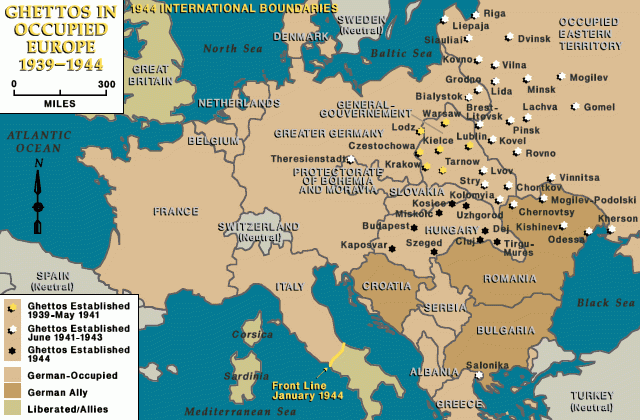
Map of Jewish Ghettos across occupied Europe


Listen to the audio version.
The Einsatzgruppen
In June 1941, Germany invaded the Soviet Union. Nazi leaders described the campaign as a racial war. Orders made clear that entire populations were targets.
The Einsatzgruppen operated across occupied Eastern Europe — especially in Poland, Ukraine, the Baltic states, Belarus, and western Russia — following the German army and carrying out mass shootings of Jews and other targeted groups.
At Babi Yar, a ravine on the outskirts of Kyiv, more than 33,000 Jews were murdered over two days in September 1941. German forces ordered entire neighborhoods to report for “resettlement.” Families arrived carrying documents and luggage. Instead, they were driven toward the ravine by soldiers and police.
At the edge, victims were forced to strip naked. Shoes were paired. Coats were folded. Eyeglasses, watches, and valuables were collected and cataloged separately. This was done quickly and repeatedly, because the killing was scheduled to continue without pause. The clothing was later shipped to sorting centers run by the SS, where it was disinfected, repaired, and redistributed to secondhand shops across the German Reich. Some garments were issued to German civilians whose homes had been bombed. Others were sent to ethnic German settlers in occupied territories. Children’s clothes were reused. Nothing was wasted.
After undressing, victims were driven down into the ravine in groups. They were ordered to lie face down on top of bodies that were still warm. Shooters stood at the edge or climbed down among them, firing at close range. The distance was so short that blood and fragments of bone covered uniforms. When one layer was finished, another group was forced on top. The process continued hour after hour.
Some people were wounded. Others were knocked unconscious. As earth was shoveled over the bodies, movement could still be seen beneath the soil. Witnesses later described the ground rising and falling as people suffocated underneath.
Shooting people at close range took a toll on the men ordered to do it. They stood only feet away. They saw faces. They heard crying and pleading. They fired again and again until entire groups were dead. Some men drank heavily afterward. Others asked to be transferred. Commanders worried that the killings were taking too long and wearing down the shooters.
The concern was not about the victims. It was all about efficiency. German reports counted bodies the way a store counts inventory. Bullets had to be supplied. Graves had to be dug. Entire days were spent killing one village at a time. Bodies piled up faster than they could be buried. The process left too many witnesses and required too many men. Nazi leaders decided the killing needed to be faster and less personal.

Men with an unidentified unit execute a group of Soviet civilians kneeling by the side of a mass grave
Listen to the audio version.
Planning the Final Solution
In January 1942, fifteen Nazi officials met at a villa outside Berlin for the Wannsee Conference. In ninety minutes, they coordinated what they called the Final Solution — the plan to exterminate Europe’s Jewish population.
This was a bureaucratic meeting. Participants discussed transportation logistics, labor capacity, and coordination between agencies. Railways were assigned schedules. Regions were given quotas. Genocide was discussed and organized as if they were planning a bake sale. Murder was written down with cold calculation.
To prepare for the next phase of genocide, new facilities were built in occupied Poland: Auschwitz-Birkenau, Treblinka, Sobibór, Bełżec, Chełmno, and Majdanek. Some camps combined forced labor with mass killing. Others existed solely to kill.

The house of German industrialist, Friedrich Minoux, where the Wannsee Conference took place.
Listen to the audio version.
The Gas Chambers
When deportation trains arrived at major camps across occupied Poland, the process followed a familiar script. People were driven from the cattle cars by soldiers shouting orders while dogs snapped at their legs. The noise and speed were deliberate. Confusion kept people moving. Families were separated almost immediately. Men in one line, women and children in another. An SS doctor or officer stood nearby, scanning faces and bodies and making rapid decisions based on age, appearance, and strength. A brief gesture sent one person toward forced labor and another toward death that same day. No explanation was given.
Those sent toward the gas chambers were told they were going to wash before being assigned housing or labor. They were marched past clean buildings and signs marked “baths” and “disinfection.” The whole thing was an act meant to deceive people and keep them from panicking.
Inside the undressing rooms, SS men and guards gave direct orders. People were told to strip completely and leave their clothes in a pile. They would retrieve them after they had bathed. The room filled with naked people who still believed they were being processed for work.
The chambers themselves were sealed concrete rooms. Once filled, vents were closed and SS soldiers dropped Zyklon B pellets from above. The poisonous gas burned the lungs and eyes, triggering panic almost immediately. People surged toward doors that could not be opened. Stronger bodies climbed over weaker ones in search of air. Children were crushed beneath adults. Death followed within minutes.
Afterward, special prisoner units were forced inside to deal with the aftermath. Bodies were untangled. Gold teeth were removed with pliers. Hair was cut and collected for wigs. Corpses were dragged to crematoria or burned in pits when furnaces overflowed. Ash accumulated everywhere — on clothing, in hair, on the ground.


Listen to the audio version.
Life Inside the Labor Camps
For prisoners selected for work, survival meant learning the camp’s routine quickly and staying invisible. Being noticed was the worst thing that could happen.
At Auschwitz and its labor camps, the day began before sunrise. Prisoners were dragged from bunks and forced outside for roll call. They stood in rows while guards counted and recounted them. If someone had died overnight, the body was pulled from the barracks and propped upright so the numbers would match. Roll call could last hours. People fainted. Guards beat them until they stood again or shot them where they fell. After roll call came work.
Prisoners were assigned to whatever the camp needed most: hauling stone, digging ditches, draining swamps, laying rail lines, unloading freight cars, or carrying materials back and forth until their bodies gave out. The work was designed to be exhausting. Speed mattered more than safety. Tools were often broken or missing. Instructions were shouted in German that many prisoners did not understand. Mistakes were met with fists, clubs, or rifle butts. Falling behind brought beatings. Those who could not keep up were killed.
Some prisoners were pulled aside based on skills they had before arrest. Carpenters were sent to construction details. Musicians were sent to entertain the SS officers. Mechanics, electricians, chemists, and engineers were assigned to factories that supported the German war effort. These jobs could mean slightly better rations or shelter, but they also meant longer exposure to the camp system. Skill did not guarantee safety. It only delayed death.
Prisoners were deliberately made to work on starvation diets. Each day they received a small piece of bread and a bowl of watery soup made from turnips, cabbage, or potato peels, often with no fat and little nutrition. The portions were never enough to replace the calories burned during forced labor. Hunger was always there.
Disease finished off what hunger began. Prisoners lived packed together in wooden barracks with no heat and unsanitary conditions. Dozens slept in the same space on straw that was rarely replaced. There was no clean water to wash with and no soap. Latrines overflowed and sewage spilled onto the ground. Rats ran through the barracks at night and across sleeping bodies.
Lice were constant, living in clothing seams, hair, and bedding. Prisoners could not get rid of them. The lice spread typhus quickly. Dysentery spread through contaminated water and filth, causing severe diarrhea, dehydration, and weakness. Pneumonia broke out constantly, especially in winter, when prisoners worked outside for hours in thin clothing and returned to unheated barracks.
The labor camps were not a path away from death. They were just a slower version of it. More than four million people died in the camp system, many within weeks of arrival.

A group of children assembled for deportation to the death camp at Chelmno


Jewish prisoners being loaded onto cattle cars destined for concentration camps.
Listen to the audio version.
Horrifying Medical Experiments
Inside certain camps, the Nazis carried out medical experiments that had nothing to do with healing. They were acts of torture carried out under the guise of science.
At Auschwitz, Dachau, and Ravensbrück, doctors used prisoners because the camp system made human lives disposable. Prisoners selected. Once chosen, there was no refusal.
At Auschwitz, SS doctor Josef Mengele became infamous for his fixation on heredity. When transports arrived, he often stood on the platform identifying twins, people with disabilities, and those with visible physical differences. Children were taken from their parents immediately. Most never saw their families again.
Twins were measured repeatedly. Their skulls, limbs, and organs were compared and recorded. Mengele injected chemicals into children’s eyes in attempts to change eye color. He deliberately infected prisoners with disease. Blood was transfused from one twin to another until bodies failed. When one twin died, the other was often killed so their organs could be examined side by side. Survivors later recalled that crying or resisting only brought beatings or injections that caused collapse.
At Dachau, experiments were tied directly to military needs. Prisoners were placed in pressure chambers to simulate high-altitude flights. As oxygen levels dropped, victims convulsed, lost consciousness, or died. Others were submerged in freezing water to test how long German pilots might survive after crashing into the sea. Prisoners were held in ice baths until their body temperatures dropped dangerously low. Some were left to die. Others were “rewarmed” using methods that caused severe injury or death. Doctors took notes throughout.
At Ravensbrück, a camp primarily for women, prisoners were subjected to surgical experiments. Doctors cut into legs, broke bones, and inserted dirt, glass, and bacteria into wounds to study infection. Many women were left permanently crippled. Others died from untreated infections or blood poisoning. Survivors later described being sewn back together without anesthesia and sent back to work while wounds reopened and festered.
Sterilization experiments were carried out across the camp system. Men and women were exposed to radiation, chemical injections, or surgery intended to destroy reproductive organs. These procedures were designed to find fast, cheap ways to prevent entire populations from reproducing. Many victims died from complications. Others survived with permanent injuries. Meanwhile, doctors recorded results, filed reports, and moved on to the next subject.
There was no recovery. Prisoners who survived experiments were often killed afterward to free space or erase evidence. Medical records were kept carefully. Bodies were disposed of casually.
After the war, many of the doctors claimed they were conducting legitimate research. The evidence showed otherwise. The experiments were brutal, unnecessary, and often scientifically worthless. They revealed how easily medicine could become a weapon once ethics were stripped away and certain people were declared expendable.

Victim of a medical experiment

Victim of a medical experiment at Dachau is being immersed in icy water.
Listen to the audio version.
Death Marches and Liberation
By late 1944, Nazi Germany was collapsing. Allied armies were closing in from both east and west, and the SS began evacuating camps to hide evidence and keep prisoners out of enemy hands. Prisoners were forced onto death marches through winter snow, often without coats, food, or shoes. Columns stretched for miles. Anyone who collapsed or fell behind was shot and left where they fell. Roadsides filled with bodies as the marches moved west.
When Soviet troops reached Auschwitz on January 27, 1945, they found about 7,000 survivors too weak to be evacuated. They also found what the Nazis had not been able to move: piles of shoes, suitcases labeled with names, children’s clothing, glasses, and hair. The gas chambers and crematoria had been partially destroyed, but the scale of the crime was unmistakable.
American forces encountered similar scenes as they advanced through Germany. U.S. troops liberated camps including Buchenwald, Dachau, and Mauthausen. At Buchenwald, American soldiers found thousands of prisoners still alive and thousands more dead or dying. At Dachau, they walked past boxcars filled with corpses and barracks where prisoners were skeletal, sick, and barely conscious. Many soldiers later said nothing in combat had prepared them for what they saw.
Many survivors tried to return home and were turned away. In Poland, Jewish survivors who came back to reclaim houses or shops often found them occupied by new owners who refused to leave. Local authorities frequently denied property claims or delayed them until survivors gave up. In July 1946, in the city of Kielce, a false accusation led to a pogrom in which more than forty Jewish survivors were beaten or murdered by local residents and police. The war had been over for more than a year.
In Germany and Austria, survivors returned to find their homes destroyed or taken. Often times, their neighbors reacted with cold indifference or even anger at their return. With nowhere else to go, many were housed in displaced persons camps—some located in former concentration camps, guarded and fenced much like before. In other towns, neighbors avoided them or denied knowing what had happened during the war.
For many survivors, returning home was not possible. Survival meant starting again in a place that no longer belonged to them.

On January 27, 1945, Soviet troops entered Auschwitz in Poland and freed the survivors, exposing the scale of the concentration camp system and the crimes committed there.

Survivors returning home – Budapest, Hungary.
825,000 Jews lived in Hungary before the war. About 565,000 were murdered during the Holocaust., Survivors came home to find their homes destroyed or sold to other families. No one had planned for them to return.
Listen to the audio version.
Why It Matters.
During the Holocaust more than six million Jews were murdered. Hundreds of thousands of Roma. Millions of Soviet prisoners of war. Tens of thousands of Poles, disabled people, Jehovah's Witnesses, homosexuals, and others labeled subhuman. These numbers were not the result of a single decision made at the start of Nazi rule. The Holocaust unfolded step by step. Each stage built on the last. Discrimination became law. Law became removal. Removal became confinement. Confinement became murder.
The Holocaust matters because it shows how a modern government can organize mass murder. Prejudice was written into law, enforced by police, and carried out through ordinary systems like transportation, industry, medicine, and record-keeping. Each step required factory workers, accountants, bankers, farmers, and businesses to build the camps and keep them running for five years. Genocide did not begin with death camps. It began when discrimination was accepted as normal and when ordinary people made the choice to turn a blind eye to violence.
Digging Deeper
Use the article to answer the questions below.
-
What was the Holocaust, and who were the primary targets of Nazi persecution?
-
How did forced ghettos and deportations begin the process of persecution against Jewish communities?
-
What were concentration camps and extermination camps, and how were they used during the Holocaust?
-
How did the Einsatzgruppen carry out mass killings during the early stages of the Holocaust?
-
What was the “Final Solution,” and how did it change Nazi policy toward Jewish people?
-
How did the liberation of camps by Allied forces reveal the realities of the Holocaust?
Copy and paste the questions onto a Word or Google Doc
Test Page