Teachers. Subscribe now and amaze exactly 0% of your friends, but you'll get great discounts and news!
THE HISTORY CAT

Listen to the audio version.
How Hate Became Law
By the early 1930s, Germany was in free fall. The Great Depression had wiped out savings, shuttered businesses, and put one in three workers out of a job. The Weimar Republic — Germany's young democratic government — was crumbling under the pressure, cycling through four different chancellors in three years as politicians fought each other while ordinary families stood in bread lines with wheelbarrows full of near worthless cash. Into this chaos marched Adolf Hitler and the Nazi Party, ready to offer simple answers to complex problems. Their solution? Blame the Jews.

Adolph Hitler meets with President Von Hindenburg shortly after Hindenburg asks him to become Chancellor.
1930–1933: The Nazis Take Power
The Nazis didn't invent antisemitism. Jewish communities had been scapegoats in Europe for centuries — blamed for everything from economic downturns to plagues. People in the Middle Ages even accused them of eating children. Hitler took that ancient hatred and weaponized it. His book Mein Kampf blamed Jews for Germany's defeat in WWI, its economic collapse, and its moral decline. Absurd? Completely. But desperate people don't always make rational choices. The political and economic chaos was the perfect environment for extremist parties like the Nazis to thrive.
The Nazi Party had a clear message: “Germany for Germans!” and a promise to restore Germany back to its former greatness. Jews, they claimed, were the ultimate villains, secretly controlling banks, media, and politics. They were the reason that Germany couldn’t recover. But who exactly was a Jew?
To sort German society into Jew and non-Jew, the government first had to define what they meant by “Jew”. That’s harder than it sounds. Centuries of intermarriage and religious conversion meant that some people had two Jewish parents and went to the synagogue on Saturday’s, others had a single Jewish mother and a Christian father, and some came from families where their grandparents were Jewish, but they didn’t follow Jewish religious practices at home. The lines weren't clearly defined, and the Nazis needed them to be. In 1933, the government used a national census to require Germans to declare their religion. But, religion alone wasn’t enough—many Jewish families had converted to Christianity generations earlier. So Nazi officials dispatched genealogists to dig through church baptismal records, marriage registries, and town archives, tracing bloodlines back two full generations. The Reich Office of Genealogy existed for one purpose: to sort the population into categories to make it easier to identify the targets for the laws that would come next.

Unit 17: Human Rights in Crisis
1939-1945
Anti-Semitism Becomes Law
Holocaust Lesson Plan | Grades 7-12
Listen to the audio version.
Propaganda: Lies on Repeat
Joseph Goebbels, the Nazi mastermind in charge of Nazi propaganda, made sure that antisemitism was everywhere—newspapers, posters, movie theaters, speeches, school textbooks, you name it. Papers like Der Stürmer published grotesque cartoons and stories portraying Jews as greedy, corrupt, and dangerous. All of it was part of a strategy to make antisemitism feel normal. And sadly, it worked.
The propaganda went beyond calling Jews dishonest or untrustworthy. The goal was to strip separate them from the rest of society. Der Stürmer regularly printed cartoons depicting Jews as rats, spiders, and snakes crawling through German society. Nazi officials and government documents used terms like Untermenschen (subhumans), Schädlinge (vermin or pests), and Parasiten (parasites). Children were taught these words in school. A 1940 propaganda film called Der ewige Jude (The Eternal Jew) literally cut between footage of Jewish people and footage of rats swarming through sewers, making the comparison impossible to miss.
When a government calls a group of people vermin often enough, publicly enough, and through enough different channels, it starts to feel like the truth. Psychologists call this the Illusionary Truth Effect and have found that people begin to start accepting a lie after hearing it in as little as 2 or 3 times.
But once the labels took hold, violence became easier to justify. Indifference became easier to maintain. By the time Jews were being loaded onto cattle cars, many Germans had spent a decade being told—through posters, films, newspapers, radio broadcasts, and school lessons—that the people in those cars weren’t quite human. Hate didn’t just happen. It was manufactured, on purpose, one slur and one cartoon at a time

Der Sturmer (The StormTrooper) - The unofficial Nazi newspaper regularly featured antisemitic articles like this one. The bottom caption reads "The Jews are Our Misfortune".
Listen to the audio version.
1933–1935: Laws, Boycotts, and the Start of Isolation
Once enough people had accepted the propaganda as truth it became easier to start chipping away at Jewish rights. After all, people won’t complain about injustice if it’s happening to someone they hate. The Nazi’s used laws to push Jews to the margins of society first—a slow-motion train wreck where each new rule made life a little harder, a little less free, and a lot more terrifying.
The Boycott of Jewish Businesses
In April 1933, the Nazis organized a one-day nationwide boycott of Jewish businesses. Brown-shirted stormtroopers (SA) stood outside Jewish shops, scrawled “Jude” (Jew) on windows, and discouraged Germans from entering. While the boycott wasn’t as successful as they’d hoped—some people still shopped where they wanted—it sent a clear message: Jews were no longer welcome in German society.
Banning Jews from Professions
The Nazis didn’t stop at boycotts. That same year, they passed the Law for the Restoration of the Professional Civil Service, which banned Jews from government jobs. Teachers, judges, and civil servants were forced out. More laws followed, targeting Jewish doctors, lawyers, and other professionals. The Nazis wanted to make it clear that Jews didn’t belong in Germany’s workforce.
The Book Burnings
In May 1933, The Hitler Youth staged bonfires where they torched works by Jewish authors and other “un-German” books. This wasn’t just about destroying ideas—it was about erasing Jewish culture and intellectual contributions. Literary works by famous Jewish authors like Sigmund Freud, Albert Einstein, and Franz Kafka went into the fire. Non-Jewish authors like H.G. Wells (1984), Karl Marx (Das Capital), Jack London (Call of the Wild), and Erich Maria Remarque (All Quiet on the Western Front) were targeted because they contradicted Nazi teachings.

The word "Jew" in German and the Star of David spray painted on a Jewish shop owners window.

On May 10, 1933 40,000 people gathered in Berlin's Opernplatz for the purpose of burning 'anti-German' books.
Listen to the audio version.
1935: The Nuremburg Laws
In 1935, the Nuremburg Laws were passed. Jews, Gypsies, Slavs and other non-Aryan people were labeled as sub-humans. Those with physical handicaps, mental illnesses, or homosexuals were sterilized to" preserve the purity" of German blood. Signs on public facilities read “No Jews Allowed”. Anti-Semitic graffiti was freely sprayed across the windows of Jewish homes and businesses. Average Germans avoided their Jewish neighbors out of fear of the Gestapo –– the Nazi secret police, who had spies everywhere.
What Did the Nuremberg Laws Do?
-
Stripped Jews of Citizenship: Under the Reich Citizenship Law, Jews were no longer German citizens. They became “subjects” with no voting rights or political voice.
-
Banned Intermarriage: The Law for the Protection of German Blood and Honor prohibited Jews from marrying or having relationships with “Aryans.” It was as creepy and controlling as it sounds.
-
Defined Jewishness by Blood: Even if your family had converted to Christianity generations ago, you were still considered Jewish if you had three or more Jewish grandparents. The Nazis weren’t interested in your religion—just your ancestry.
-
Created a Racial Hierarchy: The laws established four legally defined categories based on how many Jewish grandparents you had. Someone with four was classified as a Volljude (full Jew). Two grandparents made you a Mischling of the first degree. One grandparent, a Mischling of the second degree. Each category came with different restrictions and different levels of danger.
The Nuremberg Laws made it official: Jews weren't German anymore. Not legally, anyway, making it easier for average Germans to turn a blind eye to what was coming next.

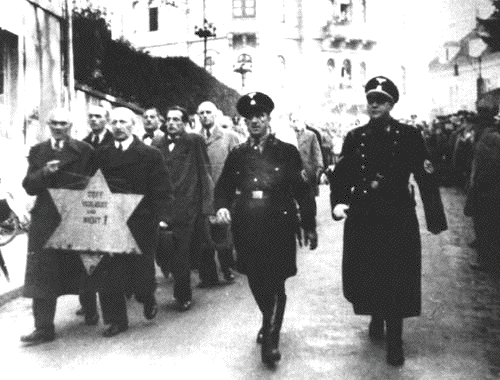
In 1933, Jewish businessman Oskar Danker and his girlfriend, a Christian woman, were forced to carry signs discouraging Jewish-German integration. Two years later, their relationship would officially be illegal under the Nuremburg Laws.
The sign that on the left reads: I am a big pig and only associate with Jews.
The sign on the right reads: As a Jewish boy, I only ever take German girls to my room.
Listen to the audio version.
1936–1938: Turning Up the Heat
By the mid-1930s, the Nazis were feeling pretty secure in their grip on power. This confidence led to a new wave of antisemitic measures and an even bolder approach to exclusion and oppression.
Economic Exclusion
Jewish-owned businesses were systematically targeted and eventually "Aryanized" — a fancy way of saying legalized theft. Jewish families who had built businesses over generations were forced to hand them over at a fraction of their value, sometimes for nothing at all. Shops, law firms, factories, medical practices — anything that could be taken, was. In just five years, from 1933 to 1938, two-thirds of all Jewish-owned businesses in Germany had been stripped away and handed to non-Jewish Germans. This happened to a community that made up less than one percent of Germany's population — the same community Nazi propaganda claimed was secretly controlling the entire economy. With no income and no way to earn one, families found themselves unable to pay rent, feed their children, or afford the papers they needed to leave the country.
The Berlin Olympics (1936)
For a brief moment, the Nazis toned down their antisemitic rhetoric to put on a good face for the international community during the Berlin Olympics. Signs reading “Jews Not Welcome” mysteriously disappeared, and Germany even let a single Jewish athlete, Helene Mayer, compete for the German team. But this was just a façade. As soon as the games ended, the Nazis cranked up their hate machine once again.

Sign reads: “Germans! Defend yourselves! Do not buy from Jews!”
Listen to the audio version.
1938: Kristallnacht
The next step for the Nazi government was to confiscate Jewish owned businesses and homes. The money from the sale of these stolen properties went directly to support the Nazi war machine. To raise additional cash, the government encouraged Jews to pay a flight tax of about 25% of their assets in order to get out of the country.
If any Jews believed that things really couldn't get any worse, they were in for surprise on November 6, 1938. A German diplomat had been assassinated by a Jewish youth who took revenge on the way his family had been treated. The Nazi’s leapt at this chance to unleash a night of terror throughout Germany. Armed thugs of Brownshirts, SS, and Gestapo roamed the streets of German towns smashing the windows of Jewish stores and synagogues. Homes and businesses were looted and burned. Jews caught in the street were beaten and thousands were arrested and sent to concentration camps. Because the streets were littered with broken glass, the attack became known as Kristallnacht - The Night of Broken Glass.
The Nazi’s conducted an official investigation into the riots and came to an open and shut verdict. The Jews were responsible for the riots that caused so much damage. The Jewish community was required to pay a billion Marks (the currency of Germany) in fines. After Kristallnacht 100,000 Jews realized which way the wind was blowing and fled Germany. But millions more were trapped. Either too poor or unable to get a visa, many had no choice but to stay put and wait out the Nazi terror.

Listen to the audio version.
1939: The Final Stages of Exclusion
By the end of the 1930s, antisemitism in Germany wasn’t just a policy—it was a way of life. Jews were completely ostracized, forced to live in isolation and poverty. New laws required Jews to carry special identification cards, register their property, and wear the infamous yellow Star of David in public. They were banned from public spaces like parks, cinemas, and schools, effectively erasing them from German society.
Ghettos and the Road to Genocide
When Germany invaded Poland in September 1939, it gained control of millions of Jews in Polish territories. The Nazis began rounding them up into ghettos—overcrowded, unsanitary urban areas designed to isolate and dehumanize Jewish communities. These ghettos were a horrifying preview of the mass exterminations that would come in the 1940s.
Polish Jews were forcibly removed from their homes and marched off to live in segregated districts called Ghettos.
Listen to the audio version.
What Made This Possible?
The Nazis didn't just rely on force. They relied on everyday Germans accepting, participating in, or looking the other way. Some were true believers who reported Jewish neighbors to the Gestapo or eagerly applied to take over Aryanized businesses. Others weren't committed antisemites — they just went along, stayed quiet, and kept their heads down. Historians still debate exactly how much ordinary Germans knew and how willingly they participated. What isn't debated is that the system required millions of people — teachers, police officers, civil servants, factory workers, shopkeepers — to do their jobs as normal while Jewish communities were stripped of everything around them.
At the peak of free elections in 1932, more than a third of Germans voted for the Nazi Party — enough to make it the largest party in the country. Hitler was never actually elected to anything. He was appointed Chancellor in January 1933 by a government that thought it could control him. They were wrong.
A 2015 study, "Nazi Indoctrination and Anti-Semitic Beliefs in Germany" by Voigtländer and Voth, found that Germans who grew up under Nazi rule were two to three times more likely to hold strongly antisemitic views decades later than those born before or after — proof that twelve years of saturating an entire generation with propaganda left marks that lasted a lifetime. The Nazis understood something that modern psychologists have since confirmed: repeat a lie often enough and it stops feeling like a lie. By the time the death camps were running, most Germans had spent a decade being prepared not to ask questions.

The Nazi's wouldn't have been able to carry out their systematic targeting of Jews without the willingness of ordinary Germans to conform or look the other way.
Digging Deeper
Use the article to answer the questions below.
-
Why did Nazi leaders blame Jewish people for Germany’s economic problems and defeat in World War I?
-
How did the Nazi's use propaganda to turn the rest of German society against its Jewish citizens?
-
What were the Nuremberg Laws?
-
What types of jobs and businesses were Jewish people banned from under Nazi anti-Jewish laws?
-
What was Kristallnacht?
-
How did anti-Jewish laws and violence gradually isolate Jewish people from German society?
Copy and paste the questions onto a Word or Google Doc
Test Page