Teachers. Subscribe now and amaze exactly 0% of your friends, but you'll get great discounts and news!
THE HISTORY CAT


Causes of WWII
The Fuse Gets Lit
World War II erupted because the world was paralyzed by fear and indecision. The Great Depression left millions jobless and desperate, creating fertile ground for strongmen who promised bold solutions. In Germany, Hitler claimed he could erase the shame of Versailles. In Italy, Benito Mussolini strutted across the stage, boasting that fascism would restore Rome’s ancient glory. And in Asia, Japan was already on the march—grabbing Manchuria in 1931 and waging full-scale war against China by 1937.
A World on the Edge
Together these forces created a storm that the so-called guardians of peace did little to stop. Britain and France, still traumatized by the slaughter of World War I, chose hesitation over confrontation. The League of Nations, designed to prevent exactly this kind of chaos, looked on as dictators dismantled the rules of international order. With Hitler rebuilding Germany’s military, Mussolini expanding Italy’s empire, and Japan carving up Asia, the 1930s became a decade of unchecked aggression. By the time Europe woke up to the danger, the war was already inevitable.

Japanese Aggression in the 1930s
While Europe nervously watched Hitler, Japan was busy building its own empire across Asia. In 1931, Japanese officers staged the Mukden Incident, blowing up a stretch of railway in Manchuria and blaming it on the Chinese. It was the excuse they needed to send in the army. Within months, Japan had seized 90,000 square miles of territory—an area rich in coal, iron, and farmland—and set up the puppet state of Manchukuo. The League of Nations wagged its finger, Japan shrugged, and then quit the League entirely. Lesson learned: the world would talk tough, but not act.
By 1937, Japan launched a full-scale invasion of China. The numbers were staggering. 200,000 Japanese soldiers stormed across the border, and by the end of the year, they had taken Beijing, Shanghai, and Nanking. In the Nanking Massacre, Japanese troops killed an estimated 200,000–300,000 civilians and prisoners of war in just six weeks. Thousands of women were assaulted in what became known as the “Rape of Nanking.” Photos and reports from foreign journalists shocked the world, but no one sent troops to stop it.
Japan justified its actions by claiming it was creating a “Greater East Asia Co-Prosperity Sphere”—an Asia run by Asians, free of Western control. In reality, it was all about resources. Japan’s island nation lacked oil, rubber, and other essentials for modern war. Expansion meant survival. By 1938, Japan controlled much of northern China, with millions of Chinese forced into slave labor to support its war machine.
The West responded with little more than protests. Britain and France were tied up with Hitler in Europe. The United States, still recovering from the Depression, passed Neutrality Acts and tried to stay out of it. Japan had proven what Hitler was about to exploit in Europe: aggression worked if no one was willing to step in.

Japanese Prime Minister - Hideki Tojo

Fascism in Italy and the Invasion of Ethiopia
While Hitler was busy flexing in Europe, Benito Mussolini was already showing the world how fascism worked. Mussolini came to power in Italy back in 1922, promising to make Italy strong again after World War I left it battered and ignored at the peace table. His answer was fascism—an ideology built on nationalism, military pride, and crushing anyone who dared to disagree. Mussolini loved pageantry. Blackshirts marched through the streets, fists raised, chanting slogans about loyalty to the state and Il Duce—the Boss.
But slogans and parades only go so far. Mussolini wanted proof that Italy was a serious empire again. In 1935, he picked Ethiopia, one of the few free African nations left, as his target. Italy had tried and failed to conquer it back in the 1890s, so Mussolini framed the invasion as payback and a shot at glory. This time he wasn’t messing around. Italy threw in 400,000 troops, tanks, artillery, and modern aircraft against Ethiopian soldiers armed mostly with rifles and spears. When the resistance put up more of a fight than expected, Mussolini authorized the use of poison gas, a clear violation of international law.
The League of Nations condemned the invasion and placed economic sanctions on Italy, but they were weak and halfhearted. Oil, steel, and coal—vital to Mussolini’s war machine—were left out of the embargo. Britain and France, desperate to keep Mussolini on their side against Hitler, looked the other way. By 1936, Ethiopia was conquered, Emperor Haile Selassie was in exile, and Mussolini was boasting about his new Roman Empire. The message was obvious: fascist aggression could succeed, and the so-called guardians of peace weren’t willing to risk war to stop it.

Dictator of Italy - Benito Mussolini

Appeasement of Hitler
Hitler wasn’t bluffing. From the moment he grabbed power in 1933, he was gearing Germany up for war. On the surface, he played the role of the peace-loving leader who just wanted fairness for his people. Behind the curtain, he and his generals were sketching maps of conquest. His pitch was simple: Germany had been humiliated, robbed, and broken—and he was the man to bring it roaring back.
The anger was real. The Treaty of Versailles had left Germans furious, stripping them of land, coal, colonies, and military power, then saddling them with a war guilt clause and crushing reparations. As if that wasn’t enough, the Great Depression threw millions out of work. Hitler stepped in with fiery speeches that gave Germans someone to blame—Jews, Poles, Slavs, Roma—and a promise to restore Germany's greatness.
The Third Reich
Hitler’s dream was the Third Reich, a German empire that he claimed would last a thousand years. At the center of it was lebensraum—“living space.” He wanted land in Eastern Europe cleared of so-called “inferior races” and resettled with Aryan families. To make it happen, Germany would need a military strong enough to bulldoze its neighbors.
And Hitler delivered. By 1937, unemployment in Germany had dropped by 80%, thanks to massive public works projects and rearmament. Ordinary Germans saw jobs and new hope, while Hitler’s hate-filled speeches faded into the background for those who wanted to believe the good times had returned.
The military buildup was staggering. Versailles had capped the army at 100,000 men. By 1939, it was over 4.5 million strong. The Luftwaffe, banned by the treaty, now had 5,000 planes. Shipyards launched new battleships and 57 U-boats, and factories turned out over 2,500 tanks ready for blitzkrieg. In under a decade, Germany went from almost disarmed to one of the most dangerous war machines on earth.
Testing the Waters
Hitler knew Germany wasn’t ready for a world war in the early years, so he moved cautiously, testing how far he could push. In 1935, the Saar region voted 90% in favor of rejoining Germany. Hitler called it “a great day for peace,” but really it was a confidence boost for his larger plans.
Over the next few years, he kept upping the stakes. In 1936, German troops marched into the Rhineland—territory that was supposed to stay neutral under Versailles. France and Britain did nothing. That silence spoke louder than any threat: appeasement worked. Every time Hitler broke a rule and got away with it, he grew bolder. By 1939, Europe’s caution had handed him exactly what he wanted—the time and space to prepare for a war he never intended to avoid.

"...I can well understand the reasons why the Czech Government have felt unable to accept the terms which have been put before them in the German memorandum. Yet I believe after my talks with Herr Hitler that, if only time were allowed, it ought to be possible for the arrangements for transferring the territory that the Czech Government has agreed to give to Germany to be settled by agreement under conditions which would assure fair treatment to the population concerned..."
_British Prime Minister
Neville Chamberlain

Adolph Hitler is greeted as a liberator by Czech Nazi's
Invasion of Poland
8:00p.m. August 30th, 1939-
Hitler was itching to find a reason- any reason- that would justify a German invasion of Poland as part of his grand scheme to create Lebensraum (German living space) even if that meant inventing one himself. Hitler’s plan read like a Hollywood movie. A group of SS guards dressed in Polish army uniforms broke into a small radio station in Gleiwitz along the Polish-German border beating up the three Germans unlucky enough to be working the late shift .
But,Hitler's little feint didn’t go off as planned for a couple of reasons that could have been avoided with a little careful preperation. For starters, the radio station wasn’t a station at all but a transmission tower-- there's a difference. The “Polish Soldiers” were supposed to hijack the airwaves and broadcast a message of Polish aggression against the German people but no such transmission was made. The whole attack lasted on a few minutes and to make their ruse more convincing the SS men had brought along the corpses of prisoners from a concentration camp who were also dressed in Polish army garb.
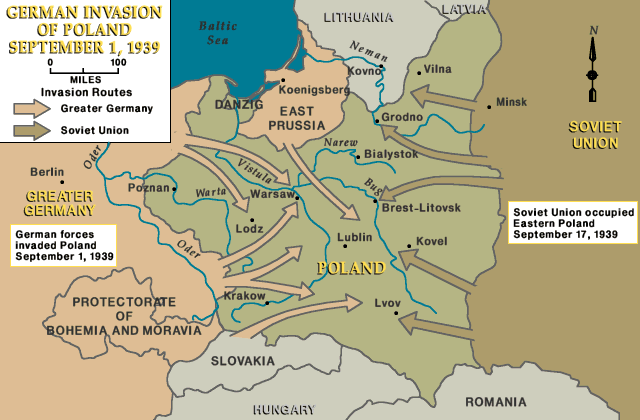
German tank divisions stood by waiting for the announcement that Germany had been taken by surprise. The following morning Germans woke up to the news that Germany was now at war with Poland. Germans were clearly stunned. There was none of the celebrations that had kicked off World War I. The German navy blasted Polish seaports and columns of German tanks rolled across the Polish border. For four weeks the Germans fought a bitter battle against the more poorly equipped Polish resistance.
Meanwhile, The Soviet Red Army was pouring in from the east to take possession of their half of Poland under a secret pact that Hitler had made with the communist enemy just a few months earlier. Great Britain and France decided that Hitler’s demand for power could not be contained and the two allies declared war on Germany on September 1, 1939. World War Two had begun. But let's back up a bit.


German troops march into Poland's Capital, Warsaw
Why It Matters
World War II erupted because unchecked aggression became the norm in the 1930s. Germany rebuilt its army in defiance of Versailles, Italy invaded Ethiopia with modern weapons and poison gas, and Japan expanded across Asia with brutal force. Each act of expansion was met with hesitation, weak sanctions, or silence from world powers still shaken by World War I and the Great Depression. That failure to act early allowed fascist and militarist regimes to grow stronger. The cost of waiting was a global war that left tens of millions dead and reshaped the modern world.
Digging Deeper
Use the article to answer the questions below.
-
What role did militarism play in creating the conditions for World War I?
-
How did alliances in Europe contribute to the start of World War I?
-
What is imperialism, and how did competition for colonies help lead to World War I?
-
What role did nationalism play in increasing tensions before World War I?
-
How did the assassination of Archduke Franz Ferdinand trigger the outbreak of World War I?
Copy and paste the questions onto a Word or Google Doc
Test Page