Teachers. Subscribe now and amaze exactly 0% of your friends, but you'll get great discounts and news!
THE HISTORY CAT


Listen to the audio version.
Maybe your parents have a cabinet stuffed with old Cool Whip containers they use for leftovers. Maybe there's a bag of plastic bags hanging off a doorknob somewhere in the house. It might seem like a quirky thing that old people do, but it has it’s roots in the Great Depression when throwing something useful away was seen as totally reckless behavior.
The Great Depression, which lasted from 1929 through the end of the 1930s, pushed roughly a quarter of American workers out of their jobs and the trauma of being constantly on the edge of poverty changed how an entire generation saw the world. The motto of the era said it all: "Use it up, wear it out, make do or do without." Today, we'd call that upcycling and we do it to save the planet, but during the Great Depression people did it because of poverty.

Listen to the audio version.
Life at Home During the Depression
Repairing things was a basic life skill long before the Depression, but in the 1930s it became an absolute necessity. You didn’t throw out socks just because they had a hole in them, you pulled out the knitting needles and fixed them. Shoes got resoled, sometimes with old tire rubber. Coats got turned inside out when the outside wore through. Clothes were handed down, then cut into rags, then used as quilt stuffing. Families cut each other's hair at home because going to a barber was now a luxury.
Women's magazines and radio shows talked about how to stretch a food budget with recipes on casseroles, soups, one-pot meals, and "fridge stew," a concoction made from whatever was left at the end of the week. Church potlucks became a staple of social life. Families planted kitchen gardens in backyards and vacant lots.
The Great Depression changed the way Americans ate. When fresh ingredients ran short, cooks improvised. A little peanut butter stuffed inside a hollowed onion and baked — that was a meal. Hoover Stew — named for the president most Americans blamed for the crisis — was sliced hot dogs, canned tomatoes, macaroni, and corn, all simmered together in pot. Mock apple pie fooled your taste buds with Ritz crackers, sugar syrup, lemon juice, and cinnamon — no apples required.
Food companies began selling dirt cheap alternatives. Kool-Aid took off during the Depression because for a penny you could make a pitcher of something that wasn’t water. Peanut butter and Jelly sandwiches became a cheap high-protein meal. Ritz crackers launched in 1934 at 19 cents a box, were buttery enough to feel like a treat and beat out baked peanut butter onions. Kraft boxed macaroni and cheese arrived in 1937 and for 19 cents a box you could feed four people. SPAM hit shelves the same year, canned pork that kept for years. Throw on a slice of pineapple and you’d think you’re in Hawaii. So, the next time you sit down for meatloaf and mac n cheese, remember that you’re eating Great Depression style!

Woman cooking on the stove
Source: Library of Congress

Listen to the audio version.
Dressed in a Flour Sack
With little money to buy new clothes, people got creative. Flour had been sold in cotton sacks since the 1800s, and poorer families had always repurposed them into dish towels, curtains, and clothing. But wearing a flour-sack dress was still a mark of poverty, and women went to great lengths to disguise it by soaking off logos, dyeing the fabric, adding buttons and ribbons to make it look store-bought. But those plain beige dresses weren’t fooling anyone.
Milling companies figured out they could help with that. If the sack already came printed with flowers, polka dots, or paisleys, nobody had to know it started as a bag of flour. Women started trading empty sacks at neighborhood swap parties, hunting for matching patterns so they could sew a full dress. A feed store salesman, interviewed years later, was still baffled by the shift: "Years ago they used to ask for all sorts of feeds, special brands you know. Now they come over and ask me if I have an egg mash in a flowered percale. It ain't natural."
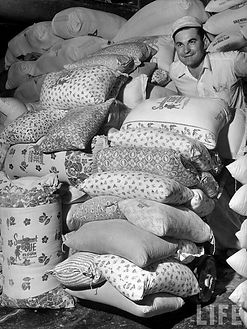
Flour and feed companies started printing designs on their cotton bags to reuse as dress material
Listen to the audio version.
Finding Work in the Great Depression
With steady work nearly impossible to find, people worked odd jobs to get by. You knocked on doors selling brushes, cleaning products, encyclopedias — whatever someone might buy. Some men set up on street corners selling apples. The Apple Shippers' Association sold crates on credit to unemployed men at just below wholesale price.
At its peak, 6,000 men were selling apples on New York City street corners alone. But how many apples could people possibly need? The truth is that this wasn’t a business, it was charity. Everybody knew it, including the customers. By selling apples or pencils, men and women could beg for money without the humiliation of being made to feel like they were asking for a handout.
The pressure on families was immense. Men who couldn’t face the shame of unemployment sometimes walked out entirely. It happened often enough that it had a name: the poor man’s divorce.

Jobless New Yorkers selling apples on the pavement Location: New York City, New York.
Married women faced pressure from two directions. The Economy Act of 1932 made it federal policy that if a married couple both worked for the government, one had to quit. Private employers went further with “marriage bars” that forced women out the moment they wed. A 1936 poll found 82 percent of Americans thought this was fair because the man was seen as the “breadwinner”.
But more women were working by the end of the Depression than at the start, which seems like a contradiction until you look closer. Men were concentrated in factories, construction, and heavy industry — the sectors hit hardest when the economy collapsed. Women were more likely to work as domestics, teachers, nurses, and secretaries, jobs that held on longer, in part because families with money still needed help in their homes and businesses. As paychecks disappeared, women filled the gaps — washing clothes, cleaning houses, and picking up whatever work they could find to keep families afloat.
Listen to the audio version.
Minorities During the Depression
The Depression hit every American hard, but for Black Americans, Mexican Americans, and Native Americans, it landed on top of years of poverty and discrimination.
Black Americans entered the 1930s already shut out of most decent jobs, most decent neighborhoods, most decent anything. The Depression made it worse. Jobs Black workers had always held — janitor, elevator operator, domestic servant — white workers were suddenly willing to take. In Atlanta, nearly 70 percent of Black workers were unemployed in 1934. Federal programs that were supposed to help often didn’t: the CCC ran segregated camps, Social Security excluded domestic and agricultural workers, and the FHA refused to back mortgages in Black neighborhoods. Communities responded with “Don’t Buy Where You Can’t Work” boycotts. That organizing continued long after the Depression ended and fed directly into the Civil Rights Movement.
Mexican Americans lost more than their jobs — many were forced out of the country entirely. Between 1929 and 1939, somewhere between 500,000 and two million people of Mexican descent were loaded onto trains and buses and sent to Mexico. About 60 percent were American citizens, mostly children born on U.S. soil. The Hoover administration called it “repatriation” and ran it under the slogan “American jobs for real Americans.” When World War II created a labor shortage, the government launched the Bracero Program to bring Mexican workers back. The people who were removed didn’t get those years back. California apologized in 2005.
Poverty on reservations predated the Depression by decades. A 1928 government report found the average Native American earned about $100 a year, compared to $1,350 for the average American. The Indian Reorganization Act of 1934 stopped land allotments, recognized tribal governments, and put over 85,000 Native American men to work through a dedicated CCC division. But federal intervention could also backfire. On the Navajo reservation, scientists concerned about overgrazing ordered a mandatory livestock reduction. The Diné were forced to give up nearly 200,000 sheep and goats at below-market prices. Sheep were central to Navajo identity and culture, not just income. Decades later, researchers found the program hadn’t meaningfully improved the erosion. By then the damage was done.

Paul Robeson and Dr. John E.T. Camper protesting at Ford’s Theatre. Paul Henderson, c. 1948. Courtesy Maryland Historical Society
Listen to the audio version.
Finding Escape
Just like everything else, movie theaters were struggling. More than a third of cinemas closed between 1929 and 1934 because people couldn't afford tickets. The ones that survived got creative — Bank Night gave away cash prizes to fill seats, and dish nights handed women a free plate just for showing up. Not a plate of food, literally an empty plate. That's how desperate things were.
Gangster pictures like Scarface and The Public Enemy drew crowds because they showed characters forcing their way out of poverty. These criminals didn’t win in the end, but it was exciting watching them try to beat the system.
They also packed theaters for fantasy films like Snow White and the Seven Dwarfs and The Wizard of Oz that offered something completely different — worlds filled with magic, danger, and adventure where for two hours you could forget about rent being due or not having a job.
In the days before TV, radio shows were just as important — and they didn’t cost anything. Families built their evenings around radio programs, hurrying through dinner or chores so they wouldn’t miss the opening music. Once it started, everyone leaned in, picking up stories that carried from one night to the next.
Comedy programs, soap operas, and swing music filled the air. Shows like The Jack Benny Program, which joked about money problems and everyday frustrations, gave people something to laugh at, while adventure series like The Lone Ranger and The Shadow followed heroes chasing criminals and restoring order. Daytime soap operas like Ma Perkins, about a small-town woman running a business and dealing with family drama, gave listeners ongoing stories they could return to each day, adding a sense of routine when everything else felt uncertain.
Cheap entertainment didn’t stop with radio. Comic books exploded in popularity at the end of the 1930s, introducing characters like Superman (1938) and Batman (1939). These early heroes took on corrupt businessmen, violent criminals, and powerful figures that ordinary people couldn’t challenge.
Monopoly became one of the best-selling games in history during the Depression. The goal was simple: buy property, charge rent, and bankrupt everyone else — the same process many families were experiencing in real life.
Miniature golf made a comeback for similar reasons. Courses were cheap to build, admission cost only a few cents, and at its peak roughly 25,000 were operating across the country. You paid a few cents, grabbed a putter, and for a little while, the only thing that mattered was getting the ball in the hole.

Family listening to radio, South Carolina 1941
Clemson University Libraries
.png)
Listen to the audio version.
Why It Matters
Life during the Great Depression changed how Americans made decisions about money, work, and everyday life. Families learned to hold onto what they had, fix things instead of replacing them, and think carefully about every dollar. Those habits didn’t disappear when the economy improved—they stuck, shaping how people saved, spent, and planned for the future long after the 1930s ended. At the same time, new forms of entertainment—especially radio—changed how people experienced the country itself. Millions of Americans were listening to the same programs, music, and news at the same time, creating shared routines and a sense of connection even when daily life felt uncertain.
The Depression also made clear that hard times didn’t hit everyone equally. Minority communities were pushed further to the margins, facing higher unemployment, fewer opportunities, and less access to government support. Organizations like the NAACP gained visibility, and local boycotts like “Don’t Buy Where You Can’t Work” gave people a way to push back. Those same strategies would show up again in the 1950s during the Civil Rights Movement.
Digging Deeper
Use the article to answer the questions below.
-
What does the phrase “Use it up, wear it out, make do or do without” mean in the context of the Great Depression?
-
List two ways families reused or repaired items during the Great Depression.
-
Identify two foods people ate during the Great Depression when money was limited.
-
What was the purpose of selling apples or small items on the street during the Great Depression?
-
What types of jobs were women more likely to have during the Great Depression?
-
Name two types of entertainment people enjoyed during the Great Depression.
Copy and paste the questions onto a Word or Google Doc
Test Page