Teachers. Subscribe now and amaze exactly 0% of your friends, but you'll get great discounts and news!
THE HISTORY CAT

Listen to the audio version.
Black Tuesday
The official kickoff for the Great Depression came on October 29, 1929, the day the stock market collapsed faster than a dollar store lawn chair. The week before had already been brutal — the market had been wildly gyrating since September, with panic selling on Black Thursday, October 24, sending prices into freefall before a group of bankers temporarily propped things up. It didn’t hold. By Black Monday, October 28, the Dow Jones Industrial Average — the scorecard that tracks the prices of America's biggest companies — had fell by 13%.
Then came Black Tuesday, when 16.4 million shares were traded in a single day — more than five times a normal busy day — and the Dow dropped another 12%, wiping out $14 billion in wealth before the closing bell. No one was sure what was happening across the United States but those who still owned stock took no chances; selling their shares before prices sank even further. Grown men mobbed the streets outside of the New York Stock Exchange, many weeping hysterically. And then came the rumors of businessmen jumping to their deaths to escape from utter financial ruin. Some news reporters got creative with their stories of businessmen lining up at windows to commit suicide. One reporter wrote that Broadway was littered with corpses of jumpers. It didn’t matter that these suicide stories were wildly exaggerated — the mental image of men plummeting ten stories to become sidewalk paste was too juicy of a story to pass up. This is how the worst financial disaster this country has ever seen had begun.
The stock market crash of '29 gets all the blame for causing the Great Depression, but really it was just the last domino in a line of bad decisions that had been set up for years.


Crowds mob Wall Street on the day of the stock market crash.

Unit 15: Roaring 20s & Great Depression
1920-1939
Causes of the Great Depression
Great Depression Lesson Plan | Grades 7-12
Listen to the audio version.
Consumer Spending
Throughout the Roaring Twenties the country had been on a wild ride of urbanization and mass consumerism. Similar to what the internet boom would do in the 1990s, America was experiencing a technology revolution as new consumer inventions promised to change the way people lived. Refrigerators, washing machines, telephones, radios, vacuum cleaners, and automobiles were just a few of the hot new products to hit the shelves. To meet the ravenous demand, factories increased production and hired more workers. By 1928 unemployment had dropped to 3%.The future had never seemed brighter.
Here's the catch: these gadgets weren't cheap. A new GE refrigerator ran around $500 — the equivalent of roughly $4,000 in today's money. A washing machine would set you back another $1,000 in today's dollars. Even a vacuum cleaner cost the equivalent of about $500. For a factory worker taking home $25 a week, a refrigerator alone represented nearly five months of pay. Only the wealthy and upper middle class could actually afford to buy these things outright. So how did everyone else get them? Enter one of the most consequential inventions of the 1920s — easy consumer credit. With a small down payment and "twelve easy monthly installments," you could own a gadget that would have otherwise been completely out of reach. Stores and manufacturers dangled the future in front of people who couldn't quite afford the present. By 1927, more than 60% of all automobiles were sold on installment plans. Consumer debt more than doubled over the course of the decade. Americans were living on borrowed money and borrowed time, and almost nobody noticed.
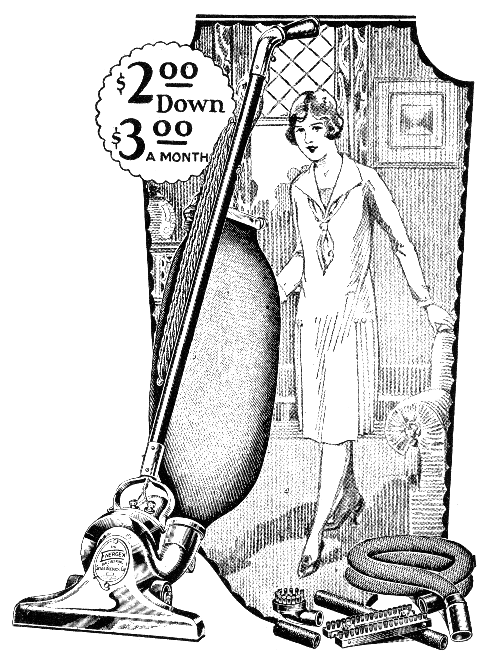
1920s advertisement for the Energex Vacuum Cleaner, manufactured by the Sleeper & Hartley, Inc. company.
Listen to the audio version.
Stagnant Wages
America was changing rapidly but not fast enough in the area where it mattered most. For decades workers had been fighting an uphill battle with their bosses to reduce hours, improve conditions, and raise wages. Workers went on strike to try and force change. But more often than not they were met with police or company thugs who literally beat them back to work. To many politicians, labor unions were synonymous with socialism.
And so, urban factory workers continued to work for wages so low that they couldn't hope to afford to buy the flashy consumer goods that they were making. How low? Henry Ford — famous for paying some of the best factory wages in the country — was paying his workers $6 a day by 1925. That works out to about $36 a week, and Ford was the exception, not the rule. Most factory workers were taking home closer to $24 a week. Meanwhile, the top 1% of American families were pulling in nearly 24% of all income in the country. The factories kept churning goods out anyway. Sooner or later companies were going to face the grim reality that they would run out of customers to sell to. The pin on this economic grenade had already been pulled and nobody even realized it.

Wage and the wealth gap.
Source: US Bureau of Labor and Statistics
Listen to the audio version.
The Big Farm Bust
While Wall Street was celebrating record high stock prices, American farmers were already in serious trouble. During World War I, the U.S. government urged farmers to plant every acre they could to feed a war-ravaged Europe, and farmers borrowed heavily to buy land and machinery to do exactly that. When the war ended and Europe’s fields came back online, demand for American crops fell off a cliff. A bushel of wheat that sold for $2.94 in 1920 had dropped to a dollar by 1929 and would hit 30 cents by 1932. Farmers did what seemed logical — they planted more to make up for the lower prices — which only made the surplus worse and drove prices down further.
By the late 1920s, farm foreclosures were already chewing through the countryside at a rate nearly five times the pre-war average. Rural America wasn’t waiting for the stock market to crash. It was already in free fall.

Source: Lee J. Alston “The Economics of the Great Depression (1983)
Listen to the audio version.
Buying on the Margin
With American businesses making money hand-over-fist stock prices continued climbing ever upward. Traditionally, playing the stock market is seen as a rich man’s game because only they are the ones who can afford to lose “a little money” when the stock goes bad. But with the stock market soaring average Americans wanted to get in on the game in the hopes of getting rich quick, Banks recklessly came up with a system called buying on the margin — lending people money to play the stock market who probably shouldn’t have been playing in the first place. The terms were almost insane: you could put down as little as 10% and borrow the other 90%. If you sold your stock for more than you paid, you repaid the loan and pocketed the profit. But if the stock dropped more than that 10% cushion, you lost everything and still owed the bank. By the summer of 1929, some 300 million shares were being carried on margin across the country. Confidence in the system was so high that people kept on believing stock prices would rise forever. With factories over-producing consumer goods and wages kept low, it was only a matter of time before the whole system came crashing down.
One of the first people to sound the alarm was economist Roger Babson who warned business leaders that the economy was headed for a crash. But rather than thanking him for his insight they shouted him down calling him a pessimist. Some even came out swinging by questioning Babson’s patriotism as an American. Even in October as the economy came crashing down, just as Babson said it would, there those who angrily accused Babson of causing the crash by creating a financial panic. But the truth is that those who should have known better simply stuck their heads in the sand and chose to pretend that optimism and rainbows would prop up an unstable economy indefinitely.

"The Margin Calling Contest," was created by Edmund "Gale" Waller published in the Los Angeles Times on October 18, 1929,
Listen to the audio version.
Hoover Fumbles
Herbert Hoover became president just months before the Great Depression officially began. The country had been through dozens of economic downturns before but one of the reasons the depression became so severe may have been because he didn’t take the crisis seriously enough. He called it a “passing incident” and promised that it would be over in a matter of a couple months. In his inauguration speech given just a few months before the crash he went so far as to say that America was on the verge of completely eliminating poverty. History has a dark sense of humor that’s for sure.
Hoover, like most conservative thinkers of the day, believed in the rugged individualism of the American people, holding bulldog firm to the belief that it was unnecessary and dangerous for the federal government to step in and offer help to those who had fallen into poverty. History has come to judge Hoover as the guy who sat back and did nothing while the nation collapsed but in reality he actually tried to head off the crisis. The only problem was that his solutions didn’t work.

Herbert Hoover Presidential Portrait
Library of Congress
Rather than having the federal government intervene directly, Hoover preferred to act as a negotiator bringing business and labor union leaders together to work out a solution on their own. He asked businesses to halt layoffs and wage cuts. But most business leaders chose to ignore cooperation and instead continued to layoff workers, cut wages, and slash prices in a vain attempt to unload the unsold merchandise piling up in their warehouses. In a vain attempt to save themselves they doomed the whole country.
Listen to the audio version.
Banks Collapse
As unemployment tripled to 9% by 1931 workers stopped buying new homes and cars, they stopped planning vacations, they stopped by new gadgets, and many stopped repaying their loans to the banks. With consumers unable to consume this led to more layoffs and wage cuts which caused more consumer panic. With so many people defaulting on their loans, banks — most of them small local operations — began to fail.
And here’s the thing that made it catastrophic: there was no FDIC back then. No federal insurance on your savings account. When your bank went under, your money went with it. So the moment word spread that a bank was in trouble, everyone who had an account sprinted to get their cash out before it was too late. Those panicked withdrawals drained even healthy banks dry, forcing them to close too. In 1930 alone, around 1,350 banks suspended operations. By 1933, nearly 10,000 banks had failed across the country — wiping out the lifetime savings of millions of ordinary Americans who had done nothing wrong except trust a bank. The economy in 1930 found itself in a nosedive with the ground coming up fast.

Listen to the audio version.
Throwing Gasoline on the Fire
With the pressure mounting Hoover and the Republican congress gave in and agreed that maybe some government intervention was necessary. In 1930, Congress passed the Smoot-Hawley tariff with the intention of protecting American businesses from foreign competition. What a tariff does is to jack up the price of imported goods by heavily taxing them, making imports more expensive than American-made goods. But tariffs are the equivalent of throwing eggs at your neighbor’s house, they’re going to egg you back. And so, foreign countries responded with their own tariffs against American goods. Right on cue, the American economy slumped even further.
What often gets lost in the story of the Great Depression is that the U.S. crash didn’t stay inside U.S. borders. Throughout the 1920s, American banks had been lending heavily to European countries — especially Germany, which was still paying off World War I reparations and desperately needed outside cash to function. When American banks called those loans back after the crash, the European financial system buckled. By 1931 the crisis had gone fully global, with banks collapsing in Germany and Austria, which then dragged down Britain. Smoot-Hawley made it worse by slamming the door on international trade just as the world economy needed it most. What might have been a bad American recession became a worldwide catastrophe.
As a last resort Hoover pushed for what today we would call a government bailout with the creation of the Reconstruction Finance Corporation (RFC) to lend money to failing businesses in the hopes that they would start hiring again. In 1932, the RFC gave out more than $2 billion (the equivalent of $33 billion in today’s money) but there were a few glitches to this plan. For starters, 80% of the money went to banks and big business who used most of it to get themselves out of debt rather than boosting workers spending power with increased wages and hiring. Unemployment grew to nearly 22% (50% in factory towns like Detroit and Chicago) and if you were African-American, Mexican-American, or Native American the situation was even worse. The United States was disintegrating fast. Hoover tried one last Hail Mary pass to save the situation by pushing Congress to pass the Emergency Relief and Construction Act, which poured over $300 million into public works projects — the biggest being the Hoover Dam in Nevada.
Listen to the audio version.
The Collapse of Charity
America had always prided itself on not needing a handout. Hoover called it "rugged individualism" — the idea that hard work and self-reliance, not government programs, were what made America exceptional. In his view, federal relief didn't just cost money; it cost something more important. "A voluntary deed," he said repeatedly, "is infinitely more precious to our national ideal and spirit than a thousand-fold poured from the Treasury." So when the Depression hit, Hoover turned to churches, charities, and local governments to handle the crisis — and kept Washington out of it. In those days welfare didn't exist. Social Security didn't exist. If you fell on hard times, you found help close to home.
The problem was that charities ran on donations, and donations dried up alongside everyone else's income. Organizations that had been stretched thin were suddenly being asked to feed and house millions. Local governments fared no better — unemployed people don't pay taxes, and tax revenue was the only thing keeping city budgets alive. The safety net Americans had always assumed would catch them turned out to be made of wet paper.

Depression era soup kitchen run by gang leader Al Capone. Chicago, IL 1931. National Archives
Listen to the audio version.
The Depression Settles In
Hoover became a joke among the American people. In fact, they openly became hostile at what they mistook for his total lack of empathy. Americans mocked him by using his name as a byword for poverty. A "Hoover Flag" referred to a person's empty pocket that had been turned inside out. A Hoover blanket were old newspapers that the homeless used to cover themselves while they slept. And as millions more became homeless the shanty towns they created became infamously known as "Hoovervilles", springing up in every major city across the country. Scraps of cardboard, tin, and plywood were thrown together to construct makeshift houses. Out of work and desperate for food people did anything they could to feed themselves.
Once proud factory workers and businessmen sold apples and pencils on the street. Many flocked to the local city dump to scrounge for anything that was still remotely edible. Breadlines stretched for blocks — by 1932, New York City alone had 82 running. Private charities and churches did what they could, but the scale of need overwhelmed them. The American Red Cross refused to get directly involved, declaring unemployment a man-made problem rather than an act of God. The American dream was dead and any hope at recovery was fading fast.
Hoover's gross mishandling of the situation led to a landslide victory for his opponent — Franklin D. Roosevelt — in the election of 1932.

Shantytowns, constructed out of cardboard and sheet, metal began popping up in the major cities of the U.S. as tens of thousands of people found themselves homeless and unemployed. These towns became known as Hoovervilles.
Source: Seattle Post-Intelligencer Collection at the Museum of History & Industry (MOHAI).
Digging Deeper
Use the article to answer the questions below.
-
What happened on Black Tuesday during the Crash of 1929?
-
How did buying stocks “on margin” contribute to the stock market crash?
-
What role did speculation play in inflating stock prices before the crash?
-
How did bank failures make the economic crisis worse after the Crash of 1929?
-
Why did overproduction in factories and farms contribute to economic problems before the crash?
Copy and paste the questions onto a Word or Google Doc
Test Page