Teachers. Subscribe now and amaze exactly 0% of your friends, but you'll get great discounts and news!
THE HISTORY CAT

Listen to the audio version.
The Fight to Fix America’s Democracy
At the turn of the 20th century, the United States was sprinting into the modern age with its shoelaces untied. Cities were swelling with new arrivals, factories were belching out both products and pollution, and railroads laced the country like veins of steel. Millionaires flaunted wealth so massive it made European kings blush. But beneath the marble mansions and ticker tape parades lay a harsher truth — overcrowded slums, eight-year-olds working in factories, and a system that worked beautifully for the few and brutally for everyone else.
The Progressive Era (roughly 1890–1920) was the nation’s attempt to fix the growing list of problems that America faced. Reformers — from journalists and social workers to politicians and pastors — set out to fix a broken system. They set out to make America cleaner, fairer, and more honest. What they built was something far more complicated — a patchwork of good intentions, government rules, and social experiments that reshaped the nation for good.


Unit 12: The Progressive Era
1890-1920
Tackling Dirty Politics
Political Machines Lesson Plan | Grades 7-12
Listen to the audio version.
Corruption Runs the Show
America’s economy was booming, but its politics were rotten. The same ingenuity that built railroads and steel mills had been applied to government, and the result was a system that ran on bribes instead of ballots.
New York’s Tammany Hall was the blueprint. Under William “Boss” Tweed, the Democratic machine controlled city contracts, police hiring, and every public dollar that passed through town. A courthouse that should’ve cost $250,000 ballooned to $13 million after Tweed’s men padded the bills and pocketed the rest. His voters — mostly poor immigrants — were kept loyal with handouts of food, coal, and jobs. Elections were rigged, ballots stuffed, and opposition silenced.
It took a cartoonist, Thomas Nast, to finally topple him. Nast’s biting cartoons in Harper’s Weekly turned Tweed into a national symbol of greed — a thief with money bags for a face. When Tweed was finally arrested in 1871, he had stolen what would amount to hundreds of millions in today’s dollars.
But Tweed’s fall didn’t scare others straight — it only taught them to be more careful. In Chicago, Mayor “Big Bill” Thompson ran City Hall like a mob front. He took campaign money from Al Capone, promised to “keep the cops off his back,” and protected gambling dens and brothels in exchange for envelopes of cash. When inspectors found maggot-infested meat in the stockyards, they didn’t shut down the plants — the companies simply paid bribes to make the reports disappear.
Out west, San Francisco’s political machine was ruled by Abe Ruef, a lawyer who demanded kickbacks for every city contract. When investigators uncovered his bribery ring in 1907, they found that the mayor, the police, and most of the city supervisors were all involved. Ruef went to prison, but the message was clear: corruption wasn’t the exception — it was the business model.
And it reached far beyond the cities. In Montana, copper baron William A. Clark bribed nearly an entire state legislature in 1900, handing out envelopes stuffed with $1,000 bills to buy himself a U.S. Senate seat. When the scandal broke, the Senate refused to seat him, calling his election “a flagrant case of bribery and corruption.” Public outrage over cases like Clark’s helped fuel the push for the 17th Amendment, which gave voters the power to elect senators directly.
Meanwhile, corporate giants were playing their own games. The Southern Pacific Railroad kept a secret “black book” of bribed officials in California, while John D. Rockefeller’s Standard Oil bought off inspectors and legislators to protect its monopoly. Reformers like Ida Tarbell and Lincoln Steffens would later expose just how deeply business had merged with politics.
By the time Theodore Roosevelt entered the White House in 1901, corruption wasn’t a glitch in the system — it was the system. And dismantling it would take a generation of reformers willing to fight the people who wrote the rules.

From an undated William Jennings Bryan campaign print, “Shall the People Rule?” Library of Congress.

The “Brains” Harper’s Weekly – October 21, 1871
Listen to the audio version.
Taking On the Machines
Progressives realized that corruption wasn’t just about crooked politicians — it was about a government that hadn’t kept pace with a modern, industrial nation. If democracy was going to survive, it had to be rebuilt from the inside out.
In Wisconsin, Governor Robert “Fighting Bob” La Follette became the face of that fight. Railroads and lumber barons had dominated his state’s legislature for years, setting their own tax rates and writing their own laws. La Follette pushed back with the Wisconsin Idea — bringing university experts into government to draft evidence-based laws and regulate corporate power. His reforms set railroad rates, taxed corporations fairly, and gave citizens direct primaries to choose candidates instead of leaving nominations to party bosses.
Other states followed. In Oregon, reformers created the initiative, referendum, and recall, letting voters write laws, approve them, or remove corrupt officials altogether. In California, Governor Hiram Johnson took on the Southern Pacific Railroad, banning corporate donations and giving voters the same direct powers.
These reforms culminated in the 17th Amendment (1913), which finally ended the era of purchased Senate seats by establishing the direct election of senators. What had been called “the Millionaires’ Club” now had to answer to the public.
The fight wasn’t easy. La Follette’s enemies tried to bankrupt him, smear him as a radical, and even falsify election results. Reformers across the country faced intimidation, lawsuits, and blacklists. But every scandal exposed by journalists, every recall petition, every honest election chipped away at the old machine.
By the 1910s, the political bosses who had once sold access like merchandise were losing their grip. The Progressives hadn’t wiped out corruption, but they had changed the rules — and for the first time in decades, American democracy looked like it might actually belong to the people.

“Bosses of the Senate,” J. Ottmann Lith. Co. after Joseph Keppler, U.S. Senate Collection
Listen to the audio version.
Theodore Roosevelt Joins the Fight
Reform found its loudest voice in the White House. When Theodore Roosevelt became president in 1901 after William McKinley’s assassination, he brought Progressive ideals to national politics. He believed government’s role was to act as a referee between labor, business, and the public — not to sit on the sidelines. His Square Deal promised fairness for workers, honesty in business, and accountability in government.
Roosevelt proved it wasn’t just talk. When 140,000 coal miners went on strike in 1902, mine owners refused to negotiate, threatening to leave the country without winter fuel. Instead of sending troops to crush the strike, Roosevelt invited both sides to the White House and forced a compromise — the first time a president had stepped in for workers instead of against them.
He also used the law to take on the monopolies that dominated entire industries. The Sherman Antitrust Act (1890) had made it illegal for companies to form trusts or monopolies that restrained trade — but before Roosevelt, presidents rarely enforced it.
Roosevelt changed that, suing corporate giants like the Northern Securities Company, which controlled nearly every major railroad in the Northwest, and later Standard Oil and American Tobacco. The courts ordered those monopolies broken apart, sending a clear message that big business was no longer untouchable.
Years later, Woodrow Wilson strengthened Roosevelt’s legacy with the Clayton Antitrust Act (1914). It spelled out exactly what business practices — like price-fixing and exclusive contracts — were illegal, and it protected labor unions from being targeted under antitrust laws. Together, these acts became the foundation for modern economic regulation.
Roosevelt’s Square Deal went beyond business reform. He backed the Pure Food and Drug Act and the Meat Inspection Act in 1906 after The Jungle exposed unsafe food production, and he launched a sweeping conservation program that protected more than 230 million acres of public land.
The Square Deal didn’t make America perfectly fair, but it changed the rules of the game. For the first time, the federal government became an active player — setting limits on corporate power and protecting the public interest in a rapidly industrializing world.

Theodore Roosevelt gives a speech at a campaign rally. c. 1900
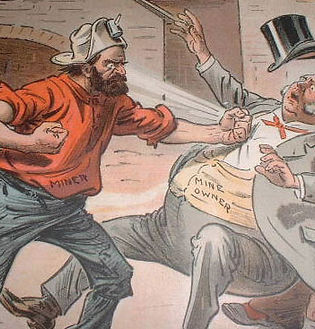
The 1902 Anthracite Coal Strike
in Pennsylvania resulted in a ten percent raise and other demands. The victory would prove short-lived as coal companies simply changed the rates they charged miners who were dependent upon supplies and housing controlled by the company.
Listen to the audio version.
A Government for the People
By the 1910s, it finally felt like the tide had turned. The old political machines hadn’t vanished, but they were limping. The same mayors who used to sell contracts under the table now had to file budgets that the public could read. The same senators who once owed their seats to railroad barons now had to win over actual voters.
It didn’t happen overnight. Every reform had been a fight — and sometimes, it took years just to pry open a single locked door. But the victories were real, and the country could feel it.
In Milwaukee, voters replaced their corrupt city boss with a no-nonsense reform mayor, Emil Seidel, who hired engineers instead of cronies to run departments. Streets were paved, sanitation improved, and graft quietly shrank. Across the nation, cities like Cleveland, Toledo, and Des Moines followed suit, putting trained city managers in charge of budgets and utilities. For once, expertise mattered more than connections.
In Washington, the 17th Amendment changed everything. The Senate — long mocked as a “millionaires’ club” — finally had to answer to the people. Candidates took to the stump, campaigning in person instead of cutting deals in smoke-filled rooms. A few old-timers scoffed that democracy had gone mad. Most Americans called it long overdue.
Ordinary citizens, too, found new power. The initiative and referendum meant voters could now write and approve their own laws — no permission needed. In Oregon, citizens used those tools to regulate railroads, limit working hours, and expand women’s suffrage. The system that had once silenced them was suddenly listening.
You could feel the difference at the ballot box. Voters cast their choices behind closed curtains using the new secret ballot, no longer watched by ward bosses or hired thugs. The old intimidation was gone; the vote finally felt like it belonged to the voter.
No one pretended corruption had disappeared. The money still moved quietly, and the deals still happened — they always would. But something fundamental had changed. Power had shifted, even slightly, away from the boardrooms and into the streets. For the first time in decades, democracy felt less like a business arrangement and more like a public trust.

Detail of “Puck” cartoon satirizing wealthy figures using their money and influence to take Senatorial positions in Congress, 1890. (Public Domain)
Listen to the audio version.
Why It Matters
The Progressive Era permanently changed what Americans expected from their government. For the first time, people saw Washington not just as a distant power, but as a referee — one responsible for protecting citizens, regulating business, and keeping corruption in check.
Progressives pushed through reforms that gave voters more control, from direct elections and secret ballots to initiative and referendum laws. But they also transformed how government worked. New agencies like the Federal Trade Commission, Food and Drug Administration, and the Federal Reserve System were created to monitor business, protect consumers, and stabilize the economy. These weren’t short-term fixes — they became the backbone of modern government oversight.
The Progressives didn’t end corruption or inequality, but they set a new standard: the government’s job wasn’t just to govern — it was to serve and safeguard the public. Their legacy lives on every time food is inspected, markets are regulated, and citizens expect transparency from their leaders.
Digging Deeper
Use the article to answer the questions below.
-
What were political machines, and how did they influence city and state government during the Gilded Age?
-
Who were muckrakers, and how did their reporting expose political corruption?
-
What reforms did Progressives support to reduce political corruption and increase citizen control?
-
How did the direct primary change the way candidates were selected?
-
What are initiative, referendum, and recall, and how did these reforms aim to give citizens more power?
Copy and paste the questions onto a Word or Google Doc
Test Page