Teachers. Subscribe now and amaze exactly 0% of your friends, but you'll get great discounts and news!
THE HISTORY CAT

Listen to the audio version.
Margaret Knight was 12 years old when the mill ate her friend. That’s what workers called it when some was injured or killed in a factory accident.
Knight had been working at the Manchester, New Hampshire cotton mill for two years when she saw a girl her age get pulled into the machinery. The steel shuttle—a sharp metal projectile that shot back and forth weaving thread—flew out of the loom and stabbed the girl in the face. Margaret watched the whole thing happen.
That moment changed her life. She went home and began working on a safety device that would stop shuttles from killing people. By the time she died in 1914, Margaret had 27 patents to her name and was called "the female Edison." But most mill kids weren't so lucky. Most spent their childhoods working long hours in dangerous conditions, making products for people who’d never know their names.
Welcome to life in the American textile mills of the late 1800s and early 1900s. If you think a part-time job at Taco Bell is rough, well, buckle up. This story is about to get pretty tragic.

Child labor was common in late 19th and early 20th Century textile factories. Margaret E. Knight’s first invention sought to keep girls like this safe. (Library of Congress)

Unit 11: Gilded Age & Industrial Revolution
1865-1900
Life in the Mills
Factory Working Conditions Lesson Plan | Grades 7-12
TEACHER RESOURCES

Get the Complete Lesson
Listen to the audio version.
The Lowell Mills
Francis Cabot Lowell had a vision. After touring British textile mills in 1810 and seeing entire families crammed into slums with children working themselves to death, he decided America could do it better. The Lowell mills in Massachusetts, which opened in 1823, were supposed to be different. Respectable. Moral. A place where young farm women could work for a few years, save money, get educated, and then return home to marry.
The marketing campaign was genius. Mill agents traveled to struggling farms across New England with promises that sounded pretty good to families barely scraping by. Your daughter would live in a clean boarding house under the watchful eye of a respectable matron. She'd attend church on Sundays, have access to a library, and could even attend evening lectures. (How exciting, free lectures!) The work was meant to be temporary; just until she'd saved enough for a proper marriage dowry.
Thousands of young women took up the call. For the first few years, the Lowell system almost worked. The boarding houses really were supervised. The girls really did have access to books and could publish their own magazine, The Lowell Offering, filled with poetry and essays they wrote in their precious few free hours.
But, by the 1840s, as competition increased, the whole "respectable moral experiment" thing started looking too expensive. Mill owners cut wages, extended hours, and replaced native-born workers with desperate Irish immigrants and children willing to work for less.
By the 1870s and 1880s, the Lowell experiment was officially dead. Textile mills had spread across the Northeast and South, and the only thing that mattered was profit. Massive brick factories dominated cities like Fall River and New Bedford in Massachusetts, Paterson in New Jersey, and Lawrence in New Hampshire. After the Civil War, southern mills exploded in the Carolinas, Georgia, and Alabama.
The workers had changed completely. Instead of native-born farm girls working a few years before marriage, the mills now employed waves of desperate immigrants—Irish, Italian, Polish, Jewish families fleeing poverty and persecution in Europe. Entire families worked together: fathers, mothers, children as young as six. In the South, poor white families who'd lost their farms to debt moved into mill villages where the company owned everything.
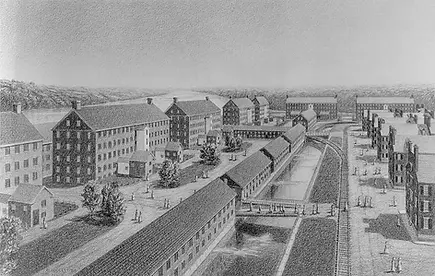
Lowell built a factory compound that included textile mills, dormitories, a church, a school, and a company store.
Credit: US National Park Service
Listen to the audio version.
A Day in a Textile Mill
Your day started before dawn. The factory bell or whistle would blast at 4:30 or 5:00 AM, giving you just enough time to dress and gulp down breakfast before your 12 hour shift started. Most workers lived within walking distance—either in company-owned tenements or crowded boarding houses where you shared a room with five or six other people.
The mill floor was a special kind of hell. Massive rooms packed with hundreds of machines, all running off the same system of belts and gears connected to steam engines or waterwheels. The noise was deafening—the constant clatter made conversation impossible. Workers developed their own sign language and learned to read lips just to communicate. The air was thick with cotton dust and lint that coated your lungs with every breath. Workers called it the "kiss of death" because breathing it day after day gave you brown lung disease.
The heat was unbearable in the summer. Mills had to keep temperatures high and humidity up so the cotton fibers wouldn't snap, which meant 90-degree heat with windows nailed shut or locked.
Textile production happened in stages, and each stage had its own job. First, raw cotton had to be cleaned and carded—combed into loose strands. Then it went to the spinning room, where those strands got twisted into thread strong enough to weave. Finally, the thread went to the weaving room where it became cloth.
Spinners stood in front of spinning frames—machines with hundreds of spindles twisting loose cotton into thread. Your job was to watch for breaks in the thread and tie them back together before the machine produced flawed thread or jammed completely. You might be responsible for 128 spindles at once, all spinning so fast they blurred together. The work required constant attention.
Weavers operated power looms—massive contraptions that interlaced thread to create fabric. The loom's shuttle—a metal projectile weighing several pounds—shot back and forth carrying thread at speeds up to 200 times per minute. The weaver had to watch the cloth forming, fix any problems with the thread tension, and swap out full cloth beams. The shuttle was the most dangerous part. These things would sometimes fly out of the loom like missiles. In 1858, the Boston Journal reported on a weaver named Mary Sullivan who got hit in the temple by a shuttle. She died three days later, leaving behind four children.
The youngest workers—doffers, ages 8 to 12—had what seemed like a simpler job. They ran between the spinning frames replacing full bobbins of thread with empty ones. But the machines didn't stop while they worked. Picture being a ten-year-old kid, exhausted from being up since before dawn, darting their hands into moving machinery hundreds of times a day. One wrong move and you lost fingers.
And you’d think for all of this exhausting, dangerous work people would at least be bringing home fat paychecks. But, they didn’t. In 1910, a male weaver in a New England mill could earn around $11 a week. That sounds decent until you remember he was working 60 to 70 hours for it. Female weavers doing identical work made $8 a week. And those child doffers? They brought home just $3 a week. But you might be thinking, $11 was a lot of money back then. When you adjust for inflation, they made the equivalent of $375 a week, in today’s money, or about $5.35 an hour.

Avondale Textile Mill, Birmingham, Alabama. 1900.
Image credit: Library of Congress


Children as young as five worked in the mills for long hours and under dangerous conditions. Many of these children had parents working in the mills or were recruited from orphanages.
Listen to the audio version.
Control and Punishment
Mill owners controlled every minute of your day. Being five minutes late could cost you a quarter-day's pay. Talking to the person next to you, making a mistake in your work, leaving your station without permission - all of these could result in fines that ate away at your already meager wages.
Bathroom breaks were tightly controlled and required permission from your overseer. Many mills allowed just two breaks per day - one in the morning and one in the afternoon. If you needed to go more often than that, you either held it or risked losing pay for unauthorized absence from your station.
The overseers walked the floor watching for any sign you weren't working fast enough. They carried leather straps to hit workers, especially children, who worked too slowly or made mistakes. The overseer's job was to squeeze maximum production out of every worker, and they were often paid bonuses based on how much the workers produced. This created a system where overseers had every incentive to drive workers harder and harder.
Doors were often locked during working hours. Mill owners claimed this prevented workers from sneaking out or stealing, but it also trapped people inside during fires or building collapses. At the end of your shift, you had to line up and submit to searches. Guards checked your pockets, your lunch pail, your bags—looking for any scrap of fabric or thread you might be stealing. It would take a tragic fire at the Triangle Shirtwaist Factory in 1911 — killing 146 people— before laws about keeping doors unlocked and having clear emergency exits began to emerge.
Listen to the audio version.
Victorian Attitudes about Poverty
Plenty of people knew exactly how bad mill conditions were. They chose to do nothing because of how Americans thought about poverty in the Victorian era.
They believed that if you're poor, it was your own fault. You were either lazy, immoral, or stupid. The rich were rich because they were superior—smarter, harder working, or blessed by God. This philosophy was called Social Darwinism. Many wealthy and powerful people believed that helping the poor actually hurt them. Charity made people dependent and government regulation interfered with the "natural order."
When it came to child labor, reformers ran into "character building" arguments. Hard work was good for children. It taught them discipline, kept them out of trouble, prepared them for adult life. One mill owner testified to the Massachusetts legislature in 1867: "I regard my work-people just as I regard my machinery. So long as they can do my work for what I choose to pay them, I keep them, getting out of them all I can."
The Supreme Court struck down federal child labor laws twice in the early 1900s. In 1918's Hammer v. Dagenhart decision, the Court ruled that Congress had no power to ban child labor because it would interfere with "the powers of the states" and "the ultimate control of parents over their children."

Listen to the audio version.
Labor Fights Back
Workers didn't take these conditions lying down. America's first major labor strikes happened in the 1830s and 1840s, but they usually failed. Mill owners had all the power - they could fire strikers, blacklist them from other jobs, and bring in desperate replacement workers. But as mills spread across the country and conditions worsened, workers started organizing more effectively.
By the 1870s, labor unions began to gain real strength.
The National Labor Union, founded in 1866, brought together workers from different industries to fight for the eight-hour workday. The Knights of Labor, which started in 1869, welcomed skilled and unskilled workers, women, and even African American workers - though they were often segregated into separate assemblies. These organizations gave workers something they'd never had before: numbers and coordination across multiple mills and cities.
The 1880s saw an explosion of strikes across American industries. Labor unions fought for basic protections that seem obvious today but were considered radical demands back then. The ten-hour workday movement started with textile workers who were regularly forced to work 12 to 14 hours. Union organizers argued that workers deserved time to eat, sleep, and see their families - ideas that factory owners dismissed as lazy and entitled.
Higher wages became a rallying cry as workers watched mill owners get rich while their own families struggled to afford food. Safer working conditions meant demanding guards on machinery, covers on gears, and protective barriers to prevent shuttles from flying out of looms. Mill owners often resisted workers’ demands, claiming the added costs would bankrupt them. The right to basic sanitation - things like clean drinking water, functional toilets, and proper ventilation – all became rallying cries.
Even bathroom breaks became a union issue, as workers organized against the dehumanizing practice of requiring permission and limiting breaks to twice a day. The mill owners were quick to punish strikers and union organizers. Strikers were fired, blacklisted, beaten by company-hired Pinkertons and thugs, and sometimes arrested by police who were sent to break the strike and get them back to work.
In the 1920s, Photographer Lewis Hine's published images of child workers that shocked middle-class Americans who'd never seen the inside of a mill. His photographs appeared in magazines and newspapers, creating public pressure for reform.
But real federal protection didn't come until 1938, when the Fair Labor Standards Act banned child labor nationwide and established the first federal minimum wage and maximum hours. It took the Great Depression, when millions of formerly "respectable" middle-class people found themselves suddenly poor, to finally overcome the mindset that poverty was your own fault.

The Lynn Shoemakers' Strike of 1860 in Lynn, Massachusetts, was a massive labor protest where thousands of shoe workers, including women, walked off the job to demand higher wages and better working conditions. It became one of the largest strikes in U.S. history at the time.

In 1929, 1,800 workers walked out on strike over poor working conditions at the Loray Textile Mill in North Carolina.
Listen to the audio version.
Why It Matters
Mill workers changed America by refusing to accept that this was just how things had to be. They organized, struck, and fought back until the country had no choice but to listen. The eight-hour workday, weekends, child labor laws, workplace safety rules - none of these happened because mill owners suddenly got generous. Workers had to force every single change through decades of strikes, protests, and sacrifice. People died fighting for the right to use the bathroom without permission.
And the fight isn't over. Fast fashion companies today run factories overseas with conditions eerily similar to American mills in 1900 - low pay, dangerous machinery, locked doors, workers who can't afford to quit. The 2013 Rana Plaza collapse in Bangladesh killed over a thousand garment workers making clothes for Western brands. The building had visible cracks in the walls. Workers complained. Bosses told them to get back to work or lose their jobs. Sound familiar? The mill workers proved that change is possible when people organize and refuse to back down.
Digging Deeper
Use the article to answer the questions below.
-
What was daily life like for workers in the mills during the Industrial Revolution?
-
List three working conditions mill workers faced in factories.
-
Why did many families send children to work in the mills?
-
How did Victorian beliefs about poverty affect the way people responded to dangerous mill conditions?
-
Why did workers form labor unions, and what changes did they demand?
Copy and paste the questions onto a Word or Google Doc
Test Page