Teachers. Subscribe now and amaze exactly 0% of your friends, but you'll get great discounts and news!
THE HISTORY CAT

Unit 2: Colonial America
1650-1775

The Thirteen Colonies
Thirteen Colonies Lesson Plan | Grades 7-12
TEACHER RESOURCES

Get the Complete Lesson
Listen to the audio version.
Ask someone from Germany where they're from. They'll say Germany. Ask someone from Japan. They'll say Japan. Ask an American, and there's a good chance they'll say Texas. Or Georgia. Or California. Not "the United States". That's not a coincidence. It's a habit that goes back over 350 years, to thirteen colonies that were never really one thing to begin with. Different geography, different economies, different religions, different ideas about who should be in charge. Each colony was created as a separate entity that ended up getting mushed together into what we now know as The United States. This is the story of how it all began.
Listen to the audio version.
How England Ran Its Colonies
Every colony had a governor at the top — usually appointed by the king or by whoever held the colony's charter. The governor had a lot of power. He could veto any law the assembly passed, appoint the judges who ran the courts, and if the assembly got too loud or too independent, he could dissolve it entirely and send everyone home.
Below the governor sat a colonial assembly of elected representatives who controlled taxes and passed local laws. That might not sound impressive, but if you consider that almost every other European country was run by absolute monarchs who didn't give their people a voice at all, the fact that England did is pretty revolutionary.
But don't get representative assemblies confused with modern democracy. Voting was limited to men who owned property, which automatically excluded women, enslaved people, indentured servants, and any free man who didn't own land — meaning that a substantial portion of the people actually living and working in the colonies had no say in how they were governed. The property requirements before someone could vote varied from colony to colony. For example, In South Carolina you had to own at least 100 acres of land and pass a religious test. But in Pennsylvania, the law stated that all you had to do to qualify to vote was to be a "free man" and pay your taxes.
Since you're probably not planning on getting a job as a 17th century English lawyer, we're not going to get too bogged down in the details. The important thing to remember is that how England ran its colonies would matter a lot when they started rebelling in the 1770s.


New England Colonies
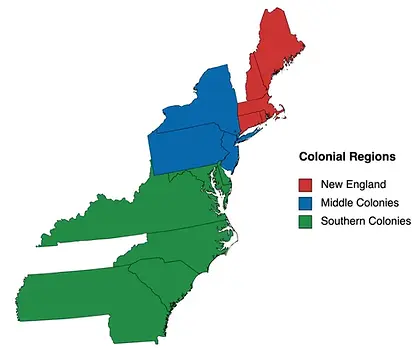
Massachusetts, New Hampshire, Rhode Island, Connecticut
Listen to the audio version.
The Geography and Economy of New England
New England's first settlers arrived expecting rich farmland like in Virginia but instead found a geologist's dream. Retreating glaciers had left the landscape studded with rocks — seriously, so many rocks — and whatever soil remained between them was thin, rocky, and acidic. Winters arrived early and stayed late. The growing season ran maybe five months if you got lucky, and clearing a field of its rocks was backbreaking work. It was, to put it charitably, not ideal farming territory. What the region did have — and what its settlers eventually figured out mattered far more than farmland — was coastline: jagged, rocky, hundreds of miles of it, with protected harbors, deep bays, and rivers so full of fish that early explorers reported you could practically scoop them up with a basket.
The fish that saved New England were mostly cod — ugly, abundant, and extraordinarily useful. They ran thick off the Grand Banks year-round, they were packed and salted for long ocean voyages and found hungry markets across Europe and the Caribbean. Massachusetts took cod seriously enough to hang a carved wooden one in its legislature, the Sacred Cod, where it still hangs today.
And once you had a fishing industry, everything else followed in a chain. Fishing required boats, boats required lumber, lumber required sawmills, sawmills required workers with specialized skills, and the whole apparatus fed into a shipbuilding industry that was, by the mid-1700s, producing some of the finest vessels in the Atlantic world. New England's forests supplied the raw material, including enormous white pines that the British Navy wanted so badly the Crown literally sent agents into the woods to mark the best trees with a broad arrow and make it illegal to cut them down.
In the earliest decades, furs were even more valuable than fish. Beaver pelts especially — European hatmakers couldn't get enough of them, and the trade kept early settlements turning a profit while colonists figured out what else the region could actually produce. But the coastal beaver population didn't last long and they were hunted to near extinction. By the 1700s the serious fur trade had moved further north into French territory.
Those glaciers that made farming so miserable did leave one useful thing behind: iron ore deposits scattered throughout the rocky soil. New England's ironworks were never a dominant industry, but they supplied the nails, tools, and hardware that a shipbuilding and fishing economy constantly needed.
Boston became one of the busiest ports on the continent, exporting fish, lumber, and ships while importing sugar and molasses from the Caribbean, which New England distillers converted into rum that moved back into the Trans-Atlantic trade. Some of those merchants were also moving enslaved people — the Triangle Trade ran through Boston and Newport as much as it ran through London, and plenty of New England fortunes were built on human traffic even as the region's own economy ran on wage labor rather than plantation agriculture.

Thanks to the poor soil and sketchy weather, the New England's economy relied on ship building, fur trading, and lumber.

Listen to the audio version.
The Middle Colonies
New York, New Jersey, Pennsylvania, Delaware
The Geography and Economy of the Middle Colonies
The Hudson, Delaware, and Susquehanna rivers cut through wide valleys with some of the best farmland in North America — deep, dark, fertile soil. The climate had four seasons, a decent amount of rainfall, and summers that were long enough to grow cash crops to export to other colonies and Europe. Those same rivers also made it easy to move goods — farmers could load a boat and float their harvest straight down to port cities like Philadelphia, New York, and Baltimore, which became three of the busiest trading hubs in colonial America.
Wheat was the main export of the Middle Colonies. It fed local families and hungry buyers all across the Atlantic — especially in the Caribbean and southern Europe, where the climate wasn't great for growing it. The Middle Colonies produced so much grain that they earned the nickname the Breadbasket of the Colonies. Grist mills turned the wheat into flour for easier shipping.
Pennsylvania and New Jersey also had huge deposits of iron ore which fed the forges that churned out tools that farms and towns needed. Yet another natural resource that the Middle Colonies were blessed with was thick forests full of cute furry animals. Fur traders pushed inland along the river routes and came back with beaver pelts that European hatmakers would pay ridiculous prices for.
Convincing people to come to the New World was always a challenge, and that's where William Penn's big idea paid off. Penn founded Pennsylvania as a Quaker colony in 1682 with an crazy policy: everyone was welcome. Different religion? No problem. Speak German? Come anyway. That kind of tolerance was rare enough in the 1600s that it worked as straight-up recruitment.
English Quakers came. German farmers came. Scots-Irish settlers came. Dutch merchants answered the call. By the mid-1700s, Philadelphia had grown from Penn's experiment in religious tolerance into the largest city in colonial America — a center of trade, printing, science, and enlightenment thinking. It was the kind of place where Benjamin Franklin would grow up to become the most famous man in the Western world.
New York's deep harbor made it the other commercial anchor, pulling in merchant networks from across the Atlantic. Baltimore grew into a major port as well, funneling grain and tobacco from the surrounding region out into the Atlantic trade.
Relying on multiple industries helped make the Middle Colonies wealthy and also much less vulnerable to economic downturns than either New England or the South.


Good soil, decent weather, and lots of forests provide the Middle colonies with a lot of potential for economic growth. Cities became centers of trade and ship building, the countryside was perfect for small time farming or large plantations. The forests provided fur and the much of the land was rich in iron.
Listen to the audio version.
The Southern Colonies
Maryland, Virginia, North Carolina, South Carolina, Georgia
The Geography and Economy of the Southern Colonies
The geography of the South came with a catch. Long, hot summers and mild winters meant a growing season that stretched months beyond what New England farmers ever saw, and the flat coastal plains along Virginia, the Carolinas, and Georgia were prime territory for large-scale agriculture. The catch was that the same heat and humidity that made crops flourish also made the Chesapeake region one of the deadliest places in the English-speaking world: malaria, yellow fever, and dysentery moved through early settlements at catastrophic rates.
The tidal rivers ran deep into the interior and shaped the economy in a specific and lasting way. A tobacco or rice plantation could load a boat and float it directly down to an ocean-going ship without ever passing through a city, which meant the South developed fewer big cities compared to New England or the Middle Colonies.
The other problem was that cash crops like indigo and tobacco quickly wore out the soil, which meant planters constantly needed fresh land, which meant pushing into Native American territory, which meant the Southern colonies experienced more conflict with Native American tribes than either New England or the Middle Colonies.
South Carolina went a different direction than Virginia and North Carolina. The hot, wet summers were perfect for growing rice and indigo — a plant that is turned into blue dye that was popular with the textile industry. But, growing rice in the coastal lowlands required precise knowledge of flooding cycles that European settlers simply didn't have — so planters deliberately sought enslaved people from the rice-growing regions of West Africa, present-day Sierra Leone and Senegal specifically, because they already knew how to do it. Their expertise built one of the most profitable colonial economies in North America.

Slaves working a tobacco plantation. c. 1700

Byrd Plantation . James River, Virginia
Listen to the audio version.
The Shift to Slavery
Growing tobacco, rice, and indigo on a large scale took a staggering amount of human labor, and the planters wanted to pay as little for it as possible. The first answer to the labor shortage was indentured servitude. Under this system, poor Europeans signed contracts to work four to seven years in exchange for passage to America, after which they were free. For a while it worked. But, freed servants were promised land and resented the wealthy planters who controlled it. They eventually picked up weapons in a conflict known as Bacon's Rebellion in 1676 when poor white indentured servants and enslaved Black Virginians joined together and burned Jamestown to the ground. For a brief moment it looked like the rebellion would succeed and upend the whole colonial order. But, in the end, the rebellion was crushed. But, for the wealthy planters, the message was clear, using indentured servants was too risky. And so, they began turning to kidnapping and slavery as a solution to their labor problems.
Virginia and the other Southern colonies passed laws called slave codes that made slavery permanent and hereditary. Their children were enslaved by law from birth. They could be bought, sold, mortgaged, and inherited. They were banned from learning to read or write. Their owners had the legal right to punish them however they saw fit. Under this system, known as chattel slavery, Africans became property, not people.
Just to be clear, slavery wasn't just an evil that only the South committed. Every colony allowed slavery. Even in New England, where large plantations weren't possible, enslaved people were forced to clear forests or work as household servants for wealthy families. But slavery never took over New England's economy the way it did in the South. In New England, enslaved people made up about 3% of the population. In the Southern colonies, the number was closer to 40%. In South Carolina it hit 60%. By 1708, enslaved people outnumbered white colonists there. By 1740, two out of every three people in South Carolina were enslaved. In the Southern colonies, slavery wasn't just part of the economy. It was the economy. This is the main reason why abolishing slavery became such a controversial issue that eventually ended in the American Civil War.

Listen to the audio version.
Why Any of This Matters
For all their differences, the three regions were economically connected together in ways none of them could separate. New England fish fed the enslaved workers on Caribbean sugar plantations that produced the molasses New England distilleries needed. Middle Colony flour moved through the same Caribbean ports. Southern tobacco and rice flowed to British merchants who sent back the manufactured goods such as cloth, tools, ceramics, furniture that showed up in homes from Boston to Charleston. British merchants sat at the center of all of it, collecting fees and commissions at every step through the Navigation Acts, which required colonial goods to move on British ships through British ports and kept the profits flowing toward London. The system worked well enough for long enough that few colonists questioned it— at least until Britain started tightening enforcement in the 1760s and suddenly made it everyone's problem. One of the biggest challenges of the American Revolution was turning the independent colonies into united states.
After 1776, the regional differences only got wider. Cotton replaced tobacco and rice as the dominant Southern crop in the early 1800s, spreading the plantation system across a much larger geography and making the demand for enslaved labor grow rather than shrink. Because of its abundance of iron and timber the New England states industrialized, building a wage-labor economy whose workers and factory owners both had economic reasons to oppose a system where enslaved people produced goods for free.
The Civil War was not a sudden event or a misunderstanding between people who otherwise had gotten along just fine — it was a slow collision of two economic systems that had been developing since the 1600s, driven by differences of land and labor that were made in the colonial period and inherited by everyone who came after.
Digging Deeper
Use the article to answer the questions below.
-
Who was allowed to vote in elections for the colonial assembly?
-
How did geography influence the main economic activities in New England, Middle Colonies, and Southern Colonies?
-
Why did many Southern planters begin replacing indentured servants with enslaved labor in the late 1600s?
Copy and paste the questions onto a Word or Google Doc
Test Page